
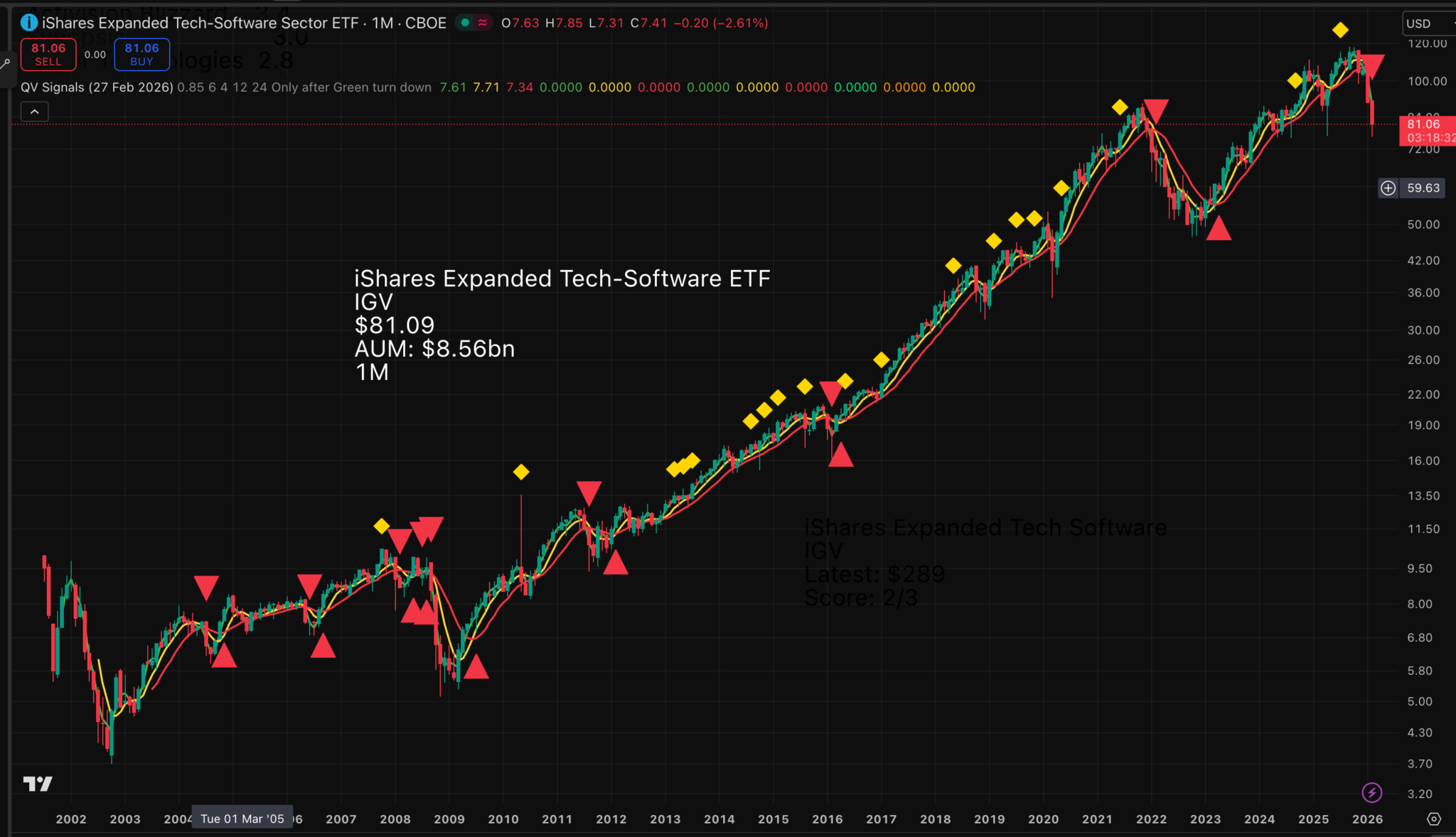
All the moving averages are falling on this chart, which is my definition of a bear market. IGV tracks the S&P North American Expanded Technology Software index. Top constituents are:
Adobe Inc. (ADBE): ~7–8%
Microsoft Corporation (MSFT): ~7–8%
Salesforce, Inc. (CRM): ~7–8%
Oracle Corporation (ORCL): ~6–7%
Intuit Inc. (INTU): ~5–6%
ServiceNow, Inc. (NOW): ~3–4%
Cadence Design Systems (CDNS): Included
Synopsys, Inc. (SNPS): Included
Palo Alto Networks (PANW): Included
CrowdStrike Holdings (CRWD): Included
These shares are falling across the board, having given red line sell signals in recent months. Investors are clearly convinced that AI poses a massive threat to the global software industry. It turns out that AI is a disruptor in unexpected ways. I would not want to be holding any of these stocks until the charts paint a more positive picture.
AI is a major something new for these companies, but a negative one, a black swan possibly portending disaster or at least big changes.
A top-performing asset manager is warning that few software firms will survive the rapid growth of artificial intelligence – which could potentially automate most of their services.
Nick Evans, a Polar Capital fund manager, saw his $12 billion global technology fund beat 99% of peers over a one-year period and 97% over five years by selling off software stocks ahead of the crowd, according to a Bloomberg report.
“We think application software faces an existential threat from AI,” Evans told Bloomberg.
Software stocks have been slammed over fears that AI, particularly tools like Anthropic’s Claude Cowork, will automate application software – which helps users complete tasks like writing documents, creating spreadsheets and managing payrolls.
An exchange-traded fund tracking the US software sector is down more than 22% so far this year. Industry leaders like Salesforce and ServiceNow are down 25% and 27%, respectively.
Evans said Polar Capital has sold virtually all of its holdings in software firms like SAP SE, ServiceNow, Adobe and HubSpot – telling Bloomberg that the fund “won’t go back to these companies.”
Investors should be “significantly underweight application software and they have to react quickly, because as the models get better, the disruption is accelerating,” Evans said.
The market rout could also hurt software firms in the long run, since many employees receive shares as part of their compensation – and managers could be forced to make up for the equity losses by shelling out more cash, according to Evans.
“We don’t believe current prices reflect the terminal value uncertainty or the pressure on free cash flow,” he told Bloomberg.
Software companies are facing heated competition not just from AI giants, but from their own clients, who are rushing to develop in-house AI tools to cut down on costs.
Evans told Bloomberg he expects only a few companies to survive a painful reckoning ahead – comparing it to the internet’s blowout impact on print media in the 2000s.
Some companies – like SAP, a German firm that makes complex software packages – will be more resilient during this market shift, Evans said.
But AI tools are “getting dramatically more powerful,” so it’s unclear how even the most specialized software firms will fare in the long term, he added.
The outperforming hedge fund is bullish on chipmakers, with semiconductor firms making up seven of its top 10 positions as of the end of January.
Its top holding is Jensen Huang’s Nvidia – which accounts for nearly 10% of the total portfolio
The fund is also optimistic on firms that make networking gears and fiber optics, and those that provide energy infrastructure critical for power-hungry data centers.
Evans also increased holdings in infrastructure software firms like Cloudflare and Snowflake in January, and said he has a neutral view on cybersecurity software, which doesn’t appear to face any immediate risks from the growth of AI.
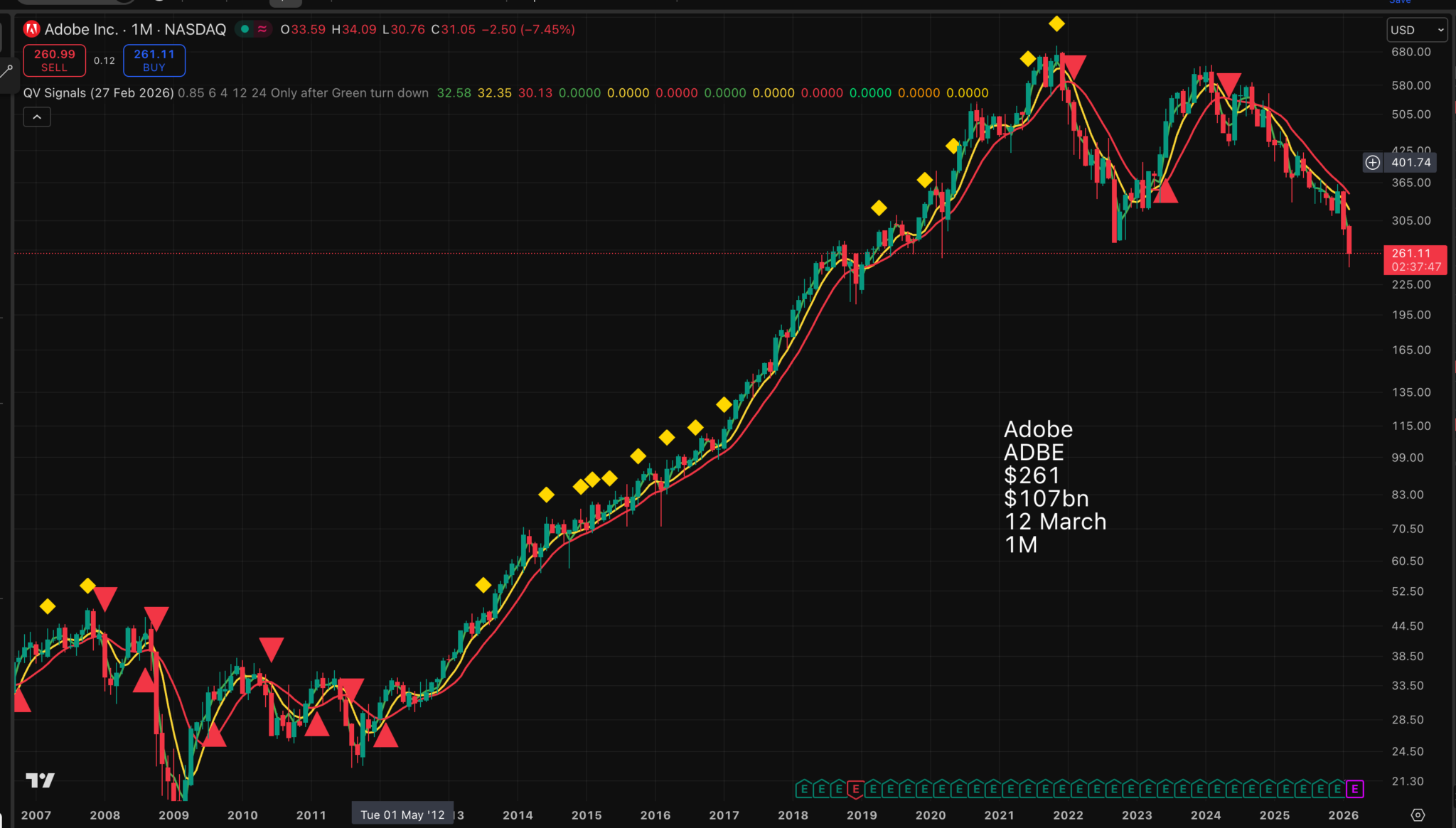
Who needs fundamentals when you have the power of red line investing? The recent buy and sell signals for Adobe have been especially timely, taking you in and keeping you there for a massive rise, and then taking you out when it was timely to do so.
Strategy – Avoid Software Stocks
Economies are super complex, even more so than weather systems, because of the power of positive feedback; each change triggers more changes. AI is attracting investment on a scale unprecedented in economic history and is going to have many effects, no doubt involving the law of unintended consequences.
Software stocks, which initially looked like beneficiaries, now look like victims. Semiconductor stocks still look well-positioned, but AI has been the stock market’s favourite theme since ChatGPT launched at the end of 2022, and every man and his dog has piled into the shares. If there is nobody left to buy, this may explain the weakness even of shares reporting outstanding results.
Falling stock markets can become self-feeding phenomena, so investors need to take care. If something happens to pull the plug on the data centre boom, there could be a terrifying scramble for the exits.
The facts are that the boom still looks solid, but the charts show share prices losing altitude and, in many cases, dropping sharply; that is not an encouraging backdrop for investors. I have seen this combination before, and it usually ends badly.
But let’s be ruthlessly analytical.
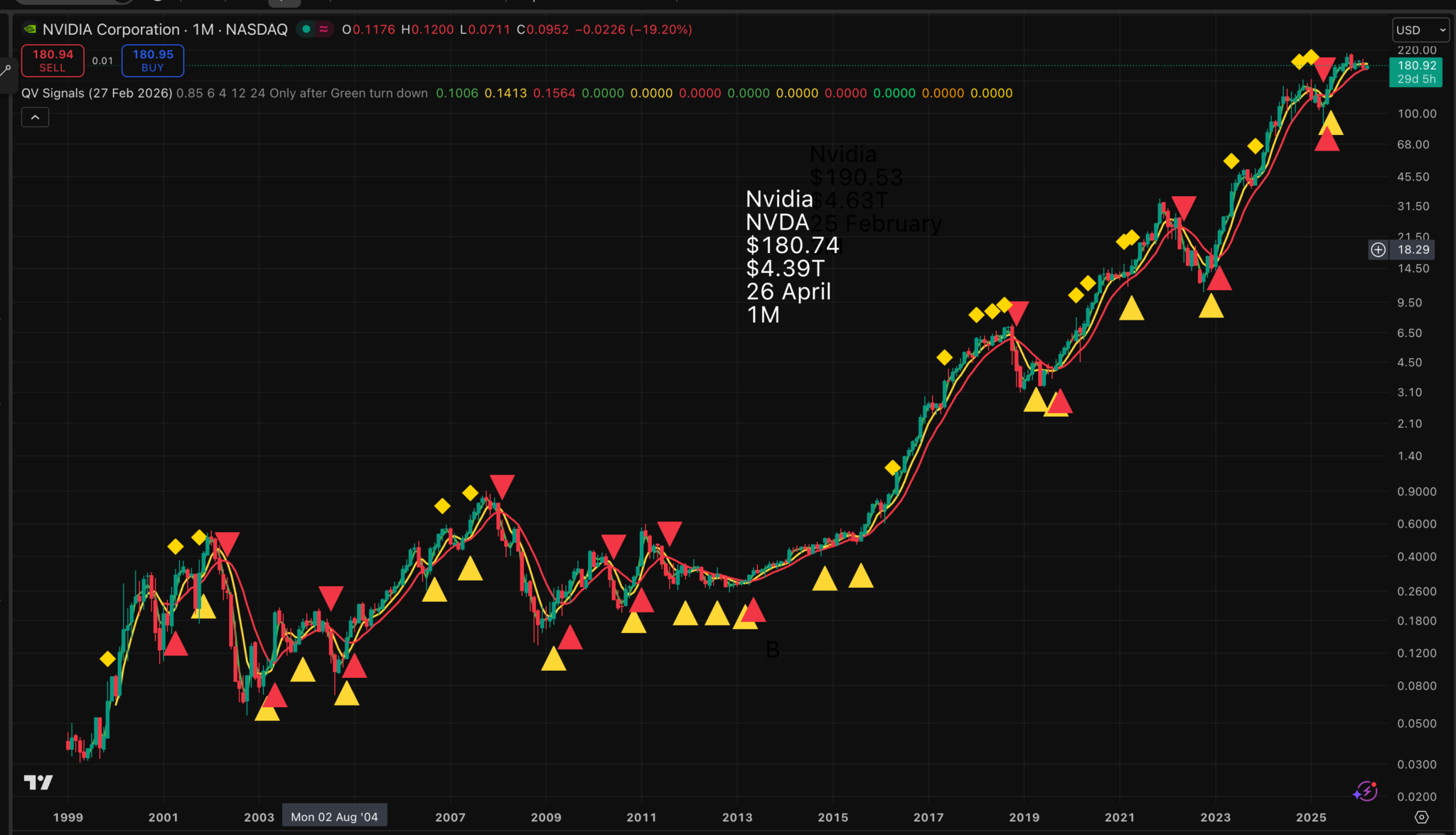
We know two things about Nvidia. It has the most exciting fundamentals of any major stock in history, fundamentals which have given it the largest market capitalisation of any company ever. Secondly, there is nothing bearish about this chart even while tall poppies are being chopped down all over the place (see above).
Quentinvest is moving in the direction, at least in part, of becoming a long-term trading system. Buy when the chart says buy and sell when the chart says sell. Very simple and we hope, very profitable!
We had a buy signal for Nvidia on July 25 when the shares were around $123, and since then, there has been no sell signal. So, using this system, which is still a work in progress, you would be holding Nvidia.
If you do not have the shares, is there another kind of buy signal which could trigger you into action? Currently, the moving averages are flatlining, leading to bunching that often precedes a major move. This could be a breakdown, likely occurring as part of an overall stock market setback.
Alternatively, the moving averages could start to spread and steepen in an upward direction, which would be a buy signal.
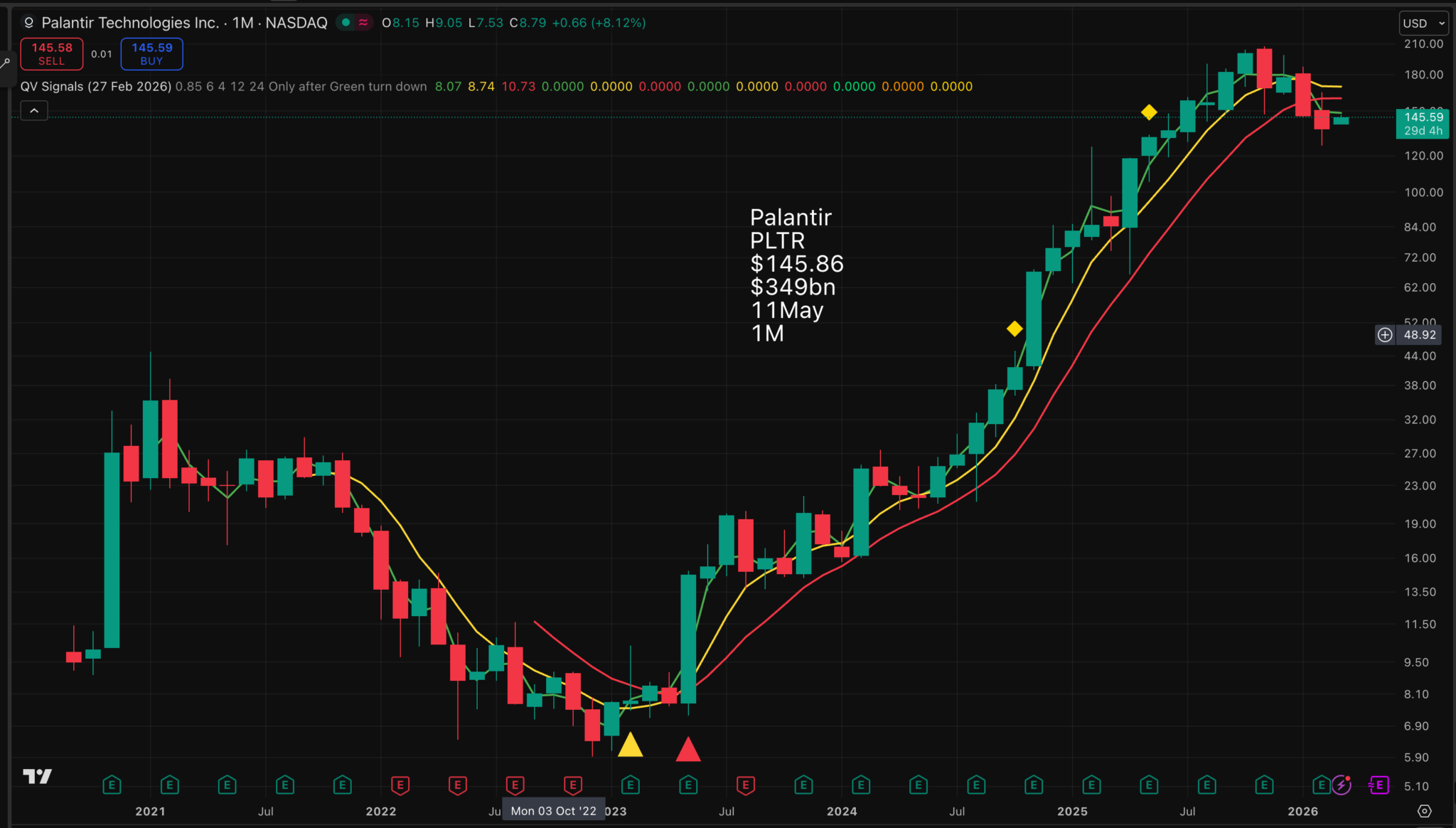
Palantir is also in an interesting situation. The fundamentals remain explosively positive. The chart has two sell signals from the green and yellow moving averages. This means we are waiting for a buy signal, which requires the longer moving average, the yellow line, to turn positive.
You could take a view and buy straightaway, but this would be an emotional rather than a logical choice. If you buy on a buy signal, you know to hold until there is a sell signal. We are not trying to capitalise on every scrap of movement in the price, just that movement which occurs between a buy and a sell signal.
That is what I mean by a long-term trading strategy. You might even decide, having bought on a yellow line buy signal, that you will only sell on a yellow line sell signal.