
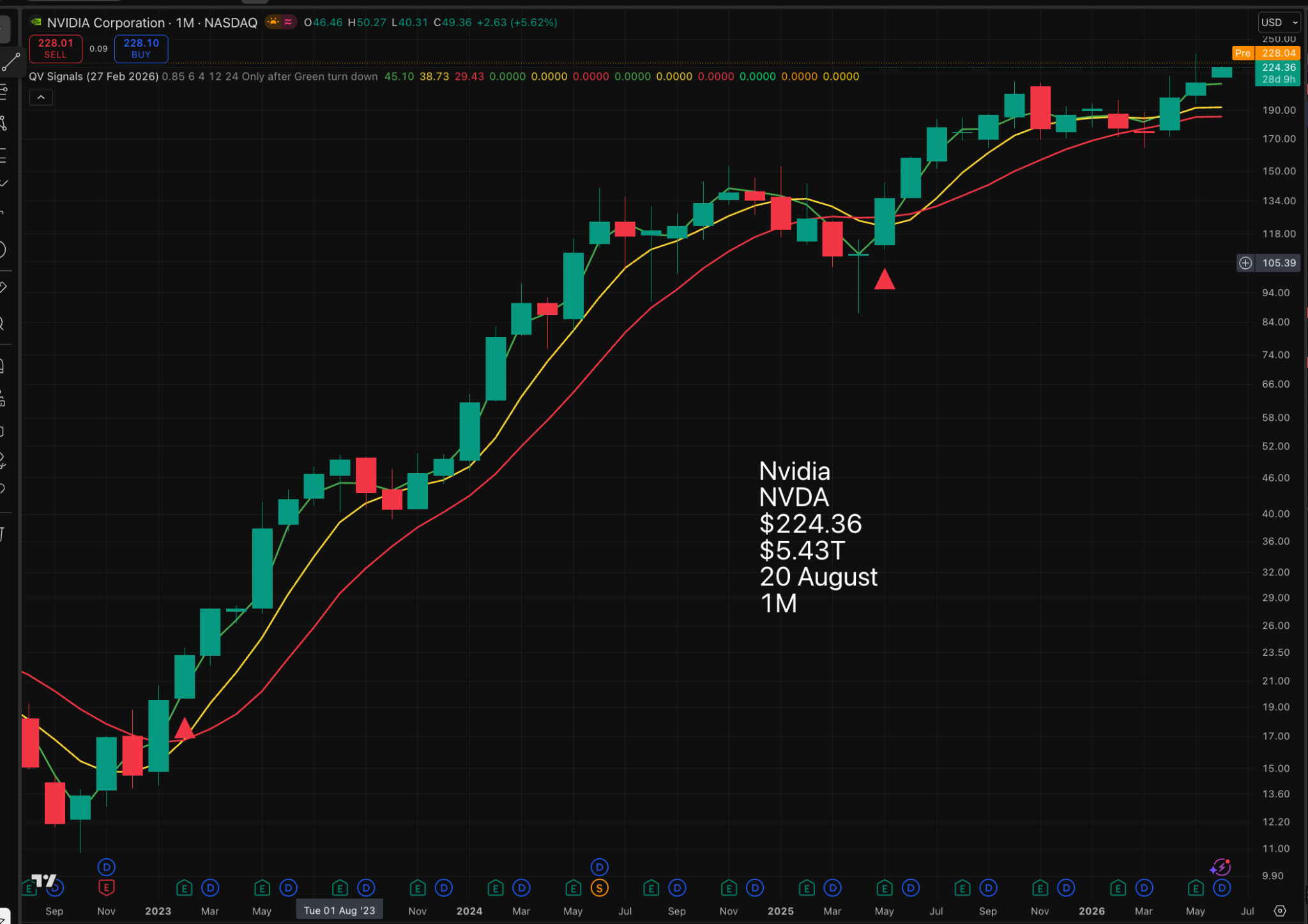
The minute I say something even vaguely cautious about Nvidia, they come up with an important ‘something new’.
NVIDIA today unveiled NVIDIA RTX Spark™, a new superchip that reinvents Windows PCs for the era of personal AI agents — offering a new class of computer that moves from tool to teammate.
Designed for AI, creating and gaming, RTX Spark brings together 30 years of NVIDIA innovation — including NVIDIA CUDA®, NVIDIA RTX™, DLSS, FP4, NVIDIA TensorRT™, NVIDIA OptiX™, Reflex and G-SYNC® — to slim Windows laptops with all-day battery life and small, ultra-efficient desktop PCs.
“The PC is being reinvented,” said Jensen Huang, founder and CEO of NVIDIA. “For forty years, you launched apps. Click. Type. With RTX Spark and Microsoft Windows, you ask — and the PC does the work. RTX Spark brings everything NVIDIA has built — CUDA, RTX, our AI platform — into a single superchip. Local agents. Frontier models. Creative workflows. RTX games. All on a laptop. This is the new PC. The personal AI computer.”
The RTX Spark superchip features an NVIDIA Blackwell RTX GPU with 6,144 CUDA cores and fifth-generation Tensor Cores with FP4 precision, connected via the NVIDIA NVLink®-C2C chip-to-chip interconnect to a high-performance, 20-core NVIDIA Grace™ CPU.
MediaTek, a market leader in Arm-based system-on-a-chip designs, collaborated with NVIDIA on the custom CPU design, contributing to its best-in-class power efficiency, performance and connectivity.
This could give a whole new lease of life to the shares, which have a great chart and a staggering position in the global technology boom. Forget any caution. They are a strong buy.
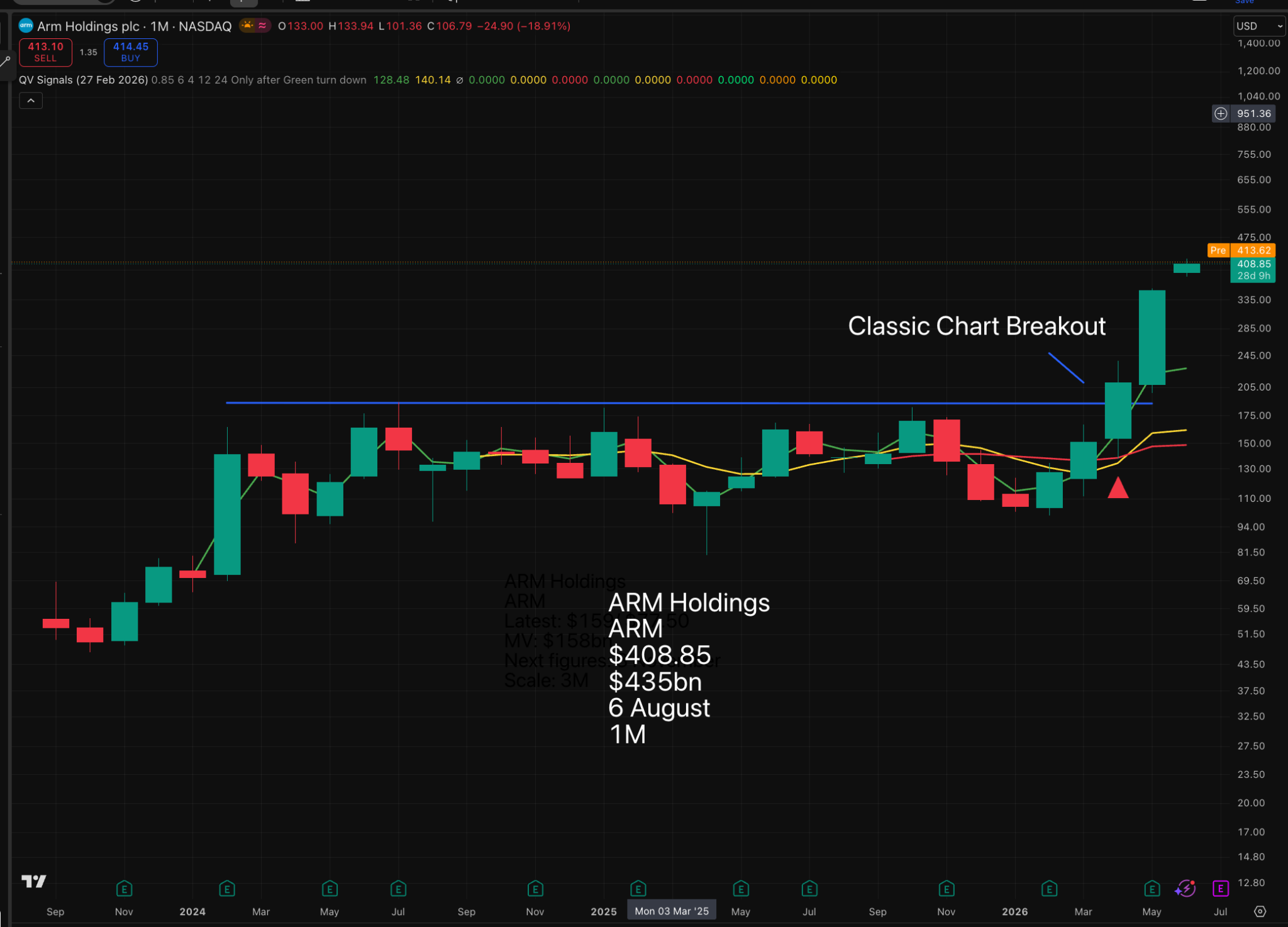
ARM has a trillion-dollar market cap. written all over it, standing as it does at the heart of the global IT revolution.
Soon, the data center will be Arm’s largest business. The direction is clear. Customers want Arm at the center of the AI data center. Customers need Arm where Agentic applications run and they need Arm where accelerators scale. For example, SAP will move their core database and business application workloads to Arm, starting with AWS Graviton and expanding to the Arm AGI CPU. This represents a significant strategic shift. Cloudflare will deploy Arm across its global network to support traffic management, security and AI inference closer to users.
Our opportunity does not stop at the data center. AI is moving to every device and every physical system. Phones, PCs, vehicles, factories, robots, cameras, sensors and connected devices all need efficient, secure compute with software that scales. These AI workloads will all run on Arm. With over 350 billion chips shipped and over 22 million developers, the Arm compute platform is the most comprehensive in history, and we are positioned to bring AI from cloud infrastructure to the Edge and to the physical world through a common compute platform and ecosystem. We enter fiscal 2027 with record results, strong customer demand and a larger opportunity ahead of us.
The biggest contribution to royalty revenue growth was from Cloud AI. Data center royalty revenue continues to more than double year-on-year, and we see no break in this momentum.
What an incredible business! What an incredible phenomenon is AI! Value investors will be running screaming to hurl themselves off cliff edges at a company with sales of just $5bn against a market cap of $435bn. Still, ARM has accumulated expertise and a gigantic footprint at the heart of everything happening in a world being transformed by technology. It is incredibly hard to value but very valuable.
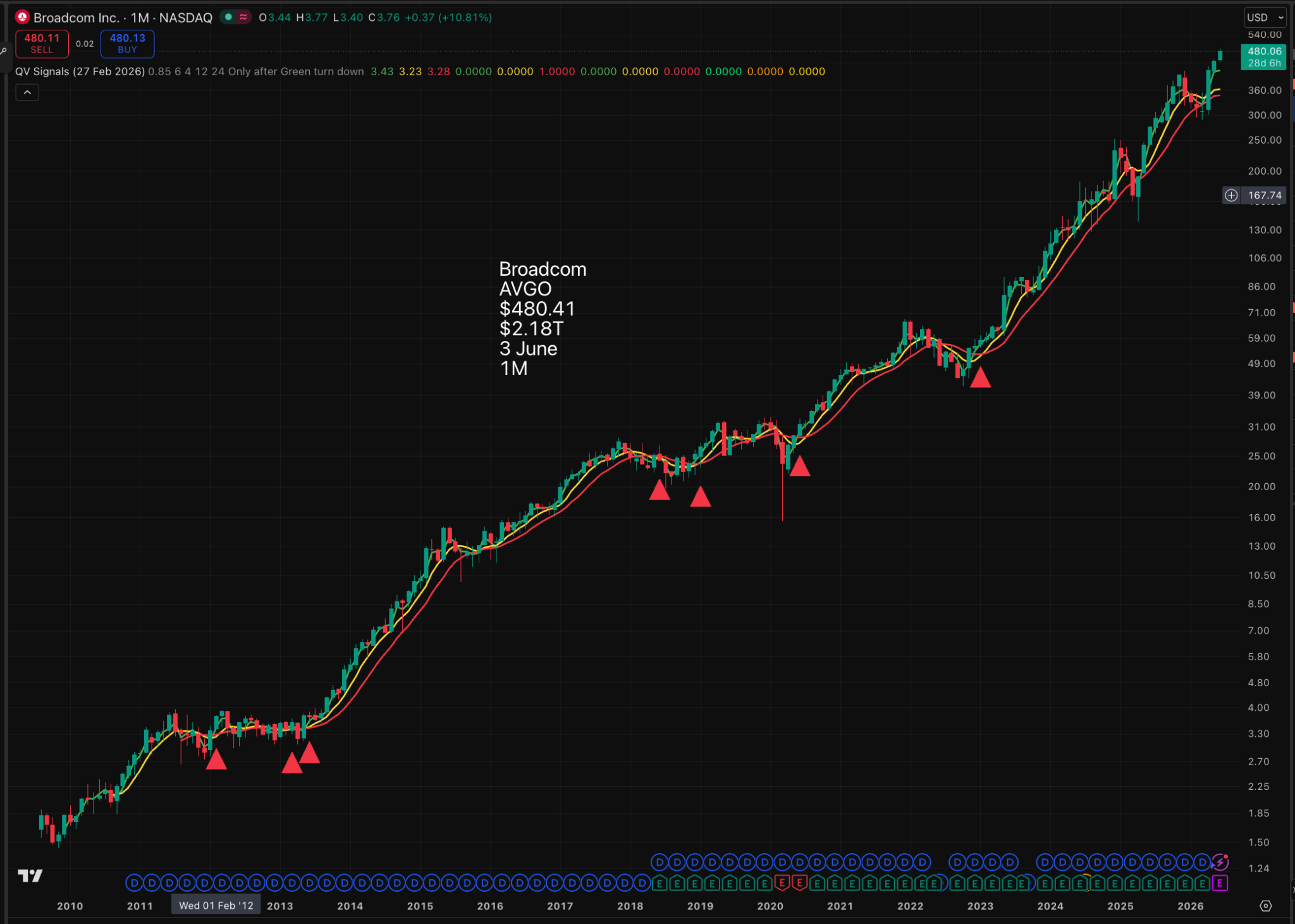
Broadcom has emerged as a leading AI company because of its focus on creating custom processors for tech companies. The company’s custom AI application-specific integrated circuits (ASICs) can be developed for a specific AI model or tuned for precise AI tasks, making them more efficient than general-purpose AI GPUs.
Some of Broadcom’s most important customers include Alphabet, Meta, Anthropic, and OpenAI. And as companies expand their data centers and rely heavily on agentic AI tasks, they’ve ramped up demand for custom processors, leading to a 140% increase in Broadcom’s ASIC chip sales in the first quarter of 2026.
Google recently extended an agreement with Broadcom to design its Tensor Processing Units (TPUs) through 2031, and all the chip deals it made led to Broadcom’s AI semiconductor revenue more than doubling to $8.4 billion in the first quarter.
Wall Street analysts are bullish on this trillion-dollar company, with 94% of them assigning a buy rating to the stock. And with Broadcom’s management estimating that AI chip revenue could reach $100 billion by the end of next year, there are plenty of reasons for investors to be optimistic about the company’s prospects.
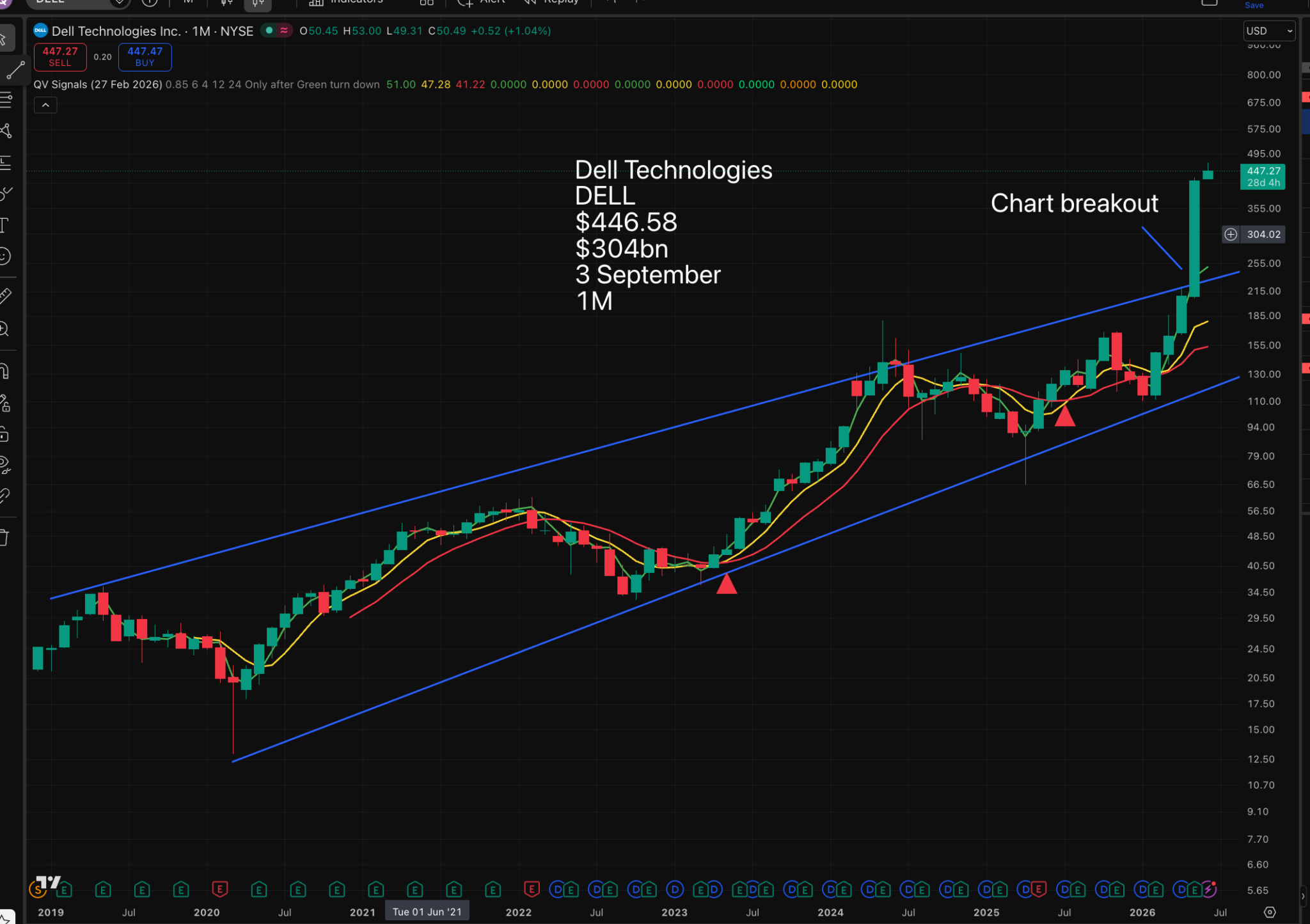
For years, Dell Technologies Inc. (DELL) was viewed as a mature hardware company. Unexciting, but profitable and investor-friendly
But like with many other things, AI has completely changed that, and the proof is in the latest earnings.
DELL is up over 40% following a very strong quarter, in which it is proving to be a major beneficiary of AI.
Back in the 1990s and early 2000s, Intel (INTC) became one of the most valuable companies in the world because it sat at the center of the computing revolution. Every PC needed Intel. Every server needed Intel. As computing expanded, Intel expanded alongside it.
I believe Dell is quietly becoming the Intel of the AI era, as it sits at the heart of data center deployments.
While the stock has already come up significantly in the last few months, Dell is still a buy in my opinion.
Revenue was up 88% YoY, while non-GAAP EPS increased 214% to $4.86.
The growth came from the Infrastructure Solutions Group, which jumped 181% YoY and reached $29 billion.
Overall, AI server revenue reached $16.1 billion in a single quarter, a 757% YoY increase.
But perhaps what the market liked the most was the increased guidance. Management raised FY27 AI server revenue guidance from $50 billion to $60 billion.
And it looks like there’s plenty more to come, as the backlog climbed to $51.3 billion.
Management repeatedly emphasized that demand remains significantly ahead of supply.
We have a supply issue. We are supply constrained in the second half. It is not a demand issue for us.
Investing in 2026 has become about chasing the next AI bottleneck, and that’s what’s happening with Dell here.
First it was GPUs, then memory. And now storage and data infrastructure are becoming critical constraints as agentic AI scales.
In the earnings call, management highlighted record demand for offerings like PowerScale, ObjectScale, and other unstructured storage products.
While Intel sat at the heart of the personal computer and the internet revolution of the 90s, Dell is likely going to become that for the AI buildout.
Whether customers are deploying Nvidia systems, running sovereign AI, building neoclouds, or implementing agentic workflows, Dell is becoming the company that stitches everything together.
While DELL doesn’t control any particular bottleneck, it arguably sits at the bottleneck of execution and deployment, which have become a much more important limiting factor than GPUs.
The market is realizing this, and it’s why the stock has re-rated so fast.
Share Recommendations
Nvidia. NVDA
ARM Holdings ARM
Broadcom. AVGO
Dell Technologies DELL
Strategy – Buy Into The AI Boom
Anita Roddick of Body Shop once said to me, however much profit you think we are going to make, we will make more. You could say something similar about AI – however big you think AI is going to be, it will be bigger. It has become the greatest project in human history, and ever more companies are joining the push to make it happen and growing at a furious rate as a result.
There is still a world of cautious scepticism out there with many analysts, investors and other observers looking for the boom to end, probably abruptly, leading to a spectacular stock market collapse.
Anything is possible, but both observation and common sense suggest that it won’t happen any time soon. On the contrary, companies across multiple disciplines are struggling to meet insatiable demand. The more interesting question is why the demand is so insatiable.
The demand for AI infrastructure is insatiable because training and running Large Language Models (LLMs) requires compounding leaps in computing. AI workloads operate by “parallel processing”—networks of chips working in ultra-close proximity to eliminate latency—meaning the industry requires dense, specialized, and highly power-intensive data centres.
This massive infrastructure race is driven by several compounding factors:
- Exponential User & Complexity Scaling: As more users adopt AI and models shift toward complex, “agentic” use cases that reason over data, computational requirements compound rapidly.
- The “Token Economy” Shift: Tech giants are drastically scaling their capital expenditure (capex) because falling inference costs have made it vastly cheaper to deploy models broadly. This rapid deployment drives a race to build capacity before scaling token-based revenue models.
- Extreme Physics & Energy Constraints: AI workloads require constant, high-density power. The infrastructure required to cool these servers and provide megawatts of active power is outstripping existing electrical grids. Hyperscalers are consequently investing heavily in bespoke power sources, including restarting nuclear reactors.
- The “Bragawatts” Arms Race: Leading technology companies are investing trillions to establish dominance, securing the hardware and physical real estate now to control the future AI economy.
Yes, you can be a scaredy-cat and stand back from what is happening because of worries that it might suddenly end, but you could miss out on the greatest investment opportunity in my lifetime. If this is the big one, you need to be involved. Journalists especially lean towards a sort of weary cynicism, which makes their advice especially suspect at times like this. It is like experts who miss every major turning point. We simple folk who use the duck test – ‘looks like a duck, swims like a duck, quacks like a duck, it probably is a duck’, are often the ones who get it right when it really is ‘different this time’.
There will be volatility and corrections. Nothing goes up in a straight line. Broadcom is reporting tomorrow, and that could easily be a source of volatility in a stock market dominated by day traders and algorithms, but the primary direction of travel for their shares and the others in my ‘Famous Four’ is higher.

Pick One Great Stock (From The AI Trade) And Buy The Buy Signals/ $-Cost Average

The Power Of The Cross – Time To Buy

Cryptos Waking Up