
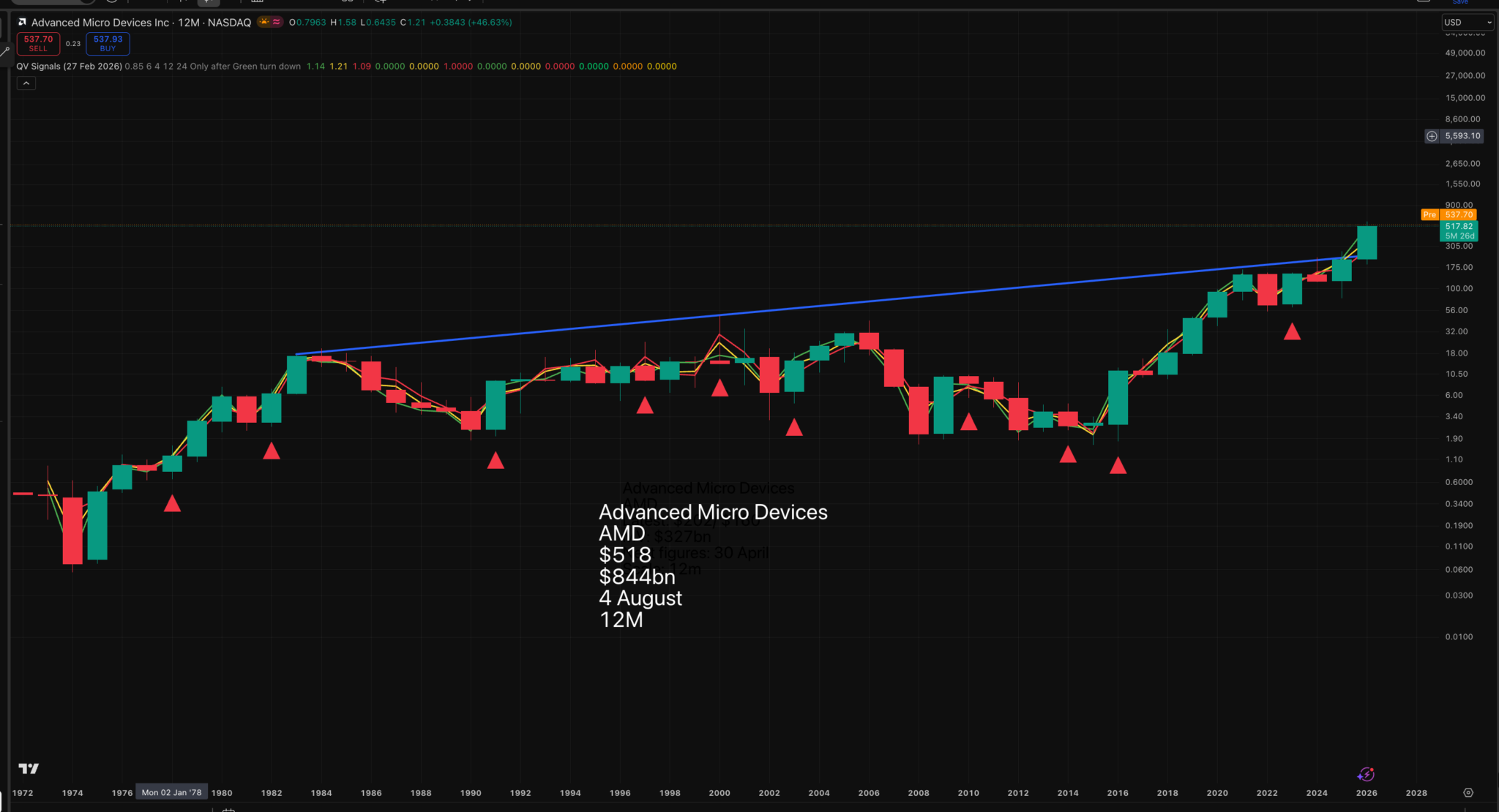
Charts are like statistics. You can play around with them to make them say what you want them to say. I have made this chart of AMD look super bullish by using 12-month candlesticks and flattening the chart. What this does is highlight the latest breakout from over 40 years of sideways trading. What I am trying to establish here is that something is happening with this share which is different to anything which has happened before and could support a massive long-term rise.
So we can look at the fundamentals, searching for what that something could be. I have always thought of AMD as a poor relation to Nvidia, which carries a twist because the CEO of AMD, Lisa Su, is related to Jensen Huang, the CEO and founder of Nvidia. The obvious place to start looking is the Q1 2026 earnings reported on 6 May 2026.
I am becoming interested in keywords as an early warning sign that a share might be in take-off mode. Amazingly, in my first application of this new approach, all four of my important keywords AI, data centre, accelerating, and inflexion- all pop up in the first paragraph of the AMD report.
We delivered an outstanding start to the year driven by accelerating demand for AI infrastructure across our portfolio. Growth was broad-based with every segment increasing year-over-year, led by 57% data center revenue growth. First quarter revenue increased 38% year-over-year to $10.3 billion, earnings grew more than 40%, and free cash flow more than tripled to a record $2.6 billion, driven by significantly higher sales of EPYC CPUs, Instinct GPUs and Ryzen processors. These results mark a clear inflection in our growth trajectory and a structural shift in our business. Data center is now the primary driver of our revenue and earnings growth.
Clearly something exciting is happening at AMD. So what do they do?
AMD (Advanced Micro Devices) designs high-performance microprocessors, graphics cards, and adaptive computing solutions. It powers everything from everyday personal laptops and gaming consoles to massive artificial intelligence data centers and aerospace systems.
AMD’s core product lineup includes:
- Personal Computers: The Ryzen series of processors and Radeon graphics cards for laptops, desktops, and handheld gaming devices.
- Data Centers & AI: The EPYC server processors and Instinct accelerators that provide the massive computing power required for AI training and cloud networks.
- Gaming Consoles: Custom chips built directly into the PlayStation and Xbox consoles.
- Embedded Systems: Highly specialized, low-power adaptive processors used in the automotive, industrial, and aerospace sectors.
Instead of operating its own manufacturing facilities, AMD designs the chip architecture and outsources physical production to third-party foundries.
What is the difference between Nvidia and AMD in their approach to the booming data centre market?
Nvidia dominates the data center AI chip market (holding roughly 80% to 85% share) with its specialized GPUs and proprietary CUDA software ecosystem. AMD acts as the primary challenger, gaining ground by offering cost-effective Instinct GPUs and focusing on open-source software (ROCm) and highly capable CPUs.
1. Hardware Focus and Architecture
- Nvidia: Designs heavily specialized AI accelerators (like the Blackwell B200 architecture) that feature built-in Tensor cores. Their data center value proposition extends beyond chips to end-to-end “AI factories” using proprietary interconnects like NVLink and InfiniBand networking to link thousands of GPUs together.
- AMD: Takes a broader and more diverse hardware approach. AMD commands a strong presence in traditional data center compute with its EPYC processors, while simultaneously scaling its Instinct
2. Software Ecosystems
- Nvidia: The biggest advantage Nvidia holds is its CUDA platform. It is a mature, proprietary software stack that data center developers have used for over a decade. Because the vast majority of AI and machine learning libraries are built on CUDA, it creates immense “switching costs” that lock developers into Nvidia hardware.
- AMD: To counter Nvidia’s moat, AMD relies on its ROCm open-source software platform. ROCm has matured significantly to support industry-standard frameworks like PyTorch. Furthermore, AMD offers drop-in compatibility features (like ZLUDA) that allow developers to run CUDA code on AMD chips with minimal modifications.
3. Market Position and Pricing
- Nvidia: Acts as the premium, undisputed leader in scale and performance, giving it massive pricing power. Nvidia is the safe default for hyperscalers (e.g., AWS, Microsoft) and holds the lion’s share of the booming AI hardware revenue.
- AMD: Positions itself as the high-value alternative. For instance, certain AMD chips (such as the MI355X) are designed to deliver faster AI inference workloads—running existing AI models—at a lower “tokens-per-dollar” ratio compared to Nvidia. This price-performance value has recently won major data center deployment deals with tech giants like Meta.
That last sentence suggests something exciting is happening with AMD as it wins major orders from hyperscalers like Meta. So let’s get AMD’s take on what is happening.
As AI adoption scales, demand is increasing, not only for accelerators, but also for the high-performance CPUs that power and orchestrate those workloads. Turning to our segments. Data Center revenue increased 57% year-over-year to a record $5.8 billion, led by strong demand for our EPYC CPUs and Instinct GPUs. In Server, we delivered our fourth consecutive quarter of record server CPU revenue. Revenue increased more than 50% year-over-year with sales to both Cloud and Enterprise customers each growing more than 50%. Share gains accelerated year-over-year, reflecting the ramp of fifth-gen EPYC Turin CPUs and continued strength of fourth-gen EPYC processors across a wide range of workloads.
In Cloud, AI was the primary driver of growth in the quarter as every major cloud provider expanded their EPYC footprint to support a broad range of AI workloads from general purpose compute and data processing to head nodes for accelerators and emerging Agentic applications. EPYC-powered cloud instances increased nearly 50% year-over-year to more than 1,600 with instances optimized for virtually every enterprise workload and expanded availability across the largest global cloud providers. In Enterprise, demand accelerated with record revenue and record sell-through in the quarter. We expanded our customer base with new wins across financial services, health care, industrial and digital infrastructure companies, while also building momentum with mid-market and SMB customers.
Exciting new products are being developed to drive growth.
We are well positioned to continue gaining share as more enterprises standardize on EPYC across on-prem and hybrid environments based on our leadership performance and TCO. Looking ahead, our sixth-gen EPYC Venice processor built on our Zen 6 architecture and 2-nanometer process technology is designed to extend our leadership across cloud, enterprise and AI workloads. The Venice family spans a broad set of CPUs optimized for throughput, performance per watt and performance per dollar, including Verano, our first EPYC CPU purpose built for AI infrastructure. Across the portfolio, Venice widens our competitive advantage, delivering substantially higher performance per socket and per watt versus competitive x86 offerings and more than 2x throughput per socket versus leading ARM-based AI solutions.
Customer demand is very strong with more customers validating and ramping platforms at this stage than with any prior EPYC generation, and we remain on track to launch Venice later this year. Looking more broadly, we are seeing a meaningful acceleration in customer demand driven by the rapid scaling of AI workloads across both Cloud and Enterprise. Inferencing and Agentic AI are increasing the need for server CPU compute as these workloads require additional CPU processing for orchestration, data movement and parallel execution in addition to serving as the head nodes for GPUs and accelerators. As a result, we are seeing both stronger near-term demand and deeper engagement with customers on long-term capacity planning.
And just look at how demand is accelerating.
At our Financial Analyst Day in November, we outlined the server CPU market growing at approximately 18% annually over the next 3 to 5 years. Based on the demand signals we are seeing today and the structural increase in CPU compute requirements driven by Agentic AI, we now expect the server CPU TAM to grow at greater than 35% annually, reaching over $120 billion by 2030. In response to this demand, we are working closely with our supply chain partners to meaningfully increase our wafer and back-end capacities to support this growth.
As a result, we now expect server CPU revenue to grow by more than 70% year-over-year in the second quarter, with robust growth continuing through the second half of 2026 and into 2027 as we ramp our next-generation EPYC processors.
No surprise, the company is optimistic about prospects.
While we are still in the early stages of the AI infrastructure cycle, the pace and scale of deployments we are seeing today reinforce both the magnitude and durability of the opportunity ahead. As inferencing and Agentic AI deployment scale, they are fundamentally increasing compute requirements, driving both larger scale accelerator deployments and significantly more CPU compute. AMD is uniquely positioned to lead in this next phase of AI with leadership products across high-performance service CPUs and AI accelerators and the ability to optimize them together as fully-integrated rack-scale solution. We have a world-class supply chain and are making significant investments to expand capacity and execute at scale.
There is a hint at where AMD is heading.
With the momentum we are seeing across the business and the expanding market opportunity, we see a clear path to exceed our long-term financial targets, including delivering more than $20 in EPS over the strategic time frame.
The bottom line is that AMD is a hot stock in a hot market.
In its Q1 2026 earnings report, Advanced Micro Devices (AMD) established a near-term focus on sustaining double-digit data center momentum through 2027, alongside a long-term strategic outlook extending to 2030 driven by Agentic AI. The company projects a compound annual growth rate for Data Center AI revenue exceeding 80% through 2027 and has doubled its 2030 Server CPU Total Addressable Market (TAM) forecast to over $120 billion.
So we know three key facts about AMD. It has an explosive long-term chart; it is growing at a fast and accelerating rate, and it has a fabulous story as suggested by CEO Lisa Su’s comment that the latest results mark a clear inflexion point in the company’s growth trajectory.
The only thing we don’t know is what the right price is for all this excitement. Fortunately, we don’t have to know because we can stagger our buying, add to holdings in periods of weakness and generally adapt our strategy to benefit from likely share price volatility.
Share Recommendations
Advanced Micro Devices. AMD
Strategy – Build A Holding In AMD
Subscribers will notice parallels with the memory stocks boom. Demand has exploded as a massive new customer, AI, is bringing in huge new customers with increasingly sophisticated requirements. The cyclical consumer and gaming markets are rapidly shrinking in importance. AMD looks like another multi-trillion-dollar stock in the making.
Incidentally, the fact that the company is ready to put in print an eps target of $20 is a good sign that the likely result will be much higher.

Pick One Great Stock (From The AI Trade) And Buy The Buy Signals/ $-Cost Average

The Power Of The Cross – Time To Buy

Cryptos Waking Up