
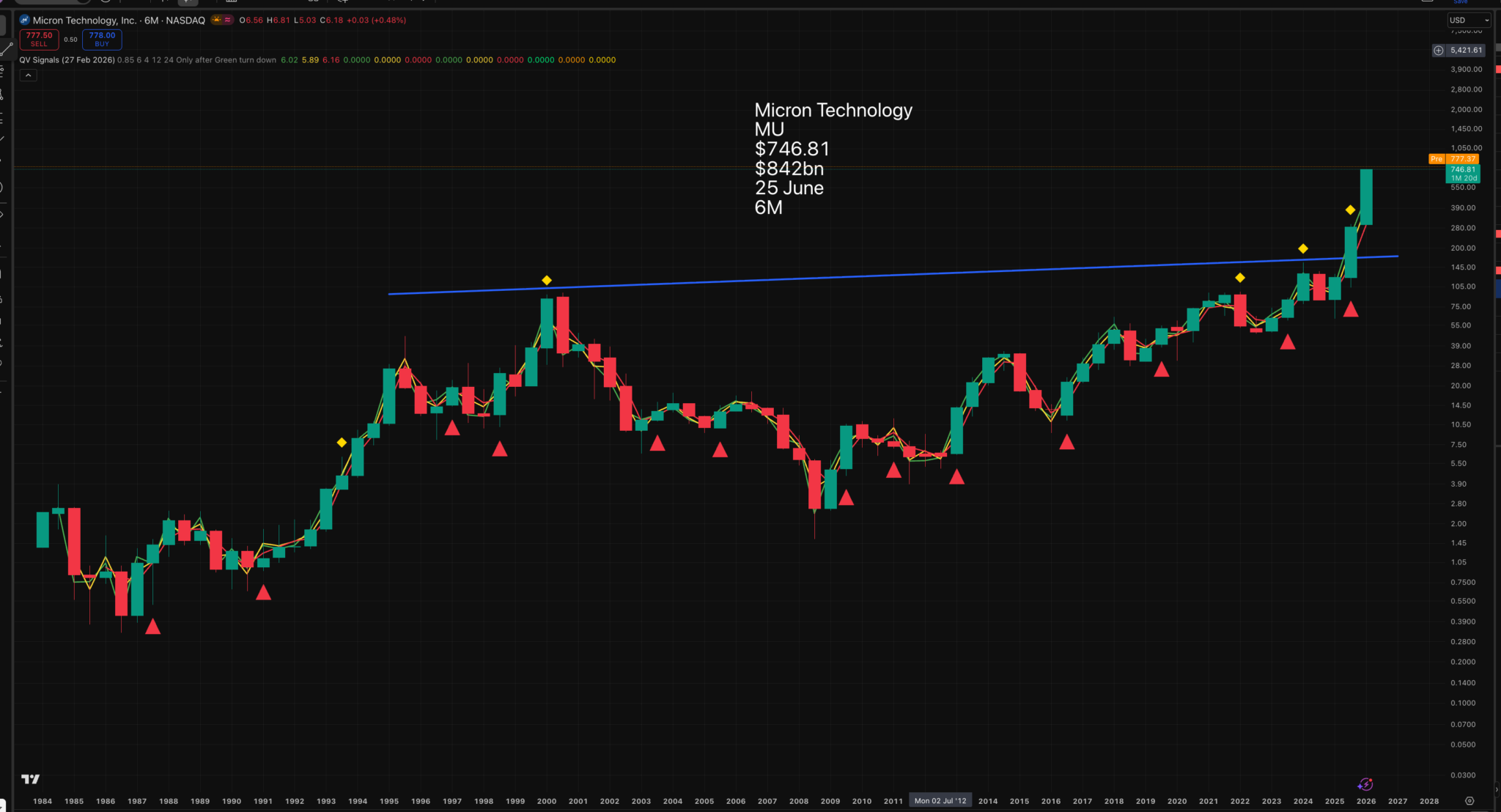
If you look at the chart, Micron Technology has been asleep (doing nothing much) for 30 years, between 1995 and 2025. But not any more. In the last year, the shares have exploded higher. This is not an uptrend which is close to peaking; this is an incredibly exciting chart breakout. These shares are in a secular bull trend which has just begun. I have flattened the chart slightly to make that breakout clearer.
Do the fundamentals support the chart interpretation? I would say yes, and so would somebody else who is more au fait with the technology (more on that below). It is not just Micron Technology. The whole sector is going mad. Samsung, SK Hynix (both South Korea), Kioxia (Japan), Seagate Technology, SanDisk and others (USA).
One analyst believes SanDisk is poised to double from here to $3,000, and both fundamentals and chart support such an interpretation. The chart is a rocket heading into orbit, so it is neither bullish nor bearish, just explosive.
The Micron chart goes back much further, so we can see that the recent explosive behaviour is bullish. It shows a textbook, epic breakout. There could be a pullback anytime (shares can do anything in the short term), but the big picture is massively higher, which would take Micron into the trillion-dollar club, which Samsung has just joined.
Everybody interested in these things knows that memory chips are in short supply because of their importance to the latest stage of the snowballing data centre boom. They also know that it is expensive and takes years to bring meaningful new supply on stream, so this boom is likely to be around for a while.
The companies involved are spending heavily upgrading the technology for the requirements of data centres and are changing their business models to encourage investment and give the hyperscale customers security of supply as they make their massive investment spending plans.
I didn’t pay much attention to Micron Technology at first. I just thought, I know Micron, it’s a boring company, but not any more. It has forced its way to my attention.
Below is a beginner’s guide to why memory and flash memory are becoming such important parts of the data centre boom.
Memory and flash storage are the foundational drivers of the current data centre boom, transitioning from simple storage components into strategic enablers of AI performance, energy efficiency, and scalability. As data centres shift from compute-centric to data-centric architectures, the ability to store, move, and access data rapidly—rather than just process it—has become the primary bottleneck and competitive differentiator.
The explosion of AI, machine learning, and cloud computing requires immense data capacity and ultra-low latency, which legacy hard disk drives (HDDs) cannot provide.
Here is why memory and flash are essential to the data centre boom:
1. Feeding the AI “Data Starvation” Problem
AI models, particularly generative AI, require constant, massive-scale data feeding to GPUs.
- DRAM (Memory): High-bandwidth memory (HBM) is essential to store active datasets, model weights, and AI training data, allowing processors to operate at peak efficiency without waiting for data.
- Flash (NAND): High-speed NVMe flash SSDs act as the storage backbone, staging and delivering enormous datasets to AI systems with minimal latency.
- Impact: Fast storage reduces “data starvation,” directly enabling faster AI training times.
- 2. All-Flash Data Centres: Speed and Density
- The industry is moving toward all-flash data centers because flash provides superior performance over traditional hard drives.
- Performance: Flash provides significantly faster I/O (Input/Output) operations and lower latency, essential for real-time analytics, databases, and AI workloads.
- Density: Flash technology (such as 3D NAND and QLC) allows higher storage density in a smaller footprint, allowing data centres to store up to 10 times more data (e.g., 100 petabytes vs. 10 petabytes) in the same space compared to HDDs.
- Reliability: With no moving parts, SSDs are more robust, lowering maintenance and reducing failures in high-density environments.
- 3. Energy Efficiency and Cooling
- With data centres consuming vast amounts of power, energy efficiency is critical, particularly with AI workloads.
- Lower Power & Heat: Flash storage requires less power and produces less heat than mechanical hard drives, reducing the need for intensive, expensive cooling systems.
- Performance-per-watt: Flash solutions offer superior performance-per-watt, making them essential for sustainable, large-scale AI operations.
- 4. Enabling Next-Gen Architecture (CXL and 100TB+ Drives)
- New technologies are being deployed to handle the scaling needs of 2026 data centers.
- CXL (Compute Express Link): Technologies like CXL allow memory pooling across servers, optimizing resource utilization.
- Massive Capacity: The adoption of 100TB+ enterprise SSDs provides the necessary capacity to manage vast amounts of data.
- Improved Throughput: PCIe 6.0 and future NVMe interfaces reduce bottlenecks, offering greater bandwidth for data-intensive apps.
Companies in the sector are benefiting from a massive tailwind. It is too early to be looking for the top of this cycle, if it is a cycle. It has just begun, like the whole AI phenomenon. Humanity and I are learning to work with AI. There is much to learn, and AI is advancing at an accelerating rate.
Below is an uber-bull’s take on Micron Technology.
Micron Technology, Inc. (MU) today stands at a $720 billion market cap (more now), trading at a measly 11x forward P/E ratio and a 0.07x PEG ratio. This is unheard of for a company showing over 190% year-over-year revenue growth and a 57% net income margin in their latest earnings release.
In my last article on MU, I discussed how structural demand is replacing cyclical volatility. Since writing this article, MU has gone up over 60%. My thesis hinged on a rerating driven by the demand driver shifting from consumer products to AI infrastructure – HBM stacks are qualified per generation of GPU with memory requirements increasing per generation & NVIDIA Corporation’s (NVDA) GPU release cadence is now annual, significantly decreasing cyclicality in this line of business.
While the market initially focused on the explosive demand for GPUs and HBM for training foundational models, the focus has now shifted toward the orchestration and inference layers, where CPUs dominate. With the Vera Rubin platform now entering high-volume production, MU is set to be a large supplier for Vera CPUs. The combination of an incredible margin profile, a fully committed 2026 HBM capacity, and growth driven by SOCAMM2 and HBM4 creates a path to $1,500 and beyond, and so I reiterate my Strong Buy rating on MU.
Intel Corporation (INTC), once considered a laggard in the AI race, is now up over 457% in the last year and 201% on a YTD basis. This rally was driven by the realization that as AI workloads evolve from foundational training to agentic inference, the burden of orchestration and complex logic handling returns to the CPU.
During the initial AI boom, GPUs were the primary beneficiaries of CapEx, as hyperscalers raced to build massive training clusters. However, the nature of AI usage is shifting toward inference: the act of running a trained model to generate responses or perform actions. Unlike training, which is characterized by heavy matrix multiplication, inference and agentic loops require a blend of single-threaded performance, data bandwidth, and deterministic execution.
In custom inference-optimized deployments, the industry is seeing a return of high-core-count CPUs. Traditionally, an AI server rack featured a ratio of one CPU to eight GPUs (1:8) to manage orchestration. These ratios have now tightened to 1:4 and are trending toward 1:1 parity in environments running agentic AI. This represents an eightfold increase in CPU requirements for the same number of GPUs.
Agentic AI represents an evolution from generative AI. These systems are autonomous agents capable of planning and executing multi-step tasks while also interacting with external tools and APIs. A single user prompt of 50 tokens can turn into a 50,000 token job. This 1,000x expansion in internal traffic does not just require GPU compute, but it also demands the logic handling and thread synchronization that CPUs provide.
The transition to agentic AI and long-context inference has triggered a memory wall where the performance of an AI system is directly limited by the capacity and bandwidth of its memory subsystem. Modern AI servers now require significantly more capacity per CPU node to handle thousands of concurrent AI agents and the exponentially increasing context windows of frontier models.
The industry is moving toward “infinite” context windows to enable AI systems to keep entire libraries of documents or months of conversation history within their memory. This requires an increase in the memory capacity of CPU nodes. Industry sources report that CPU makers are planning to equip their latest AI CPUs with 300 GB to 400 GB of dedicated DRAM per chip. This represents a significant increase from 96 GB to 256 GB, which was standard in previous years.
To support these increasing memory requirements in CPUs, the CPU architecture is being redesigned to handle workloads where memory is core to computation. For example, the NVDA Vera CPU, shown above, has a bandwidth of 14 GB/s for each of its cores, totaling 1.2 TB/s for the whole processor. This level of bandwidth is essential to sustain over 90% of peak memory utilization during the Extract-Transform-Load and real-time analytics phases of agentic loops.
One of the most crucial catalysts for the MU bull case is the company’s confirmed role in the NVDA Vera Rubin ecosystem. Rumors that circulated in early 2026 suggested MU might be excluded from HBM4 supply for the Vera Rubin platform. However, MU shut down these reports, confirming high-volume shipments of HBM4. Mark Murphy, CFO of Micron, stated,
And let me, at this time, address some recent inaccurate reporting by some on our HBM4 position. We have been in high-volume production on HBM4. We’ve commenced customer shipments of HBM4, and we see shipment volumes ramping successfully this calendar Q1. This is a quarter earlier than we mentioned during our December earnings call. Our HBM capacity is ramping well, and we have sold out our calendar year ’26 HBM supply as we highlighted a few months ago. Our HBM yield is on track.
However, MU is serving the Vera Rubin platform beyond just HBM4 supply. MU has confirmed SOCAMM2 will be used in NVDA’s Vera Rubin NVL72 systems and standalone Vera CPU platforms. The Vera CPU utilizes SOCAMM2 (Small Outline Compression-Attached Memory Modules), a technology MU developed for data centers. Unlike traditional soldered memory, SOCAMM2 modules are detachable and upgradable, combining the efficiency of LPDDR5X with server-class serviceability. MU’s 192 GB and 256 GB SOCAMM2 modules are now in high-volume production, supporting up to 2 TB of memory and 1.2 TB/s of bandwidth per CPU socket.
I also believe MU’s CPU positioning is being abetted by technical hurdles facing its competitors. For example, Samsung Electronics Co., Ltd. (SSNLF) reportedly struggled with issues in its early SOCAMM2 designs, a hurdle it only resolved recently by lowering soldering temperatures. Meanwhile, SK hynix is racing to scale its sixth generation (1c) DRAM process to match MU’s node maturity. MU’s 1-gamma (1γ) node is already on track to become the majority of its DRAM bit mix by mid-2026, representing the fastest ramp to mature yields in the company’s history.
In Q2 of fiscal 2026, MU reported revenue of over $23.9 billion, a 196% increase from the prior year. This growth was driven by a combination of increasing bit shipments and sharply rising average selling prices. Gross margins expanded to 74%, up from 37% just one year ago, as the product mix shifted toward high-margin AI and data center solutions. Net income has also surged to 57.7%, up from 19.6% a year ago.
MU, according to their latest balance sheet, has a cash position of almost $14 billion. This is almost double what it was last year. This exceptional cash generation is allowing MU to simultaneously fund its massive capital expansion, reduce its total debt to $10.8 billion from $15 billion last year, and return cash to shareholders through both buybacks and dividends.
Management expects 2026 capital expenditures to exceed $25 billion. While such high spending carries execution risk, it also serves as a barrier to entry. Building a modern memory fab costs upwards of $15 billion and takes years to complete. MU is the only US-based player with the scale and technology to participate in this cycle, and its build-out in Idaho and New York (supported by $6.4 billion in CHIPS Act grants) positions it as a strategically essential supplier.
Looking ahead, management has signaled revenue of $33.5 billion and a record-breaking gross margin of approximately 81% – this revenue guidance is higher than full-year revenue for every year in MU’s history through 2024. This margin expansion is expected to be driven by higher pricing, lower manufacturing costs from the 1-gamma node ramp, and a favorable product mix heavily weighted toward HBM4 and high-capacity server DIMMs. Investors should anticipate that these results will consolidate MU’s position as one of the highest-margin players in the AI infrastructure stack, rivaling software-level profitability.
When assembling a set of comparable companies and comparing forward multiples, it is clear MU is incredibly undervalued with respect to its peers. I intentionally did not include SK hynix and Samsung within this peer set because I consider these companies to be undervalued as well – they are set to rerate alongside MU, as discussed in my previous coverage of them in my EWY article.
To value MU, I am going to use a forward P/E ratio of 25.99x—this is the median multiple of its peer set of comparable companies shown in the image above. This yields a price target of $1,506, representing an over 130% upside. I expect this rerating to be a function of multiple expansions as the sector rerates cyclical demand to structural demand & continuing increases in memory requirements on both fronts of CPUs and GPUs driven by the seemingly infinite demands of AI workloads.
Something unprecedented is happening to the world’s memory and flash memory industry. An explosion of demand is hitting inflexible supply and has turned the whole industry upside down. It represents an extraordinary investment opportunity.
Share Recommendations
Micron Technology. MU
Roundhill Memory ETF. DRAM
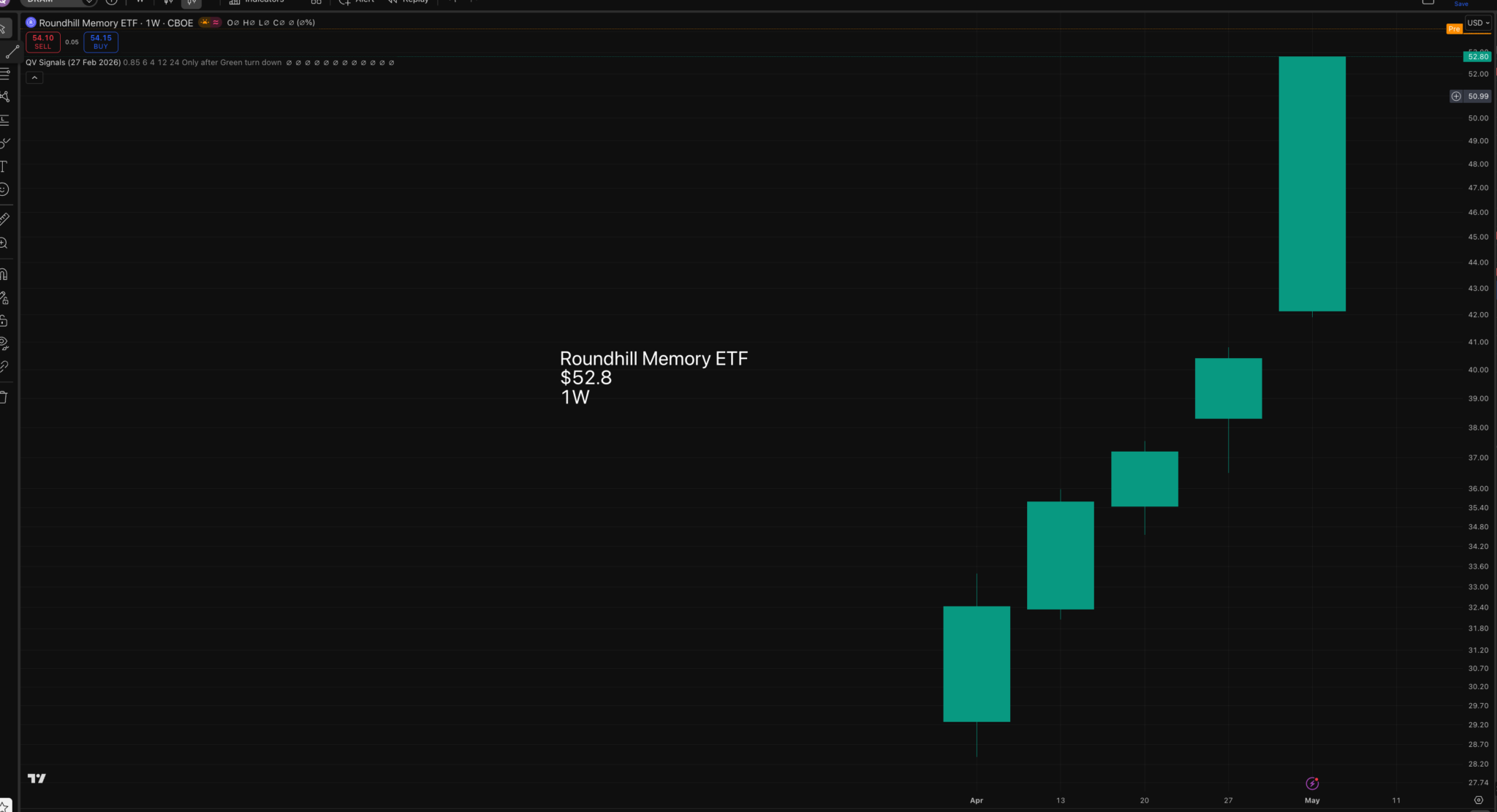
This is about Micron Technology, but I like the whole sector. There is even an ETF, called DRAM, which is going through the roof.

Pick One Great Stock (From The AI Trade) And Buy The Buy Signals/ $-Cost Average

The Power Of The Cross – Time To Buy

Cryptos Waking Up