
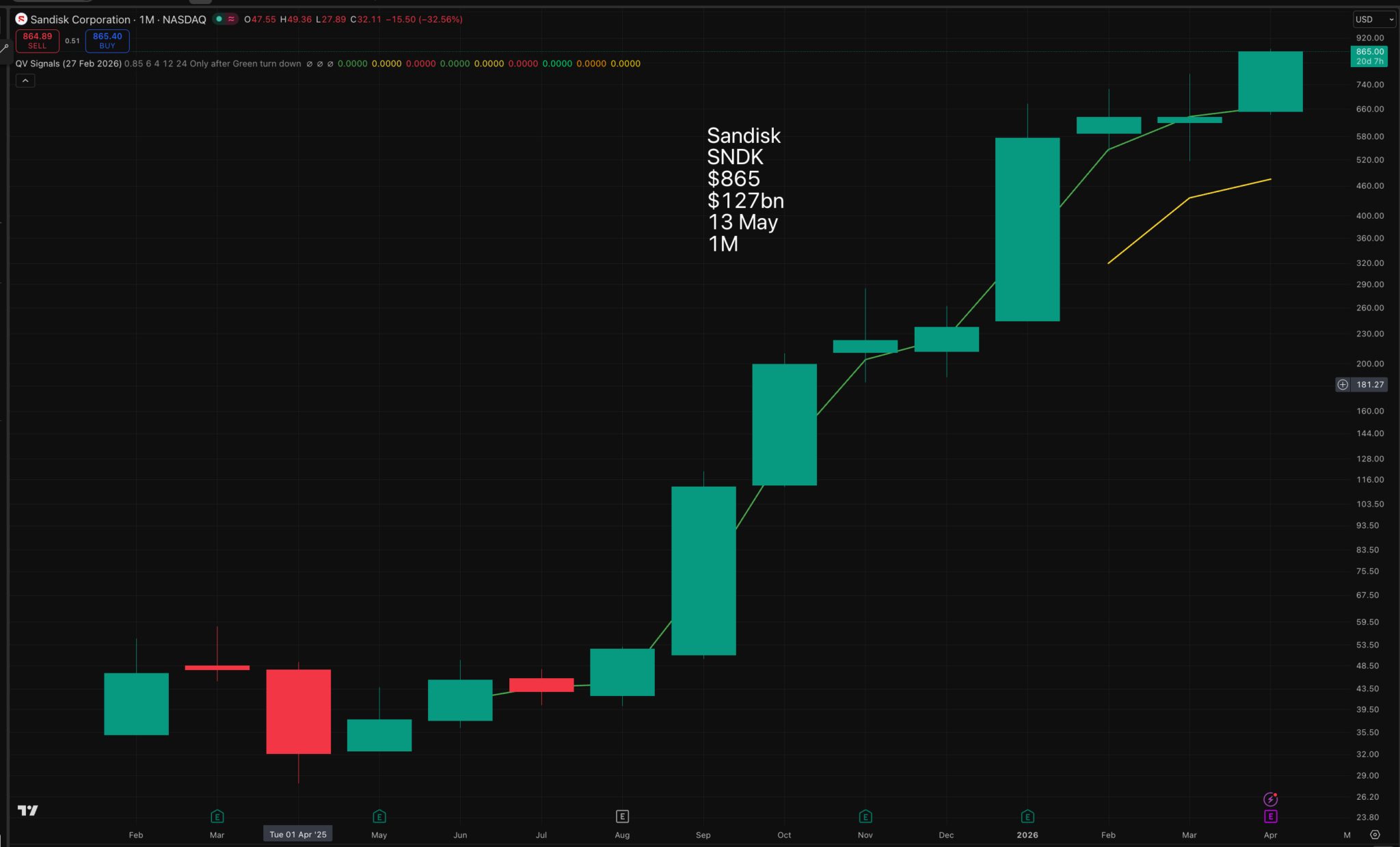
It turns out something amazing is happening, which is having a dramatic impact on companies like SandDsk.
The cost of computer memory (DRAM and NAND flash) is climbing rapidly, with some estimates showing prices doubling since late 2025 due to a “perfect storm” of demand and supply constraints. The primary driver is the explosive growth of artificial intelligence (AI), which has triggered a massive, industry-wide shortage.
Here is a breakdown of why memory costs are soaring:
- AI Data Center Demand: AI technology—particularly large language models—requires massive amounts of high-speed memory for training and inference. Tech giants like Google, Meta, and Microsoft are purchasing immense quantities of memory for their data centers, outbidding consumer-grade manufacturers.
- Shift to High-Margin Products: Manufacturers such as Samsung, SK Hynix, and Micron are prioritizing production of high-margin memory types like High Bandwidth Memory (HBM) and advanced server-grade DDR5 to meet AI demands.
- Reduced Consumer Supply: Because factories are dedicated to producing server-grade AI memory, the supply of consumer-grade DRAM for laptops, desktops, and gaming consoles has fallen, causing prices to soar. Some manufacturers have even reduced the production of older DDR4 memory, making it scarcer and more expensive.
- Long-Term Shortage Projections: The memory crisis, sometimes termed “RAMmageddon,” is not expected to be a short-term issue. Experts warn that the shortage could persist until 2027 or 2028, with AI data centers predicted to consume 70% of global memory production in 2026.
- Impact on Component Prices: RAM and SSD prices for consumers have doubled or tripled in some cases within a few months, forcing manufacturers of products like the Raspberry Pi and Framework laptops to raise their prices.
In summary, the demand for AI infrastructure has caused a supply chain reallocation where memory has shifted from a cheap commodity to a scarce, high-demand component, driving up costs for consumers and enterprise buyers alike.
The bottom line is that SandDisk’s business is going ballistic.
In summary, we continue to successfully navigate these early stages of a far-reaching evolution in our business. In addition to its central role in technology we use every day, like PCs, smartphones, tablets, the cloud, cars, gaming devices, robotics, and more, NAND is a critical technology enabling the development and proliferation of artificial intelligence. For the first time, the data center is expected to become the largest market for NAND in 2026, driven by some of the world’s largest and most well-capitalized technology companies. Fueled by the performance our technology delivers, customers across all our end markets are increasingly seeking business practices built around shared commitments and agreed financially attractive terms aligned with our preexisting supply plans.
Our supply plans will remain aligned to such attractive, real, and sustainable long-term demand. With this backdrop, margins are expected to reset at a structurally higher level, delivering fair returns on the substantial innovation and investment required. Our technology and product portfolios intersect these changing market dynamics at the perfect moment, positioning us to manage a balanced portfolio and deliver industry-leading financial performance.
SanDisk is a classic case of a company in the right place at the right time. Some analysts are forecasting 2026 sales as high as $15bn, which would value the company at around eight times sales. In the circumstances, that does not look expensive.
SanDisk’s AI business is super-strong.
Within hyperscalers, we have completed qualification of our PCIe Gen 5 high-performance TLC drives at a second hyperscaler and are on track to complete qualification at additional hyperscalers over the coming quarters, with Bix 8 TLC solutions soon thereafter.
This product is driving significant revenue growth across our data center portfolio, which was up 64% sequentially. Our Bix 8 QLC storage class product, code-named Stargate, continues advancing through with two major hyperscalers and is expected to begin shipping for revenue within the next several quarters, providing an additional tailwind for data center growth.
CEO, David Goeckeler, had this to say about the outlook for its AI-related business.
We saw, I think, 29% sequential growth in the first fiscal quarter. Now we just saw 64% sequential growth in the second fiscal quarter, and I think you’ll see that accelerate from here in the second half of the fiscal year.
Below is a question and answer from the latest quarterly report which gives a flavour of the demand explosion hitting SanDisk.
I guess the first question, is there a way to quantify incremental demand for NAND related to AI infrastructure build-out? I’m not including KV cache, but you know, we were mid to high teens before, and I’m curious now based on your conversations with customers, and the demand trends that you’re seeing, where do you think the new demand growth CAGR [comound annual growth rate] is looking out ’26, ’27, ’28?
David V. Goeckeler: I think the best proxy we have for that right now, CJ, is just what we’re seeing in exabyte demand in the data center. As I said earlier, I mean, two cycles ago, we were looking at, you know, call it mid-twenties exabyte growth in ’26 for data centers. Last quarter, we were talking about, we upped that to mid-40s given the CapEx cycle that went on. We’re now looking at high sixties exabyte growth in data centers in our forecast. And that doesn’t include any CapEx raises on this earnings cycle. So you know, significant increase just quarter over quarter in demand. And we think most of that is driven by AI, obviously.
There is another exchange that gives an insight to the transformation taking place in SanDisk’s business.
Mehdi Hosseini: Okay. Great. And one question for David. Look, we’re sitting here, and there is increased shortage. It’s intensifying. You and your peers are involved in discussion for a multiyear contract. And as you highlighted, these projects take several years. Building a fab and putting equipment is a very long process. Why isn’t there more urgency? Why aren’t your customers’ customers willing to commit more? They’re committing investment throughout the AI supply chain. But when it comes to memory or NAND, I don’t get a sense of urgency. Is it going to wait till the second half of this year, meaning the shortage is going to intensify unless the SSD exabyte growth of 60% is maybe just a short list?
How can I reconcile the two?
David V. Goeckeler: I have lots of thoughts on that, Mehdi. I mean, first of all, I mean, I would argue that there actually is a fair amount of urgency, and things are changing rather dramatically rather quickly. I mean, you’re talking about a market that’s operated the way it’s operated for, you know, arguably decades. And the way that market has operated is there’s essentially been a quarterly auction for NAND that goes on that sets the price, and then we all talk about what the price was every quarter. And then on the supply side, we’ve tried to get it right on how much we supply. And often gotten it wrong.
And when you get it wrong, the economics just completely crater. So we’re trying to navigate out of that world. There are a lot of reasons why we’re navigating out of that world. There are a lot of technology reasons and all kinds of stuff we’ve talked about in the past. We could talk a lot about it. But to change behavior on something you’ve been doing for, you know, a decade and just wake up within a quarter and decide to completely change the business practices of an industry is almost really, really hard to do. But I do think it’s happening.
I do think that customers are starting to look, like I said, they’re starting to look further down the horizon, especially in the data center. I don’t think this can be underestimated, this idea that now the data center is the largest market in NAND. I mean, it’s a market that’s been dominated by not dominated, but where the primary customers were then smartphones and PCs. What I talk about is, you know, I kind of view that as traditionally being the commodity NAND market. I hate that term, but that’s what people think about it. The data center is not that market. Like, the data center is not a commodity NAND market.
The data center is NAND is a highly strategic product, part of a very sophisticated AI architecture. And I need extraordinarily high performance, and I need innovation, and I need, you know, a specific enterprise SSD that fits my configuration. It’s way on the other side of, you know, I just need the same product and I can plug in anyone from, you know, five different suppliers. That’s not you know. So that market now becoming the primary market and especially the primary growth engine is really, I think, starting to challenge the business practices of the way the market has traditionally worked. And again, I’m actually quite optimistic that this is happening pretty quickly. Now we’ll see how quickly.
I mean, do we actually get to the point where we’re announcing contracts? We’re not quite there yet. We’ve got, you know, some that are coming along. But, you know, from my perspective, on a relative basis, it’s going pretty quick. For a market this big, we’re talking $150 billion maybe this year. For a market this big, this many players, this much business transacted every quarter. To see it change as fast as it’s changing is pretty remarkable.
It seems that what is happening to SanDisk with NAND is similar to what happened to Nvidia with GPUs, as AI and the data centre build out transform the market. Where it will take SanDisk shares, I have no idea, but it could be much higher.
Share Recommendations
Sandisk. SNDK

Pick One Great Stock (From The AI Trade) And Buy The Buy Signals/ $-Cost Average

The Power Of The Cross – Time To Buy

Cryptos Waking Up