
I think I have mentioned this before, but it is so significant that it is worth revisiting. Years ago, my printer brought his son to visit me, hoping he might gain some work experience with me before joining the RAF. This wasn’t possible, but we had a long discussion about my approach to investment and the emphasis on exciting growth shares, £-cost averaging, and a long-term view.
My friend’s son took this advice on board because when he joined the RAF, he followed the precepts to the letter. He was able to do this on a significant scale because the RAF pays for everything: food, accommodation, heating, and so on, so your salary is free cash flow. He invested this every month in exciting stocks chosen according to my rules but chosen by him, so all credit to him for his achievement.
Recently, his father wrote to thank me because, thanks to rigorously following this approach, his son had amassed a portfolio of £1.8m. In effect, he had done a test run of the concept and delivered dramatic proof that it works. The message is that we should all think seriously about £-cost averaging because it can deliver amazing results. I don’t know how much he invested, but it is a safe bet that he multiplied that investment many times.
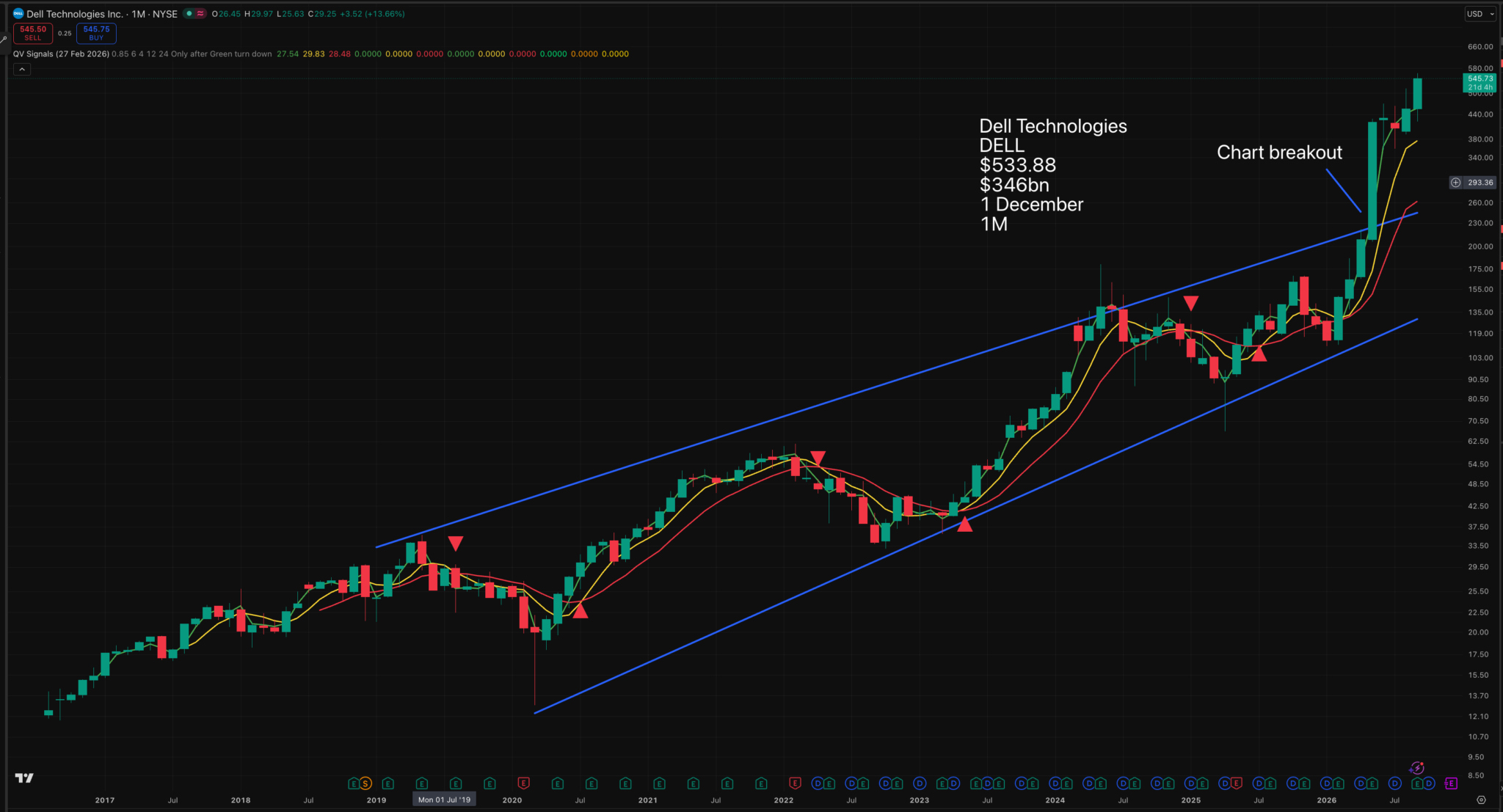
One reason why such amazing results are possible is that the world is in the grip of the most astounding investment boom in history, and this is driving a phenomenon known to investors as ‘the AI trade’. As a result of this boom, even large companies like Nvidia, Broadcom and Micron Technology are growing at astounding speed. Above, I am adding a new name to my favourites for the AI trade: Dell Technologies, which is growing explosively, has a spectacular story and a wonderful chart- classic 3G, in short (not entirely new; I have recommended them before).
As I have frequently noted in the past, and as demonstrated by simple observation, these explosively growing companies have explosively rising share prices and that makes them super volatile and so classic candidates for £-cost averaging. It is the obvious way to play them and is highly likely to be successful and profitable over time. I want my subscribers to win, and this is the way to do it.
Investors worry, about things like the war between Iran and the USA, about whether President Trump knows what he is doing, about inflation, interest rates, bond yields etc.etc.etc. Their biggest worry about the AI trade is that the investment boom and associated effects on share prices will end painfully as the bubble bursts. Every man and his dog has a view on that; mine is that AI is such an amazing phenomenon that it will keep rolling more or less indefinitely. Looking for it to end is like looking for technology to stop advancing; that is never going to happen.
The boom is running exceptionally strongly at the moment, but this looks more like an early-stage phenomenon than anything remotely approaching an endgame.
Listen to what Dell has to say.
Over the past 12 months, we have booked more than $130 billion in AI server orders. In just the past 2 quarters, we have generated almost as much revenue from traditional servers and networking as we have in any prior full year in company history. Storage returned to growth and share gain, with strong demand for Dell IP storage products, and CSG revenue is growing at the fastest rate in 5 years. It is clear why demand for our solutions is exceeding available supply. Our results and guidance demonstrate the strength of our position as customers enter a new era of infrastructure modernization.
Against this background, monthly purchases at whatever price, higher or lower, make a great deal of sense. Just keep doing it because it is a classic win-in-the-end strategy. I am doing it with four stocks at the moment and will probably add Dell to that number since it meets all my criteria for a phenomenally exciting stock.
Share Recommendations
Dell Technologies (DELL) and all the usual suspects from the AI trade
Strategy – To Leverage Or Not To Leverage
Significantly, my friend’s son achieved his amazing results without leverage, and this may explain part of his success because he was never at risk of being sold out. On the contrary, fierce share price setbacks worked to his advantage because they provided cheap buying opportunities, and shares often rebound fast after a sell-off, so buying into those sell-offs makes great sense.
I find it hard to imagine life without leverage, but I have made a rule for myself. I will buy on leverage, but I will not use any share price appreciation to buy more shares. New monthly purchases, the £-cost averaging strategy, must be funded with fresh injections of funds into my account. In this way, hopefully, if the strategy is working well, the leverage should fall over time, giving protection against the inevitable sell-offs.
I make my purchases using forward bets in a spread betting account, so there is no liability for tax and relatively low dealing costs if the strategy is maintained. The alternative is daily funded bets where you are charged interest on the whole position by IG. All the shares I hold are part of the AI trade. I use AI a lot for all kinds of things and already cannot imagine life without it. Indeed, I can attempt projects which would have been unthinkable without AI.

Pick One Great Stock (From The AI Trade) And Buy The Buy Signals/ $-Cost Average

The Power Of The Cross – Time To Buy

Cryptos Waking Up