
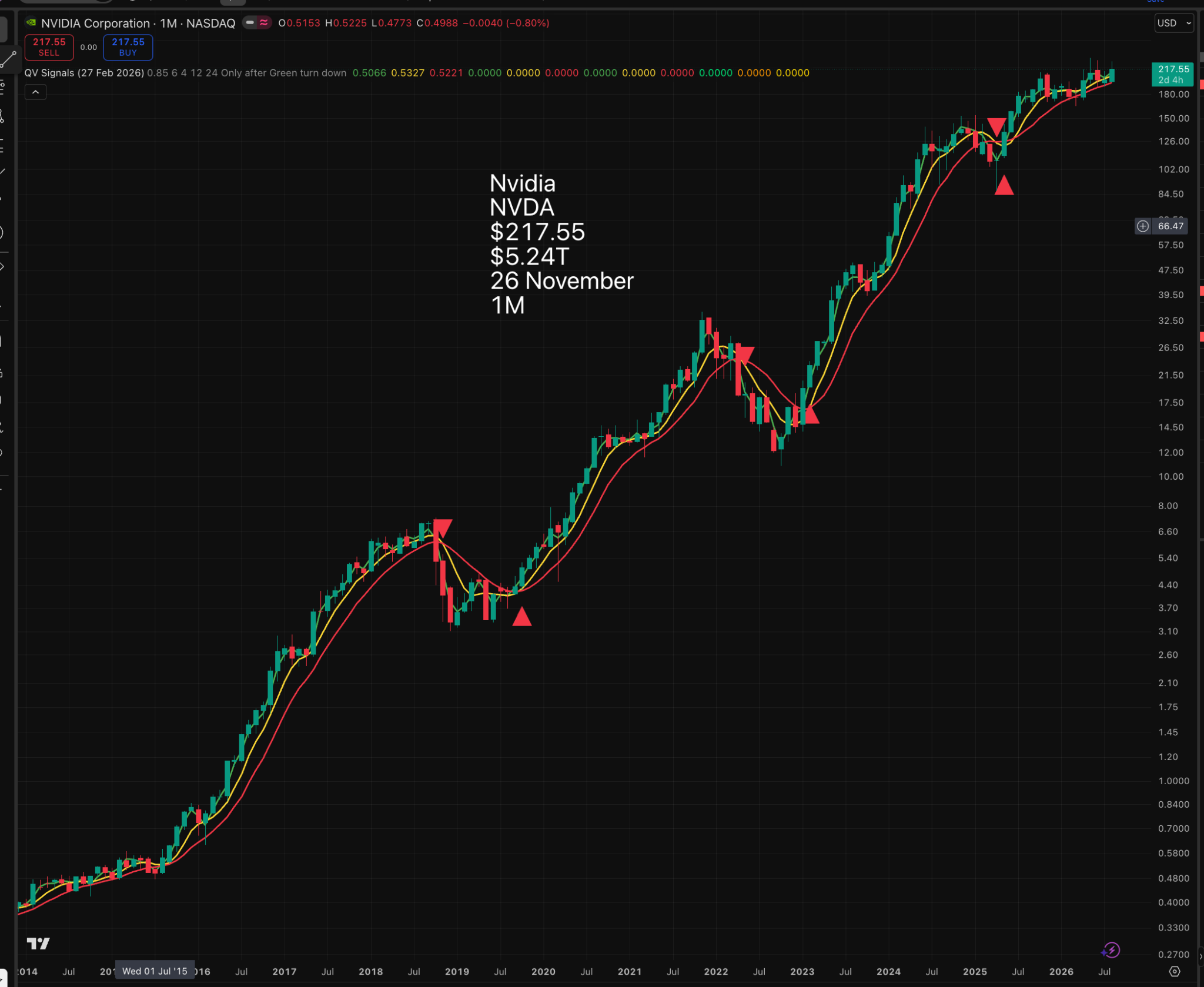
Nvidia and Palantir have to be candidates for the two most exciting companies in the world right now. Their products stand at the heart of the AI trade, which is a part of the greatest revolution in human technology since some long-distant ancestor learned to use and then control fire. They both have charismatic, opinionated, super optimistic CEOs, and they are growing at incredible speed against a background of insatiable demand.
Yet again, the latest results from Nvidia confirm what a staggering business this is.
Total revenue of $96 billion more than doubled year-over-year as growth accelerated for the fourth consecutive quarter. The surge in AI demand is driving a global infrastructure buildout, supported by an expanding and diverse set of growth opportunities, spanning hyperscalers, AI labs, AI natives, enterprises and sovereign customers. We expect to grow revenue by approximately 70% in fiscal 2028. This is a supply-constrained outlook.
In 1999, Nvidia’s revenue was $374m for the year. Now it is doing nearly $100bn in a quarter and growing faster than ever. It is a matter of time before Nvidia’s annual revenue hits $1 trillion. Despite this staggering performance, the shares are relatively becalmed, having gone nowhere much over the last year. Nothing rises in a straight line. It’s that simple. They will go higher; I don’t know when, but they will, probably much higher as new demand drivers become more visible.
Everything AI is scaling at incredible speed.
Global VC funding in AI, roughly 70% of which is spent on compute exceeded $400 billion in the first half of 2026, surpassing the $265 billion raised in all of 2025.
The world is trying to do something extremely ambitious: reinvent itself for AI. Not surprisingly, this is not easy to do, and there are bottlenecks along the way. Governments have no answer to this. Only the extraordinary capital allocation mechanism that is shareholder capitalism can even attempt to provide the answers.
Those looking for a lead from North Korea may have a long wait.
Has a company as gigantic as Nvidia ever had this to say about future demand?
It is the case that we’ve never forecasted or never guided to a year in advance. And even though our demand is much greater than 70%, our supply allows us to confidently deliver 70%. And we’re going to continue to work with our supply chain to increase on that. But what we wanted to do is to be consistent with everybody from our customers, our shareholders, our supply chain, everybody sees the same view. And the reason why that’s important is because everybody is putting a lot of resources at play. And so we wanted to make sure that everybody has the same set of information. And we’ve got a huge year coming up next year, and it’s going to be pretty extraordinary.
So that’s Nvidia. Now, what about Palantir?
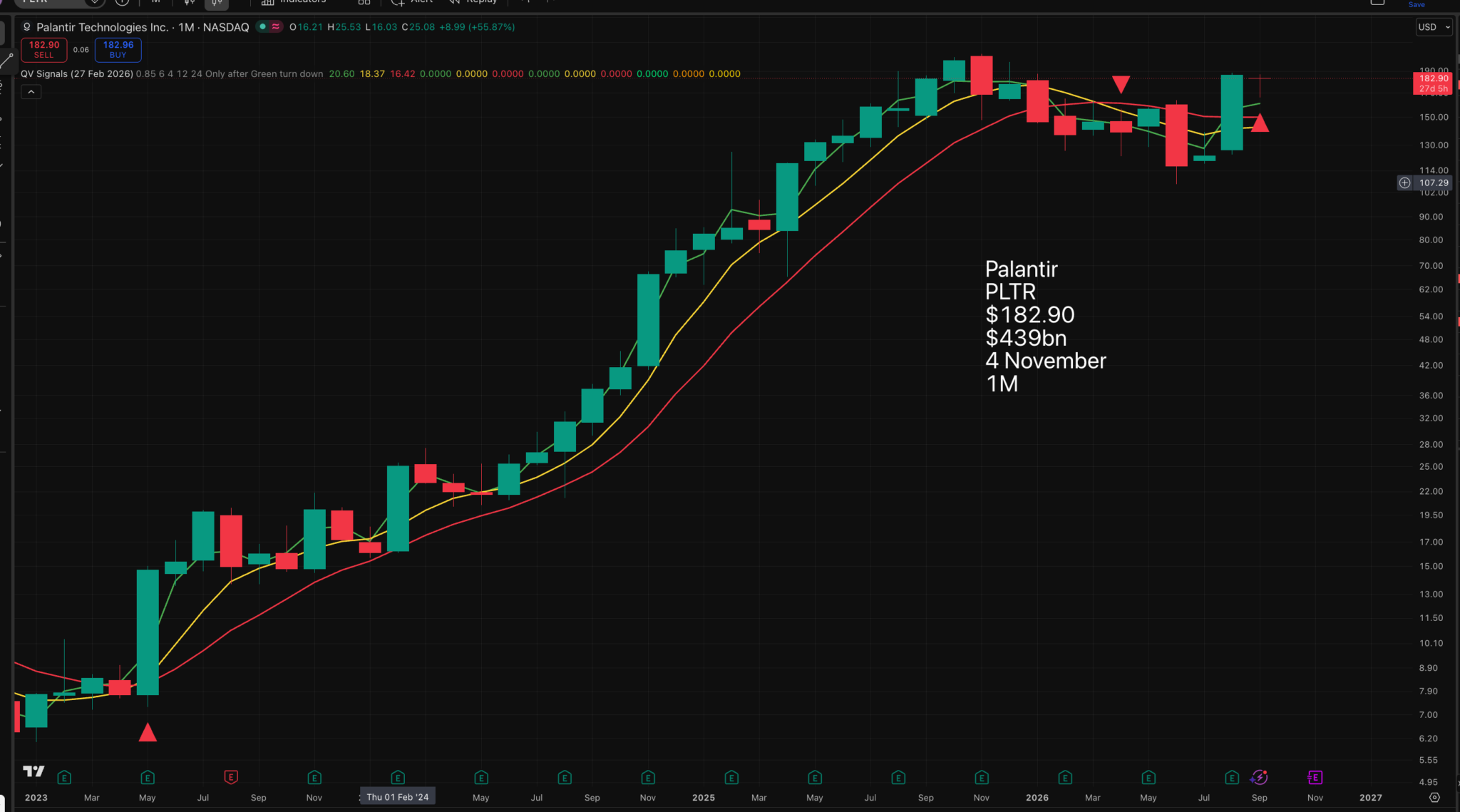
In itself, this chart is not decisively informative about where the shares will go next, although I would rather be holding them than not. The shares fell from the peaks, partly because of profit-taking after an incredible run, but also because of a worry that Palantir was a software company and AI was going to make software developers redundant. But it is not so easy to use AI to get the results you want, protect your data and achieve your goals. Palantir is a company dedicated to doing that, and it is growing at a sensational rate.
What we do have on the chart, which has appeared since I began writing this alert, is a new red triangle buy signal. This is only the second such signal in Palantir’s history as a quoted company. At the least, it is a good sign.
We have now generated more profit in a single quarter than we did in total revenue in the same period the year before.
Talk about insane. Does Zak Polanski ever ask himself what Palantir might be doing that is so important that it can achieve these astounding results, or does he, in his usual brain-dead way, just write them off as criminals and profiteers, while having only the vaguest notion about what they actually do and how it fits in with the greatest technology revolution in history?
I have a contempt for socialists because they think with their hearts, to give them the benefit of the doubt, and, as a result, never think at all. Scientists ask questions; fanatics jump to conclusions. God help us if a man like Polanski ever gets his hands anywhere near the levers of power in this country.
Europe has its knickers in a twist about Palantir, not so the USA, where business is booming.
We generated a record $1.6 billion in revenue for the second quarter in the United States, representing a 115% increase over the same period last year.
We generated a record $764 million in U.S. commercial revenue this quarter—a 149% year-over-year increase. Such an achievement would be cause for astonishment in any business; for one of our size, scale, and consequence, it is simply staggering.
While our U.S. commercial business is on fire, we believe it is nonetheless just nascent.
Share Recommendations
Nvida. NVDA
Palantir. PLTR
Strategy – Waiting For US Shares To Get A Second Wind
I have not been writing much in August, partly because of holidays but also because of the lack of direction in stock markets. Fundamentally, the AI trade looks as strong as ever, led by the amazing Nvidia, but share prices are all over the place with plenty of heavy profit-taking and struggling momentum.
Two shares at the heart of the AI trade which command attention are Nvidia and Palantir; both companies are delivering results which are both amazing, with growth accelerating. There is a technology explosion taking place in the world, and these two companies are at the heart of it.
I found this wonderfully pithy description of what Palantir does.
Thats one of its uses as a byproduct of its core purpose, which is to integrate, analyze, and help its users make sense of massive amounts of information, often times completely unrelated to each other. Its like in the movies when the detectives are trying to make sense of a case at 3am while plastering different evidence all over their wall. Imagine if you had a trusty sidekick that could take all that evidence and find a gap or a connection 100x faster than what you could do while sitting there staring at the wall. Thats Palantir.
Here is a similarly succinct analy sis of Nvidia’s advantage.
Nvidia had a huge head start on GPU computing and has never stopped.
There’s an interesting history to all of this.
A long time ago GPUs were used to process graphics. They took your 3D models and textures and did the calculations to project them to the screen. It was a fixed-function pipeline. You supplied the GPU with drawing commands and it did the drawing.
In 2001 Nvidia introduced the first GPU with programmable shaders. The graphics pipeline was no longer fixed, it was programmable. This is when we started to see more real-time lighting, shadows and particle effects.
There was a master’s student who tried to leverage this limited programmability to do scientific computing. Nvidia got word of this and hired him. Nvidia then made the bold move of making their GPUs completely programmable. They called it CUDA. This was a huge thing for high-performance computing and supercomputing. Some scientific codes had like a 50-100x speedup overnight.
In 2012 at the ImageNet competition, some guy used a neural network. Nobody used neural networks because they took too much computing power to train. But he trained it using Nvidia GPUs. Blew away the competition and proved that neural networks are viable.
Nvidia saw the potential and went all-in on AI. All the major AI software started to be built around Nvidia’s CUDA interface. And that has how it’s been for over a decade.
AMD, Intel have not been able to catch up. AMD is making some progress with their Instinct GPUs. A lot of the hyperscalers are using both Nvidia and AMD GPUs now.
Trying to catch Nvidia is like skiing with my children. They rocket off down the slope, wait for me, exhausted and panting to catch up, then rocket off again. Nvidia is at the heart of the greatest technology revolution in human history, like they had a patent on early man’s use of fire. Investors know this and have valued the business at over $5 trillion, which is a huge valuation for any business, no matter how wonderful. Even so, at some point in the future, even $5 trillion will look like a bargain.
Fire is strange because Homo erectus is thought to have used it, perhaps as long as 2m years ago, and because it let them eat cooked food; far less time and energy went into processing food, freeing up energy to power larger brains. So fire made humans smarter, but they had to be smart enough to think to use it. Where did that come from?
My theory, not just mine, is that when a drier climate led to shrinking forests in Africa, stronger chimps took over the forested territories, and the primates which became homo sapients had to try to survive in the open savannah, where they must have been horrendously vulnerable to predators and had to get smart fast to survive. How did those primates survive surrounded by hungry predators with sharp teeth that could run much faster than they could?
The AI answer references things that happened later, like bipedalism, living in large groups, using sharp tools and eventually using fire, but there must have been a terrifying period when these little guys were surrounded by predators, scared off by viciously territorial chimps in the jungles and hadn’t evolved all the characteristics that enabled them to survive later. Maybe there was such an abundance of game that predators didn’t need to eat primates and preferred the taste of venison. Maybe they stayed close to trees, and there was always somebody on lookout. I guess they evolved incredibly fast to learn to survive.
AI may be a bit like that, a huge change which is going to test humanity to the limits but maybe also offer breathtaking opportunities. There is still room for progress, though. The image illustrating this story is AI-generated, but AI clearly has no idea what these early men, women and children from a few hundred thousand years ago looked like because, to me, they look just like us.

Pick One Great Stock (From The AI Trade) And Buy The Buy Signals/ $-Cost Average

The Power Of The Cross – Time To Buy

Cryptos Waking Up