
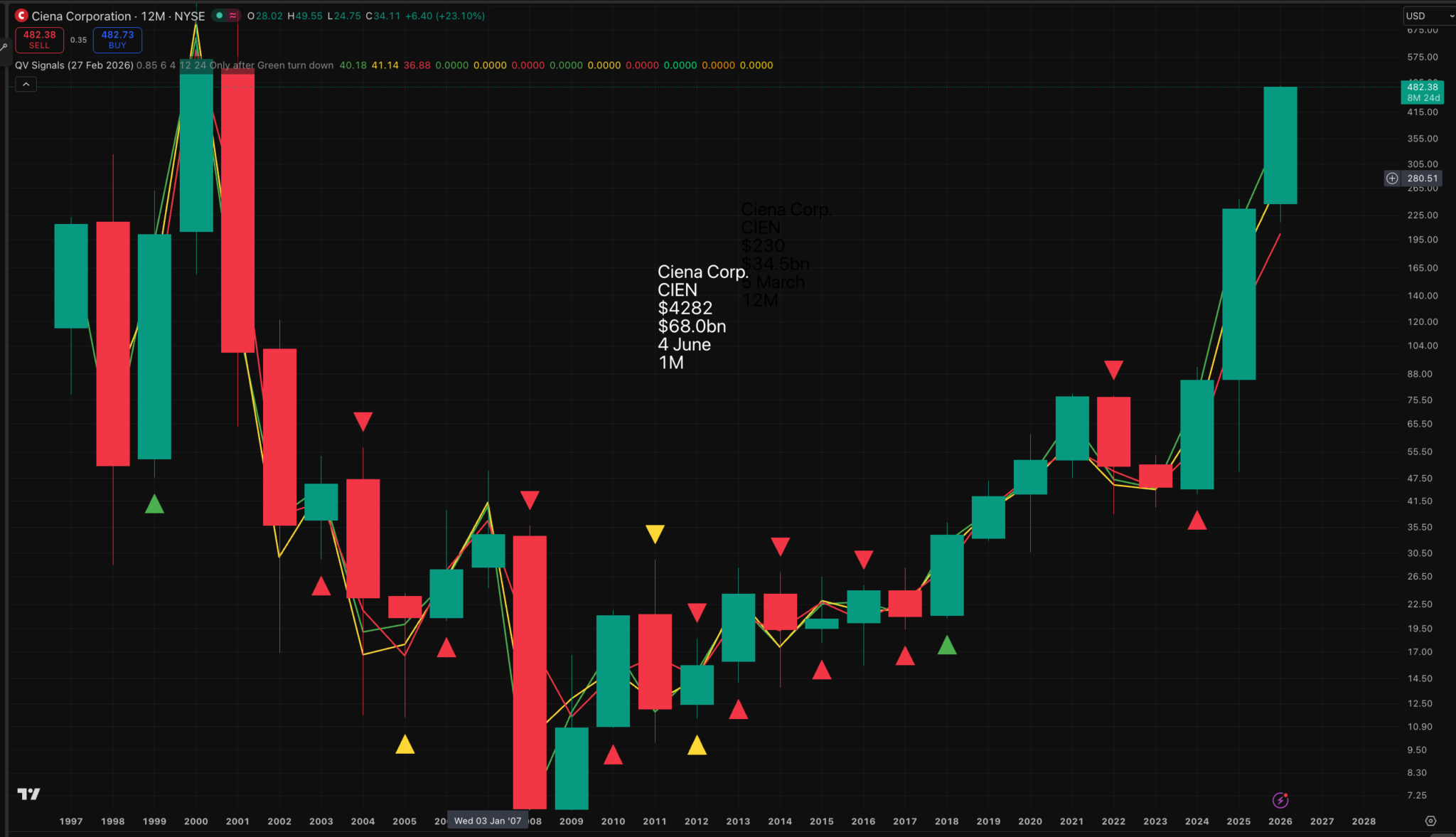
This is a massive chart breakout after over two decades of consolidation. It doesn’t take a rocket scientist to grasp that something is happening at Ciena Corporation – a massive ‘something new’.
With our recent inclusion in the S&P 500, we may have new listeners on the call, so allow me to begin with a brief summary of our business. At the highest level, Ciena Corporation is the global leader in high-speed connectivity. We build solutions that move enormous amounts of data across cities, data center campuses, countries, and oceans, quickly, reliably, and at massive scale. Through industry-leading optical systems and interconnect solutions along with automation software and services, we power the world’s most advanced networks, helping service providers, cloud companies, hyperscalers, governments, and enterprises meet explosive connectivity demands, especially in an increasingly AI-driven world.
Our foundational business has always been to address connectivity needs in the wide area network, or WAN, spanning subsea, long-haul, metro, and data center interconnect, or DCI. We remain the undisputed global leader in this domain. Today, much of this business is driven by the continued adoption of cloud services across our global customer base and the network infrastructure required to support it. It is also increasingly fueled by the rise of large-scale AI data centers that need to be interconnected with DCI solutions, linking data centers across campuses, regions, and continents.
Additionally, service providers around the world have begun reinvesting in their optical transport infrastructure alongside autonomous networking capabilities, both to support surging AI-driven traffic growth across their networks and to improve operating efficiencies. And service providers and cloud provider customers are increasingly working together to deliver connectivity through managed optical fiber networks, or MOFN, as they navigate regulatory requirements and capacity needs in the U.S. and in other new and emerging geographies around the world. By way of example, our orders in India were up 40% year over year, reflecting ongoing high demand specifically for MOFN in that country.
Together, we view these as structural multi-year demand drivers that reinforce the critical need to serve WAN-connected connectivity requirements, fueling both our growth and continued momentum. We expect revenue from the MOFN application will continue to be an important contributor to overall service provider growth going forward, and we are uniquely well positioned to further strengthen our leadership in high-speed WAN connectivity for service providers, cloud providers, and the growing group of neoscalers from whom we saw increased momentum in the quarter for both direct and MOFN-related design wins.
In parallel to this, we are focused on the significant expansion of our addressable market opportunities in and around the data center. It is now well understood that cloud providers are investing heavily in data centers to deliver on both the current and future promises of AI. In just the last few weeks, we have seen announcements from the four largest global hyperscalers that outlined a step-function increase in their 2026 CapEx to more than $600,000,000,000 in aggregate, driven by infrastructure needs related to AI training and inference workloads at massive scale.
The opportunity looks staggering.
I will start first to discuss the scale across, which is really an application supported in part by our interconnects portfolio, which is emerging as AI data centers grow in size and begin to hit power and space limitations. To overcome these constraints, customers are distributing compute across multiple sites and using high-speed performance optical networks to interconnect them, effectively creating one single AI training environment that operates across distance.
We believe that we are in the very early stages of this wave of opportunity, and we are already experiencing extraordinary demand, with three hyperscalers choosing to use our optical solutions for their training applications across distance, which we have talked to you about in recent quarters, and all three hyperscalers are significantly ramping, including additional orders for multiple additional from the first hyperscaler we announced in Q3 2025.
Let me summarize by emphasizing that demand in Q1 ’26 was unprecedented, reflected in very strong order intake and a meaningfully higher backlog. We executed well and demonstrated strong performance on both top and bottom lines. This exceptional demand was broad-based across service providers, hyperscalers, and an expanding set of neoscalers. Opportunity continues to build in waves, from our traditional and expanding WAN business to multiple applications in and around the data center. Furthermore, to monetize AI for both training and inference workloads, the latter of which represents another significant growth vector still in its infancy, the foundational requirement is again high-speed connectivity.
These dynamics, combined with our deep collaborative customer relationships that improve our long-term visibility plus our continued focus on execution, give us increased confidence for multi-years of strong growth and profitability ahead.
The ‘something new’ at Ciena Corp. is that, thanks to AI, their business is taking off. The chart supports the fundamentals in suggesting that the shares, too, are taking off. It is a reasonable hypothesis that this development is just beginning.
Strategy – Buy Ciena
I think Ciena is emerging as a very exciting share indeed at the heart of the technology infrastructure boom. This is an opinion, so I just threw it in there. The facts are an explosive chart pattern, accelerating growth, a dramatic story and a massive ‘something new’.
Palantir has reversed direction in an alarming fashion and is close to aborting the green buy signal. Short seller Michael Burry is arguing that Palantir’s enterprise software business is under threat from privately listed Anthropic’s cheaper software packages.
Anthropic announced Wednesday the launch of a new product that aims to make it easier for businesses to build and deploy AI agents. The tool, Claude Managed Agents, offers developers out-of-the-box infrastructure to build autonomous AI systems, simplifying a complex process that was previously a barrier to automating work tasks.
The move positions Anthropic to capitalize on its rapidly growing enterprise business. On Tuesday, the company said that its annualized recurring revenue has surpassed $30 billion, roughly three times higher than it was in December 2025. Both Anthropic and OpenAI, which also has an agent platform called Frontier, are racing to build out robust enterprise offerings as they prepare to go public as soon as this year.
The majority of Anthropic’s recent revenue growth has come from Claude Platform, an enterprise product that allows developers to tap into the company’s AI models through an API, according to Anthropic’s head of product for the Claude Platform, Angela Jiang. Developers have been using Anthropic’s API to deploy AI agents, such as Claude Code, in their workspace.
Jiang argues there’s a notable gap between what Anthropic’s models are capable of and what businesses are using them for. The new tool “enables any business to take the best-in-class infrastructure and deploy a fleet of Claude agents to do whatever work they need,” says Jiang.
Managed Agents will give developers an agent harness, which describes all of the software infrastructure that wraps around an AI model to help it work agentically, or take actions on behalf of a user. In practice, a harness is made up of software tools, a memory system, and other infrastructure. Agents made through Claude Managed Agent will also come with a built-in sandboxed environment, in which the agent can spin up software projects in a secure setting. The product also allows developers to create agents that can run autonomously for hours in the cloud, monitor what other Claude agents are doing, and toggle permissions that allow agents to access certain tools.
“When it comes to actually deploying and running agents at scale, that is a complex distributed-systems engineering problem,” says Katelyn Lesse, head of engineering for the Claude Platform. “A lot of customers we’re talking about previously had a whole bunch of engineers whose job it would have been to build and run those systems at scale. Now that we are giving them that bit out of the box, they’re able to have those same engineers be focused on the core competencies of their business and of their product.”
In a demo shared with WIRED, the AI productivity startup Notion showed how it’s using Managed Agents to power a client onboarding feature. Eric Liu, a Notion product manager, demoed how he could off-load a long list of tasks within Notion to a Claude Managed Agent, which was able to start ticking off client onboarding tasks one by one. The product in the demo runs in Notion, but Liu opened a dashboard on the Claude Platform and looked at how the agents were working and what tools they were using.
Wall Street investors have grown wary of software stocks in recent months as Anthropic has released a wide range of enterprise offerings, which some believe could make traditional software-as-a-service companies obsolete. Whether that threat materializes or not, Managed Agents makes clear that Anthropic still has significant ground to cover before most enterprises are fully running on Claude.
There is speculation that Anthrpoic’s revenue could reach $100bn this year.
Anthropic PBC is an American artificial intelligence (AI) company headquartered in San Francisco. It has developed a range of large language models (LLMs) named Claude.
Anthropic was founded in 2021 by former members of OpenAI, including siblings Daniela Amodei and Dario Amodei, who are president and CEO, respectively.[7] As of February 2026, Anthropic has an estimated value of $380 billion.[8] Anthropic focuses on AI safety.[9]
Anthropic may be the fastest-growing company in the history of the planet and is a massive threat to anyone engaged in similar lines of activity, which includes Palantir. If Anthropic IPOs this year, the interest will be off the scale.