
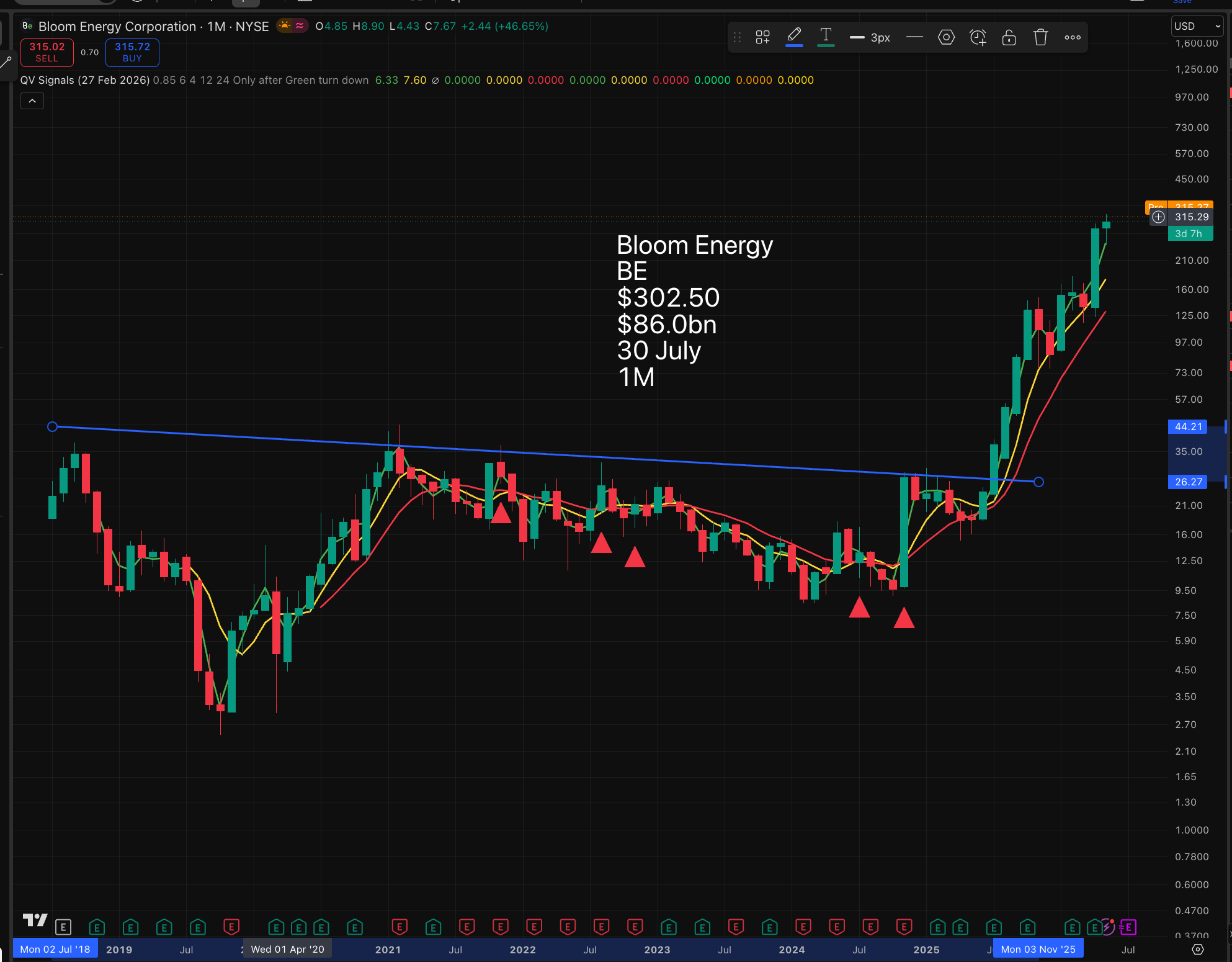
What does Bloom Energy do?
Bloom Energy (BE) is a Silicon Valley-based power tech company that designs, manufactures, and installs solid oxide fuel cell systems for onsite electricity generation. Its Energy Servers convert fuels such as natural gas, biogas, hydrogen, or blends of those fuels into electricity through an electrochemical process rather than combustion. The company serves data centers, semiconductor manufacturing, large utilities, and industrial facilities, among others. According to Bloom’s Q1 2026 earnings release, the company manufactures its systems in the US and employs more than 2,000 people worldwide.
This enthusiastic analyst sees Bloom Energy shares reaching $550.
I am rating Bloom Energy a Strong Buy with a price target of $550 because the company is now sitting at the intersection of three powerful forces. These forces are AI data center demand, grid constraints, and improving economics. BE is transiting from a clean energy story into an AI infrastructure earnings story. That differentiation matters because a clean energy story usually depends on policy, subsidies, and investor patience. On the other hand, an AI infrastructure earnings story depends on customers needing power now, paying for speed, and scaling deployments because compute capacity is useless without electricity. BE is now sitting inside that bottleneck. I say this because, for instance, in Q1 2026, revenue grew by 130.4% y/y to $751.1Mn, while adjusted EBITDA increased almost 6x to $143Mn. On the other hand, non-GAAP EPS increased to $0.44 from $0.03 last year. To me, this is a sign that operating leverage is showing up in the numbers.
The reason I am comfortable rating BE a Strong Buy, even with the stock already trading at a premium, is that the company now has three things working at the same time. First, AI data centers are creating power shortages that utilities alone cannot solve quickly enough. Secondly, Oracle (ORCL) has validated Bloom’s model by expanding its agreement to procure up to 2.8 GW of fuel cell systems, with 1.2 GW contracted and deployment underway. Thirdly, BE’s own financial guidance shows the margin profile improving as revenue scales. I say this because management is guiding for 2026 revenue of $3.4Bn to $3.8Bn, non-GAAP gross margin of about 34%, and non-GAAP EPS of $1.85 to $2.25. My interpretation is that Bloom is not just growing revenues but also converting revenue into earnings power.
The incredible data centre infrastructure boom is creating bottlenecks all over the place.
Data centers cannot delay power the way a software company can delay a product feature. If power is unavailable, the project does not scale. That gives Bloom a strong negotiating position when customers need onsite power faster than the grid can deliver it.
Bloom is an unusual company.
How we think about and execute on capacity addition is one of the clearest ways to see what makes Bloom different. The traditional power industry has been the past 2 years, celebrating its backlog that is 4 and 5 years out.
Backlog at that scale and time frame in the age of AI is a result of their constrained supply. At Bloom, we see it differently. Our ability to expand capacity is our competitive advantage. We want to rapidly build capacity, build product help build productive AI factories to help build commercial and industrial facilities and help build our economy, not just be satisfied with simply building backlog. Our current manufacturing footprint will allow us to deliver 5 gigawatts of product annually. We will expand to that capacity and meet the delivery dates needed by our customers. In other words, today, we are not order constrained and not capacity constrained.
The pace of our revenue growth is decided by how fast our customers can build their greenfield sites, not how fast we can power them. We will never be a bottleneck to our customers. We built our business around that promise. Going beyond the 5 gigawatt capacity, our supply chain and manufacturing strategy and planning allows us to build that capacity significantly faster than any other option in the market using our copy exact model. We will strive to bring power to our customers faster than they can stand up their greenfield facilities. We were able to make that promise because we invested deliberately ahead of demand.
Unlike a traditional power plant, our platform is also a different kind of neighbor in a community. We are community friendly. As more on-site generation gets deployed to support AI and industrial growth, communities care deeply about what kind of infrastructure shows up next door. Bloom preserves local air quality, we do not combust and pollute the air like conventional technologies. We use minimal water edge startup and none during normal operations. we acquired compact and efficient with land use. We integrate well with environments rather than disrupt them and become an ISR. As permits and permissions become the gating factor for AI infrastructure, community acceptance matters increasingly.
Our fully landed grid-independent one-stop full stack power solution does not raise the monthly electricity bill for community residents and brings them economic development without compromises. The cost equation has also shifted in our favor. We have spent years driving down product cost while improving performance. That work is meeting the market at exactly the right time. our energy servers are now cost competitive with grid power in most U.S. markets and with off-grid alternatives in nearly all markets. With over a decade of double-digit cost reductions, we remain the only on-site generation solution with a sustained downward sloping cost curve.
Finally, to the Bloom team, thank you. What you’ve built over more than 2 decades is meeting the market at exactly the right moment. You believed and always knew that an inflection point would come.
This is exciting stuff, so what, I expect you are wondering, does Bloom Energy do exactly?
Bloom Energy manufactures highly efficient solid oxide fuel cells (SOFCs) that generate electricity on-site without combustion. By using an electrochemical process, their systems convert fuels like natural gas, biogas, or hydrogen into constant, resilient power.
Their primary technology and services include:
- Bloom Energy Servers: These modular, on-site power generators are used by large-scale commercial and industrial sectors. Because they bypass the traditional power grid, they provide uninterrupted, 24/7 baseload power highly valued by data centers, hospitals, and manufacturing plants.
- Electrolyzers: Bloom also builds high-temperature solid oxide electrolyzers. These machines use electricity and water to produce clean, carbon-free green hydrogen.
- Combined Heat and Power (CHP): Their systems can be configured to capture the heat byproduct from electricity generation, maximizing overall energy efficiency.
- Microgrids & Carbon Capture: They are designed to integrate alongside renewable sources (like solar and wind) to support microgrids and can be adapted to capture carbon emissions.
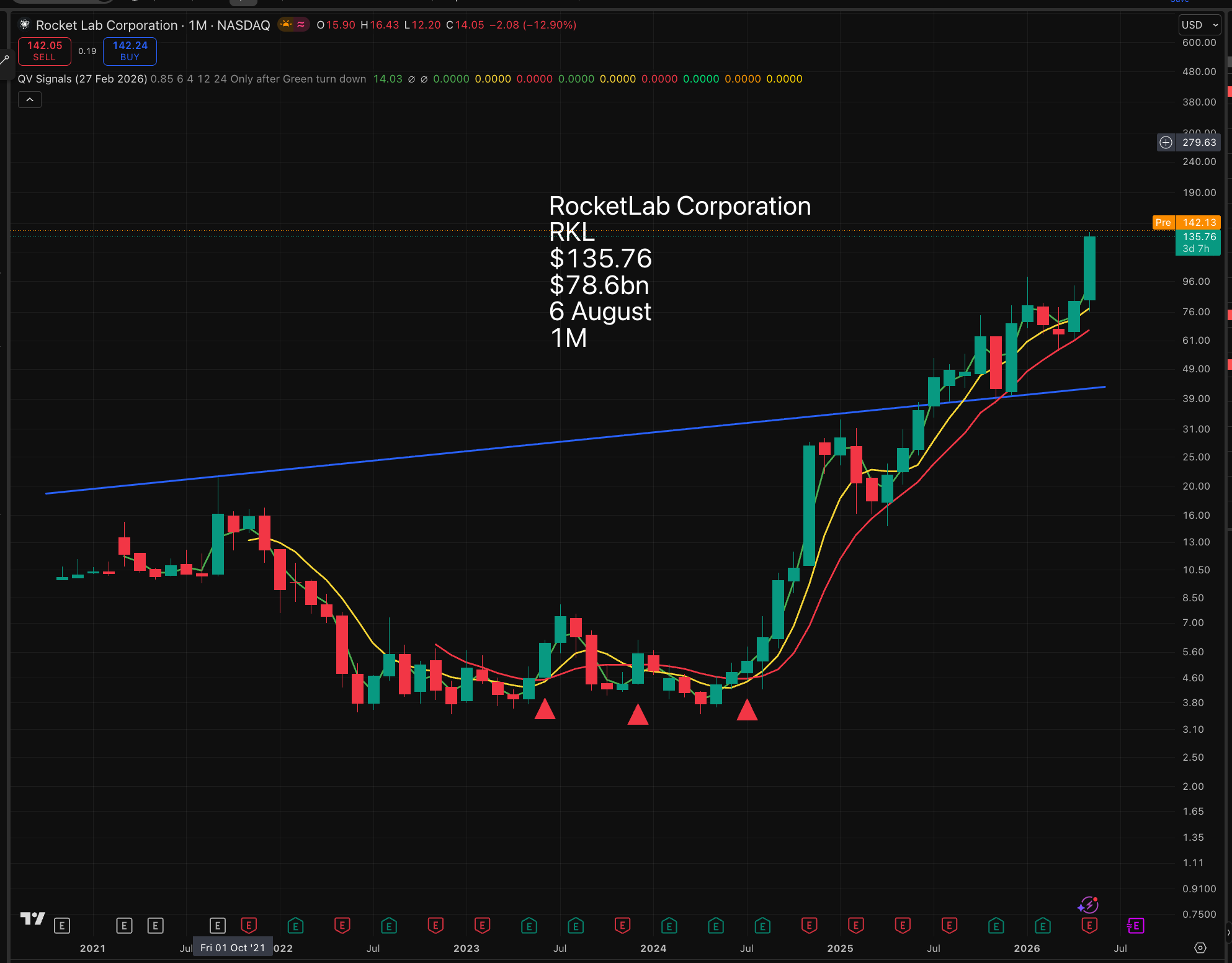
They didn’t have companies like this when I was young, and a packet of 20 cigarettes cost 15p.
Founded in 2006, Rocket Lab is an end-to-end space company with an established track record of mission success. We deliver reliable launch services, satellite manufacture, spacecraft components, and on-orbit management solutions that make it faster, easier, and more affordable to access space. Headquartered in Long Beach, California, Rocket Lab designs and manufactures the Electron small orbital launch vehicle, a family of flight-proven spacecraft, and the Company is developing the large Neutron launch vehicle for constellation deployment. Since its first orbital launch in January 2018, Rocket Lab’s Electron launch vehicle has become the second most frequently launched U.S. rocket annually and has delivered more than 200 satellites to orbit for private and public sector organizations, enabling operations in national security, scientific research, space debris mitigation, Earth observation, climate monitoring, and communications. Rocket Lab’s spacecraft have been selected to support NASA missions to the Moon and Mars, as well as the first private commercial mission to Venus. Rocket Lab has three launch pads at two launch sites, including two launch pads at a private orbital launch site located in New Zealand and a third launch pad in Virginia.
Below is an example of the kind of stuff RKLB is doing.
MAHIA, New Zealand, May 22, 2026 (GLOBE NEWSWIRE) — Rocket Lab Corporation (Nasdaq: RKLB), a global leader in launch services and space systems, today announced the successful deployment of the latest satellite for Synspective, marking the ninth dedicated mission Rocket Lab has completed for the Japan-based Earth observation constellation. This launch further strengthens one of the most consistent commercial launch partnerships in the small satellite sector and highlights Electron’s industry-leading dedicated launch service.
The “Viva La StriX” mission launched on Electron from Launch Complex 1 in New Zealand at 9:33 p.m. NZST on May 22, 2026 to a 572km low Earth orbit. Rocket Lab’s deployment of the ninth StriX satellite expands Synspective’s synthetic aperture radar (SAR) constellation delivering high-resolution Earth observation data globally. As part of its dedicated launch service, Rocket Lab also supplied Synspective with a custom Electron rocket fairing for the launch that was tailored to the StriX satellite’s dimensions. The customisation is a unique feature of Rocket Lab and Synspective’s partnership that helps to ensure Electron’s ongoing 100% mission success rate for StriX satellite deployments.
Today’s mission brings Rocket Lab’s total launch count to 88 and reinforces Electron as the premier small launch provider globally. With another 18 launches for Synspective booked on Electron, Rocket Lab remains the company’s sole launch provider and trusted partner in enabling rapid, repeatable access to space.
Like Space X, rumoured to be heading for the stock market on a valuation of $1.5 trillion-plus, RocketLab is a hard company to value since it so clearly has an exciting future. I have a hunch that investors are going to become very excited about space exploration stocks – the ultimate frontier happening on the stock market.
It is not really about revenue and profits but about the rate at which the business is moving.
For launch, we have Electron, the world’s leading small launcher, alongside HASTE, which is delivering critical hypersonic test launch capability to the Department of Defense, and Neutron, a medium-lift rocket tailored to constellation deployment and national security missions. But launch was just the start. In 2020, we launched Photon, our first in-house developed spacecraft.
That moment marked the beginning of our evolution from a pure-play launch provider to an end-to-end space company. In just six short years, we expanded our technology stack to include a full family of highly capable spacecraft available at constellation scale. Critically, we also manufacture the subsystems and payloads that go into these spacecraft. This vertical integration means we control quality, schedule, and cost in ways that our competitors simply cannot. These technologies have given us a huge suite of capabilities. We provide tactically responsive space launch and dedicated small satellite launch with unmatched flight heritage; suborbital hypersonic and missile defense testing for our defense customers; and national security launch on both Neutron and Electron.
Our rockets also deploy and replenish constellations, launch lunar and planetary missions, and more. On space systems, our satellite and subsystems enable communication and content connectivity infrastructure; missile warning and tracking; space reconnaissance and surveillance; space protection and space control; astrophysics and earth science missions; space manufacturing; and more. Execution is what matters most. Anyone can promise capabilities, but Rocket Lab USA, Inc. is actually delivering right now for demanding and complex programs. We are enabling SDA’s proliferated Warfighter Space Architecture, delivering satellites with payloads on aggressive timelines. We are supporting the Department of Defense’s MaRV TB hypersonic program and the Golden Dome space-based interceptor program.
We are onboarded as a National Security Space Launch provider, and we are executing missions for the NRO, Space Force, Missile Defense Agency, DIU, and DARPA. We are a trusted partner for the U.S. and international space agencies, including NASA, JAXA, and ESA. Rocket Lab USA, Inc. hardware is flying on Artemis missions. Our technology is on Mars rovers and orbiters. We support ISS resupply and other flagship NASA missions. Commercially, we are supporting direct-to-device constellations, earth observation constellations, lunar landers, orbiters, and reentry missions. This is execution. Real missions are on orbit now or in production and generating. When the world’s most sophisticated space organizations need mission success, they choose Rocket Lab USA, Inc.
To coin a phrase from Star Trek, this company is playing in a game of big numbers, sales and earnings could move higher at warp speed and are likely to be valued highly by investors. If SpaceX were a grocery business, it would not be valued in the trillions. It is the combination of space and Elon Musk that delivers that incredible valuation.
The pace at which we rolled out new products this year has been relentless, whether it has been organic or inorganic. What unifies our acquisitions and our internal innovations is a powerful vision: complete vertical integration across the entire satellite value chain. Everything you see on this page—optics, solar, laser terminals, propulsion, and other components—is already being built into our own platforms or being supplied to others. That means a good chunk of upcoming missions across civil, commercial, and national security have a Rocket Lab USA, Inc. logo on them somewhere. We are the supplier of choice across the industry, and other prime contractors turn to us for mission-critical technology.
Share Recommendations
Bloom Energy BE
RocketLab Corporation RKLB
Strategy – Aim For The Stars
Value investors will run a mile, but both these companies tick all the boxes for excitement, and there will be a flood of news flow from both companies, contracts, deals, acquisitions, breakthroughs – it is all happening for these guys, which makes them the perfect rides for bolder investors. Volatility is guaranteed. Try to turn it into a positive by using sharp dips to buy.

Pick One Great Stock (From The AI Trade) And Buy The Buy Signals/ $-Cost Average

The Power Of The Cross – Time To Buy

Cryptos Waking Up