
The innovation engine is alive and well across the whole industry, which is how are we going to satisfy the demands for the storage of AI. Models get bigger, more tokens get generated, caches get bigger. This is naturally a thing where you start to think about NAND, and its tremendous scaling properties. You’re right, there’s a lot of innovation there. There’s the high IOPS (individual operations per second) enterprise SSD, (solid state drives) which of course is something you could imagine we’re working on. We had our own ideas about this. Two years ago, and we talked about it at our Investor Day that we believe there was a chance to re-architect NAND to bring it into AI. We trademarked that high bandwidth flash.
I think over the last year, that’s become a more recognized path forward. And there’s now lots of folks working on that. We continue to work on it, by the way. We’re very happy with the progress. We’re deep in conversations with customers on use cases. We’re designing the NAND die. We’re building the controller so that continues to go forward. Obviously, we’ll have more to say about it. As we go forward and plans firm up. I think all of this is just an example of the tremendous opportunity for innovation as the AI architecture continues to scale.
It’s incredibly exciting that we are just in the very early innings of driving this technology and scaling it around the globe. The technology industry writ large is incredibly well-positioned to do that. Some of the largest, most capable technology companies in history are obviously putting an enormous amount of resources into how they drive this technology and scale it around the world at a very rapid pace. I think that is incredibly exciting. I think this is going to go on. I think we’re super early in this, and I think this is going to go on for a very long time.
SanDisk is not an overnight wonder.
NAND is now recognized as indispensable to the world’s storage needs, driving a foundational shift in how commercial relationships between suppliers and customers are structured.
Supply certainty, longer planning horizons, and multiyear commitments are increasingly essential to support structural demand that extends beyond the traditional cyclical model of our market. As a result, we are engaged in discussions with customers to evolve from quarterly negotiations toward multiyear agreements with firmer commitments on supply and pricing, enabling better planning practices and more attractive returns. These changes would better align our planning cycles with customers’ demand profiles to our mutual benefit. Accordingly, our supply plans will continue to be designed around predictable, long-term demand at current and forecasted market prices. These dynamics reveal the true value of our NAND technology and reinforce the need for continued innovation and disciplined execution.
Our products are enabled by decades of sustained investment in R&D and innovation across NAND and system solutions, supported by substantial capital investments in world-class front-end and back-end manufacturing. As a result, we believe NAND is becoming a more durable, structurally attractive industry with higher average returns.
SanDisk is delivering accelerating growth. This is exciting, but the real bonus for long-term investors is what might be happening several years from now, and that depends on innovation. This, incidentally, is what makes technology companies such exciting investments because they are all about innovation.
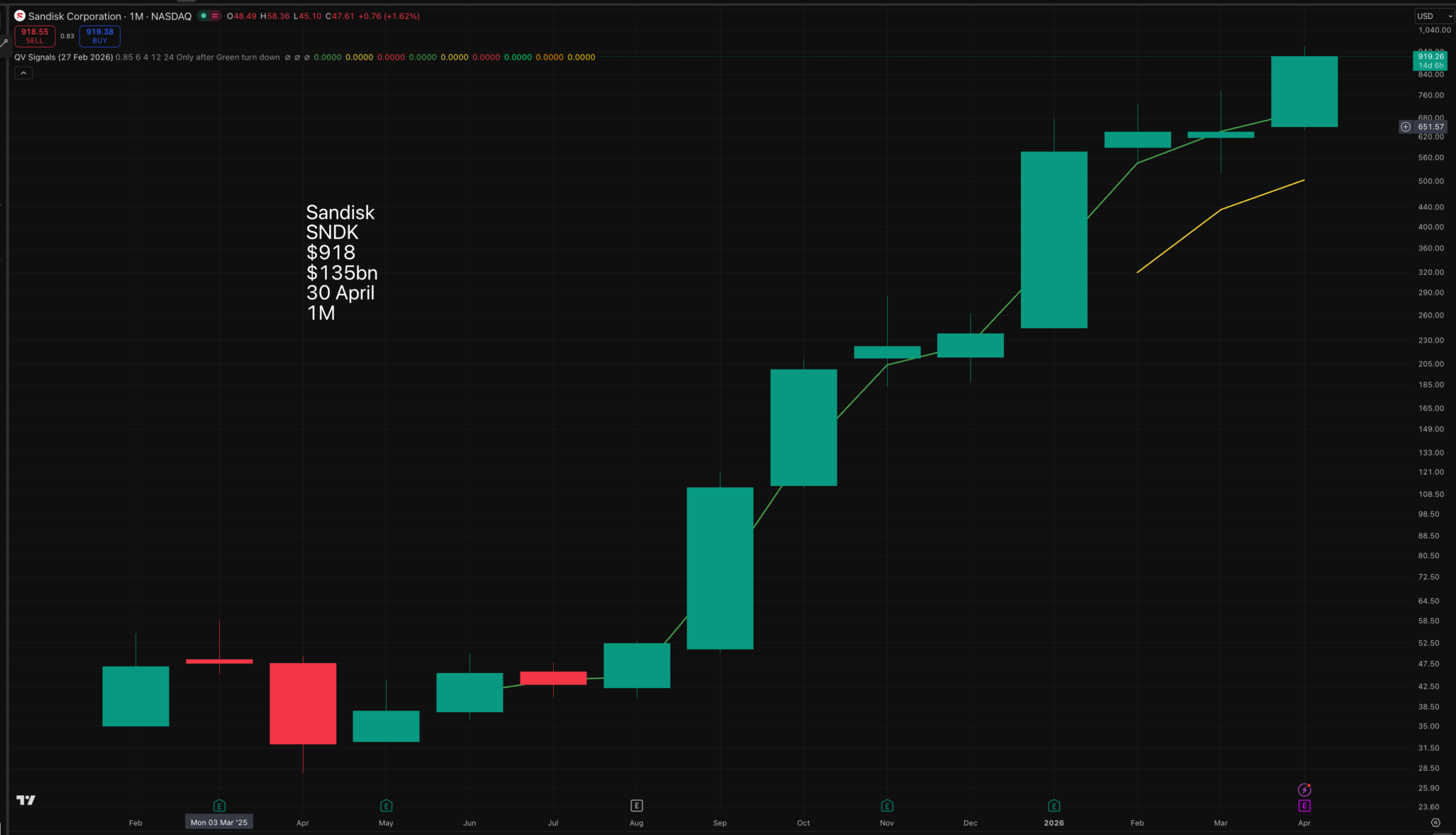
I like this chart. It is explosive, and it is backed by explosive fundamentals. AI is transforming the NAND industry. Let’s remind ourselves – what is NAND?
NAND (Negative-AND) is a type of non-volatile flash memory technology that retains data without power, commonly used in USB drives, SSDs, smartphones, and memory cards. It acts as high-density, durable storage, storing data in vertical or planar grids of floating-gate transistors that trap electrons, allowing for fast read/write speeds.
Key Characteristics and Types
- Non-volatile: Retains information even when the device is turned off.
- Structure: Cells are stacked vertically (3D NAND) or arranged horizontally (2D/Planar NAND) to maximize capacity.
- Lifespan: NAND cells eventually wear out after a finite number of write/erase cycles.
- Types: Classified by bits per cell, affecting speed and endurance: Single-Level Cell (SLC), Multi-Level Cell (MLC), Triple-Level Cell (TLC), and Quad-Level Cell (QLC).
- Logic Gate: In electronics, a NAND gate is a basic logic gate that produces a false output only if all its inputs are true.
Common Applications
NAND is the standard storage for modern portable electronics, including:
- Solid-state drives (SSDs) in laptops and data centers.
- Smartphones, tablets, and digital cameras.
- USB flash drives and memory cards (SD cards).
Advantages
- High Density/Capacity: High storage in a small physical space.
- Durability: No moving parts, making it resistant to shock.
- Performance: Fast data access and transfer speeds.
Disadvantages
- Limited Endurance: Cells degrade over time, limiting the drive’s life.
- Block-based Writing: Data must be erased in blocks before new data can be written.
Major manufacturers of NAND flash include Samsung Electronics, Kioxia, Western Digital, Micron Technology, and SK Hynix.
Note that SanDisk does not even merit a mention on this list, perhaps because, until recently, it was part of Western Digital. I have just listened to the CEO of SanDisk, David Goeckeler, talk about changes in the NAND industry, how SanDisk’s business model is evolving from quarterly auctions to long-term supply contracts, the impact of AI, and the technological innovations the company is making.
What he was saying was way above my pay grade, but there is no doubt that he is excited and that his company is in the throes of a transformation against the background of demand being overwhelmed by supply. The same forces that have sent Nvidia shares through the roof.
Below is another take on what is happening at SanDisk.
SanDisk Corporation SNDK has delivered truly remarkable market performance in 2026, cementing its status as a semiconductor sector powerhouse. SanDisk’s stock price has surged, propelled by a tidal wave of demand for its essential memory products that fuel the artificial intelligence (AI) revolution.
Now, a pivotal and mechanically precise event is on the horizon that has captured the attention of market participants worldwide. On April 20, 2026, SanDisk will officially join the giants of the prestigious Nasdaq-100 index, replacing Atlassian Corporation TEAM. This promotion into one of the world’s most-watched equity indexes is far more than a symbolic honor; it is a market-moving event that sets in motion a predictable and significant series of financial transactions.
How a Rule-Based Trade Triggers a Buying Frenzy
The inclusion of a company in a major index like the Nasdaq-100 triggers a powerful, well-documented phenomenon known as the index effect. This process is not driven by the strict rules of passive investing.
A colossal amount of capital, over $600 billion in assets, is held in investment vehicles designed to perfectly replicate the performance of the Nasdaq-100. The largest and most famous of these is the Invesco QQQ Trust QQQ, but it is joined by hundreds of other ETFs and mutual funds that are all bound by the same mandate: to own the stocks in the index in their precise weightings.
This strict mandate creates a period of intense, non-discretionary buying. When SanDisk officially joins the index, every tracking fund in the index is required to purchase its shares. This is not an optional trade or a suggestion; it is a mechanical obligation that must be fulfilled to maintain compliance and accurately track the index.
Given SanDisk’s formidable market capitalization of over $140 billion, its entry will necessitate a capital inflow estimated at multi-billion-dollar levels. The execution of these massive orders falls to institutional trading desks, which must acquire enormous blocks of shares in a relatively short timeframe, often leading to a surge in trading activity. To put this into perspective, SanDisk’s average daily trading volume is about 17.5 million shares, and since the announcement, the average has risen to over 19 million shares per day.
Adding Rocket Fuel to an Already Blazing Stock
SanDisk’s promotion to the Nasdaq-100 is not happening in isolation. This technical tailwind is converging with a stock that is already demonstrating incredible momentum. Over the past 30 days alone, SanDisk’s shares have climbed over 40%, contributing to a nearly 300% year-to-date return that has left the broader market indices far behind.
This performance is firmly anchored in a solid fundamental narrative: the AI memory supercycle. The explosive growth of artificial intelligence, from large language models to complex enterprise software, requires a massive expansion of data center infrastructure. At the heart of these data centers are high-performance NAND flash storage chips, SanDisk’s core product. SanDisk is therefore a primary beneficiary of this once-in-a-generation technological shift, providing a solid business foundation for its stock price to rise.
This potent combination of technical strength and fundamental demand has not gone unnoticed by Wall Street.
A recent flurry of analyst upgrades signals that institutional sentiment is growing increasingly bullish as the financial community recognizes the durability of this growth story.
- Evercore recently initiated coverage with a bullish $1,200 price target.
- Mizuho saw the mounting potential and boosted its price target to $1,000.
- Citigroup followed suit, raising its own target to $980.
This trend of upward revisions shows analysts are recalibrating their models to account for SanDisk’s commanding position in a growing market, lending further credibility to its current valuation.
Life After a Promotion: What History Suggests Happens Next
For investors observing this event, the critical window is the period leading up to the April 20 effective date. Historically, the bulk of rebalancing trades and the largest volume spikes occur in the final hours of the trading session immediately preceding a stock’s official inclusion. This places the market close on Friday, April 19, squarely in the spotlight as a key period to monitor for heightened activity.
Once the index rebalancing is complete and the wave of forced buying has crested, the market’s attention will pivot. The stock’s performance will no longer be influenced by this specific technical driver and will instead become more closely tethered to company-specific news, industry trends, and macroeconomic factors. While the inclusion provides a strong vote of confidence, historical patterns suggest that some stocks experience a brief consolidation period after the event as the market digests the run-up.
Looking ahead, the next major catalyst on the docket is SanDisk’s fiscal third-quarter earnings report, scheduled for April 30. This will be a crucial moment, as it will offer the first comprehensive view of SanDisk’s financial health since its price appreciation. Investors will be focused on key metrics such as revenue growth, gross margin trends, and, most importantly, management’s forward guidance for the upcoming quarter. This report will be instrumental in determining whether SanDisk’s operational performance can justify its new, higher valuation.
Where Technicals and Fundamentals Collide
SanDisk’s elevation into the Nasdaq-100 is more than just a milestone; it is an important technical event creating a predictable and substantial demand for its shares. This rebalancing serves as a powerful near-term tailwind, complementing SanDisk’s solid fundamentals, glowing analyst sentiment, and undeniable market momentum. For investors, this represents a rare and compelling confluence of catalysts, solidifying SanDisk’s position as a formidable leader in the new era of technology.
My conclusion, which is an opinion, so take it with a pinch of salt, is that SanDisk is emerging as a key player in the AI infrastructure boom and a major technology business.
Share Recommendations
SanDisk. SNDK
Strategy – Accumulate A Holding In SanDisk
I am writing frequently about SanDisk because I believe it is an emerging superstock, which will capture the imagination of investors in a big way. What happens to me is that when I find a new killer stock, like SanDisk, I fall in love. Well, I am in love xxxxx – big time.
The whole memory storage industry is booming, but I suspect SanDisk is the hottest play in a hot sector. In the short time I have been observing SanDisk I have noticed that the shares are prone to dramatic daily plunges. They recently fell by almost $100 in two days. These drops can be used to buy the shares.

MegaCaps Place Huge Bets On AI

Stuck In A Rut

Pick One Great Stock (From The AI Trade) And Buy The Buy Signals/ $-Cost Average