
Charts Say The AI Trade Is Dead But The Fundamentals, Oh, The Fundamentals
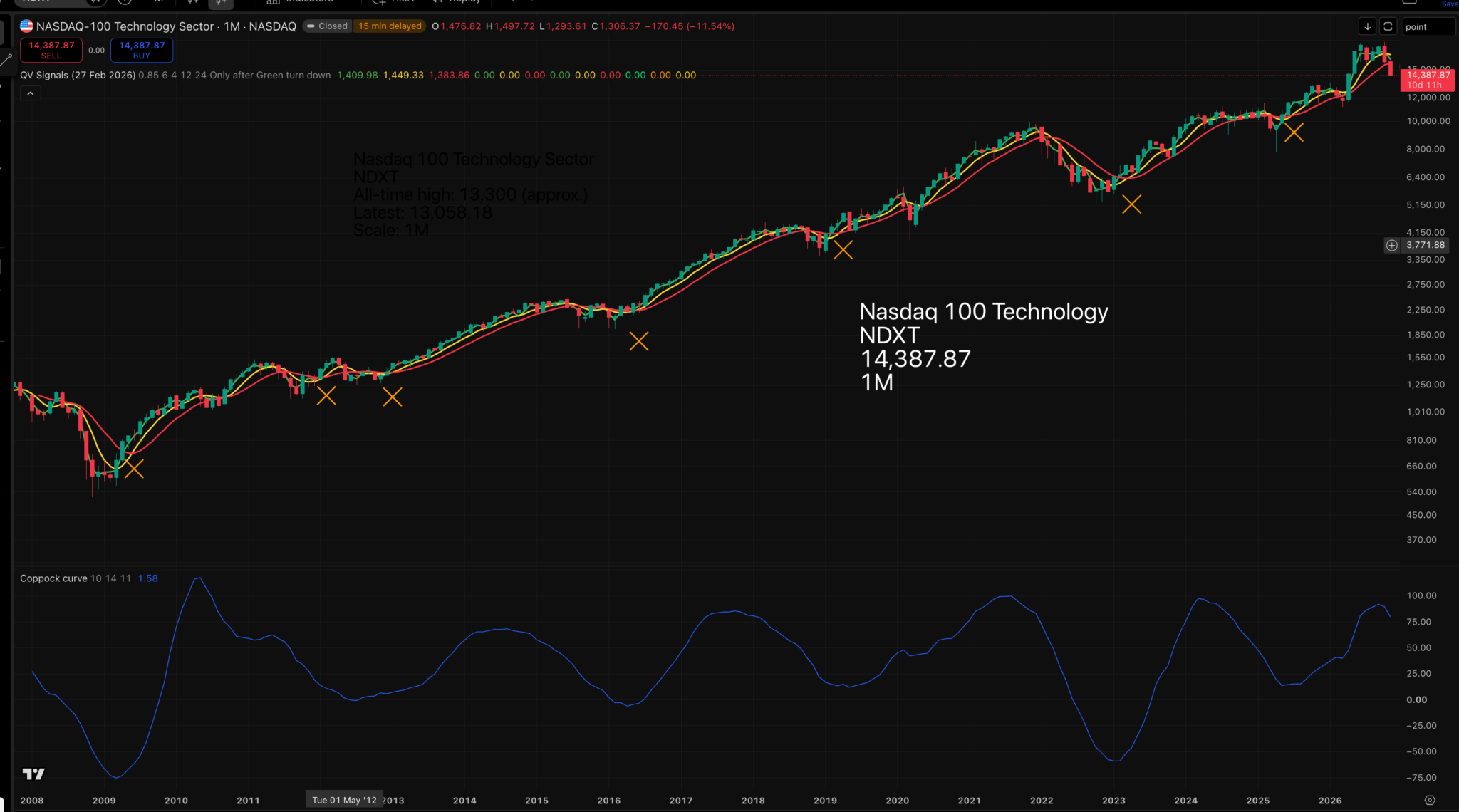
I have commented a number of times in recent alerts on the disconnect between the message from the charts and the message from the fundamentals. Nvidia is growing faster than ever so what are the shares doing – plummeting. It is as though somebody stuck a pin in the AI trade and balloons are bursting everywhere. It makes you wonder. Is any one ever going to look at fundamentals again? The charts are a different story. They have proved useful. In this time of stress I am revisiting Coppock which subscribers may remember has an almost infallible record predicting when bear markets end and new bull markets begin. The trick is to turn bullish when Coppock turns higher after falling into negative territory. It doesn’t have to turn positive, just become less negative and that is the signal to buy.
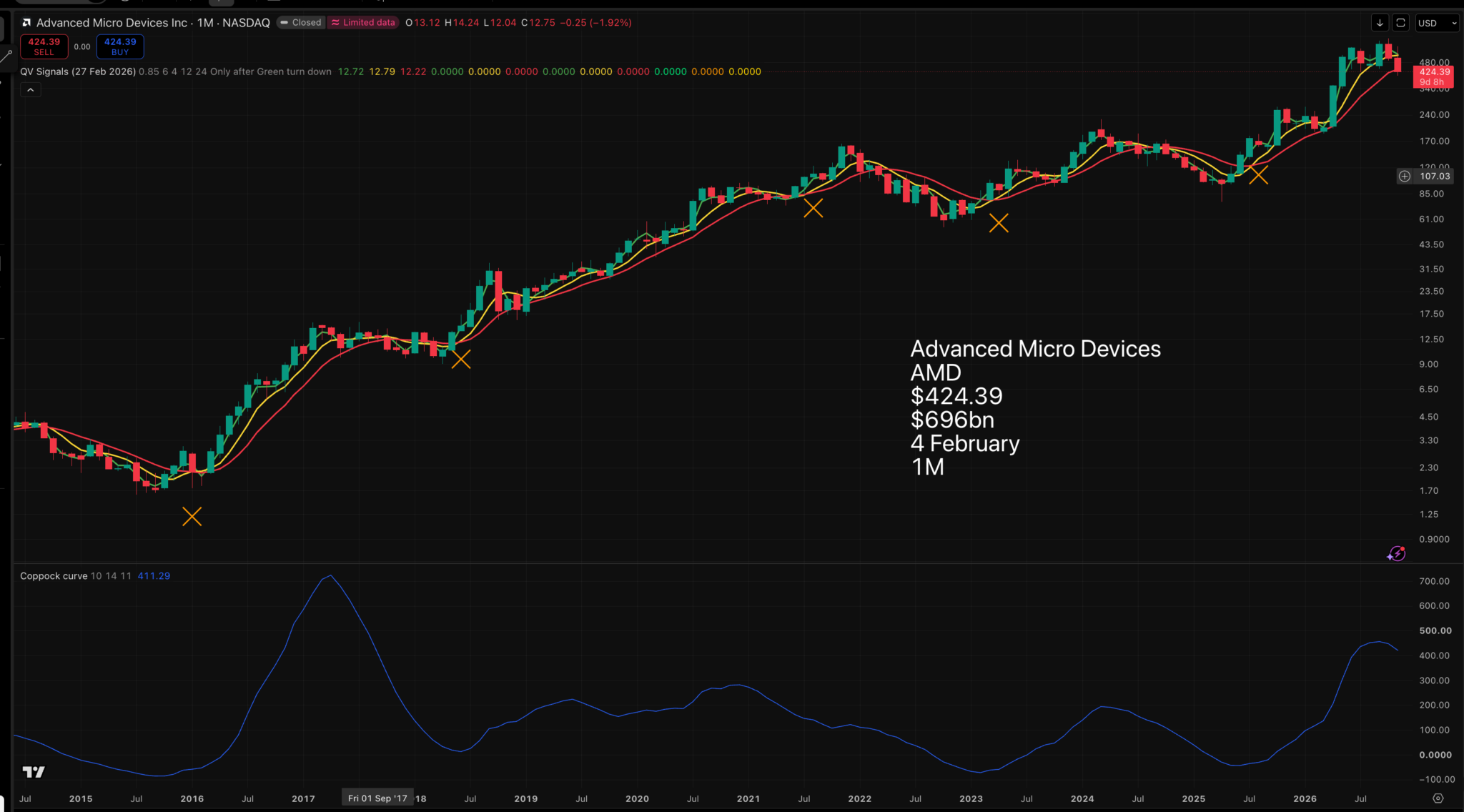
I have noticed that there is another thing that Coppock does well, which is useful. This is not a new observation, I have mentioned it before. If you don’t like to be caught by these dramatic sell-offs, Coppock can be very helpful. There is a simple rule. Only hold shares, I am talking about individual shares, when their Coppock line is rising.
You can refine the rule slightly. Individual shares are safe to hold as long as their Coppock line is rising, indicating strong momentum but become unsafe when the Coppock line is falling indicating fading momentum. Fading momentum does not stop shares from rising but if you want to ALWAYS make money then only hold shares with rising Coppock lines. It seems to be an infallible rule, especially with the dramatic, high growth shares, that I favour.
The example above is Advanced Micro Devices (AMD). In its latest quarterly report Nvidia specially referenced insatiable demand for CPUs, which AMD makes. You would have thought the fundamentals could not have been better, but as we are learning, in late 2026, fundamentals might as well be moonshine as far as investors are concerned. Just for the record AMD recently said growth was accelerating and projected revenue growth of 80pc for fiscal 2027.
In the face of these glittering fundamentals, Coppock paints a picture of fading momentum. After a sustained rise it began falling in October. A safety-first investor who immediately sold the shares would have been spared Friday’s 13.25pc decline.
Anyone would think that so far from just having an affair with a woman who might be a Chinese spy that Jensen Huang had defected to China and taken Nvidia’s entire research department with him. I have given up trying to make sense of it all except to notice that the charts have been proving more useful than fundamentals in guiding tactics for investors, at least in the very short term.
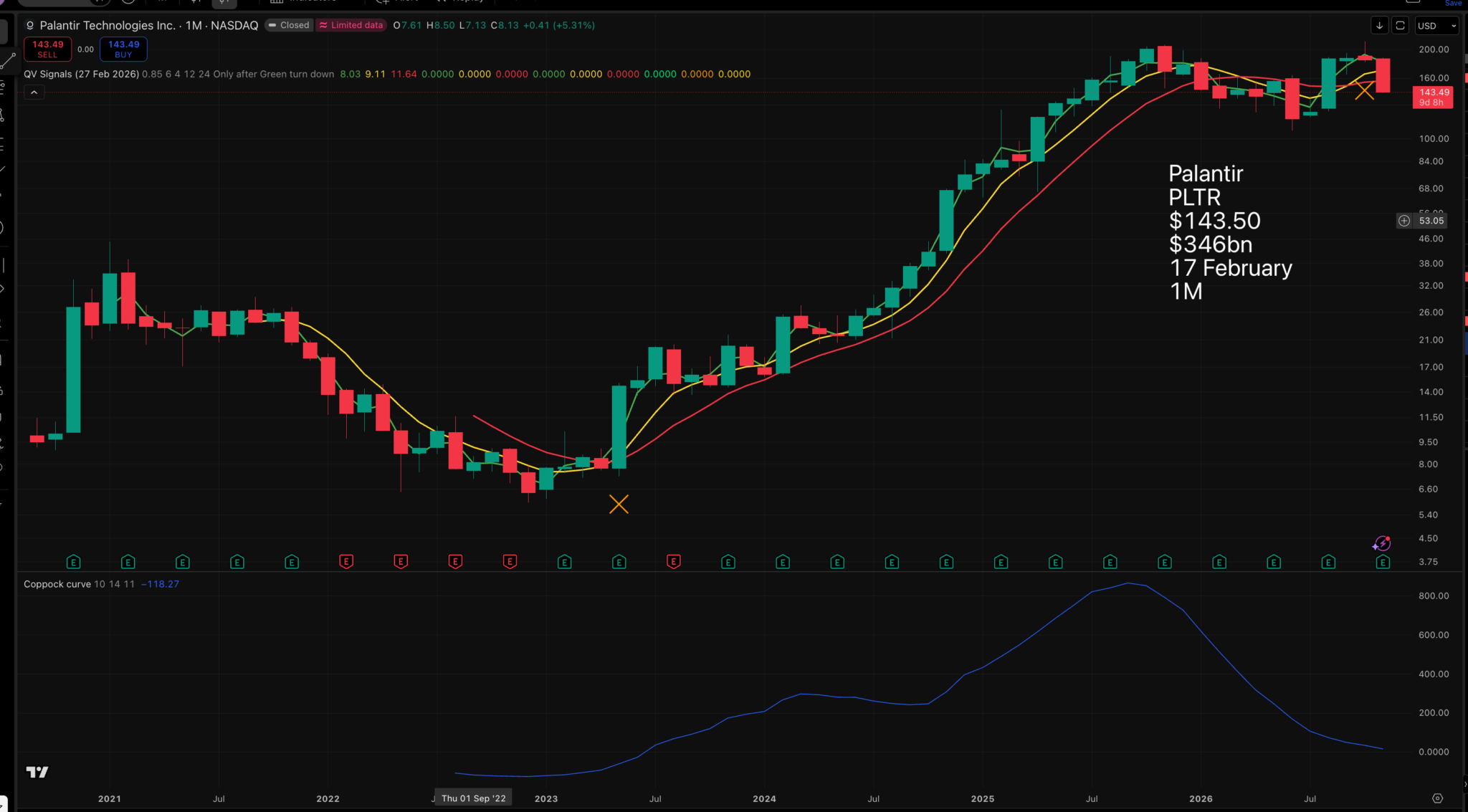
The Coppock indicator for Palantir began falling in October 2025, when the shares made the first top in what looks like a double top reversal pattern. Is growth slowing at Palantir? Of course not; it is accelerating. What is interesting about the Palantir Coppock line is that it has just become negative. In the past I have suggested that when Coppock for an individual share becomes negative that is often a good time to start accumulating the shares. When it turns higher that is a powerful buy signal.
Coppock moves in slow swings, up, down, up, down so it will turn higher at some point. Then you can pile in and hold the shares with confidence until it turns down again. Alex Karp is convinced that Palantir is just at the start of its growth journey so, assuming that one day we will return to a world where investors pay attention to fundamentals, the shares could still have a long way to go.
What is it that is terrifying investors? I asked my chum Gemini why is the AI trade falling apart. The answers were so bland, just a recap of what is happening in the world and vague worries about what the future might hold that I am not even going to reproduce them here. The truth is that, like me, AI is baffled. As the old market makers used to say, shares are falling because there are more sellers than buyers. Why is that; search me Guv.
Strategy – It’s A Funny Old World
Back in the day and maybe still there were people call ‘ivory tower chartists’, who only looked at charts and carefully avoided knowing anything about fundamentals. That would be a good approach just now as shares in companies with some of the best fundamentals I have ever seen break down on the charts. As I said in a recent alert, the charts look terrifying, with breakdowns from substantial patterns all over the place.
Maybe all will become clear in the future as the data centre boom comes to a grinding halt with massive order cancellations and supply shortages turning into gluts. Is that what is about to happen? None of the CEOs seems to think so but something is scaring the pants off investors. Investors oscillate between greed and fear and fear is uppermost at the moment.
If you want a safety first strategy option, which has worked well in the past but could take a while, it would be to wait for Coppock to start signalling that it is time to buy stocks. Looking at the charts as they stand currently, share prices have rapidly ripped down to an area of strong support. But support doesn’t always work in bear markets, which is most likely what we are now in.
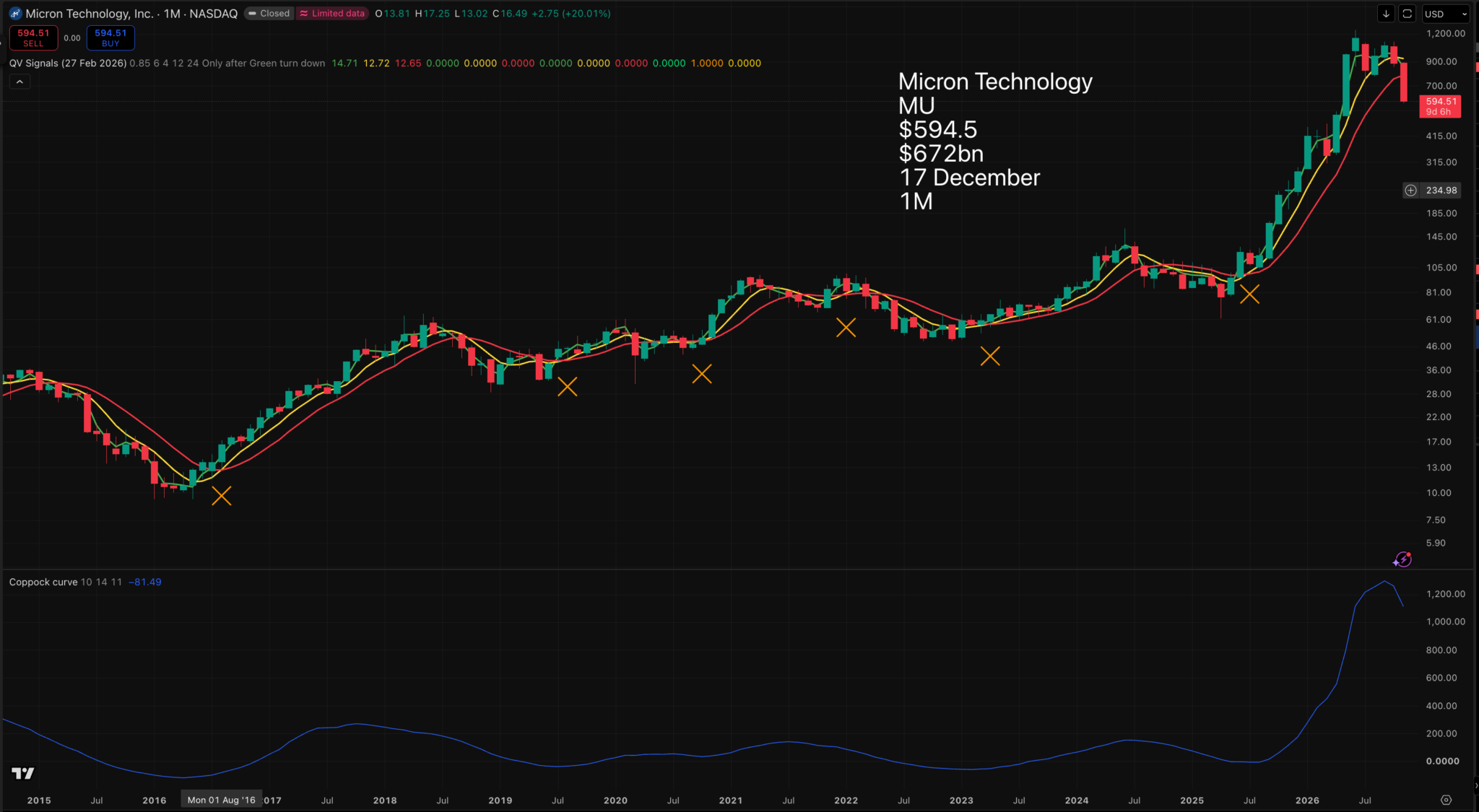
With the wisdom of 20:20 hindsight we can see how well Coppock warned of trouble ahead for Micron Technology shares. After rising to an unprecedented peak Micron’s Coppock indicator turned down in October and looking at the chart pattern you could probably have anticipated in September that would happen. In the case of Micron as soon as the Coppock trend signalled that holding the shares was unsafe they became very unsafe indeed.
Needless to say the business is growing at a furious rate and prospects are described as outstanding. In its latest quarterly statement Micron reported cash and liquidity at $74bn and quarterly free cash flow of $33.3bn. This compares with a market value of $672bn. It would not take many years of that level of performance for Micron’s market value to be substantially backed by cash.
Share Recommendations
Palantir PLTR
Strategy – Shut Your Eyes, Pray & Buy The Bust
$-cost averaging is a classic win in the end strategy which works best with super volatile shares in fast-growing businesses. This is exactly what the shares in the AI trade are all about. Some of the fastest growing businesses ever seen and their shares are all over the place.
An intriguing thought is that this weakness may not be a portent of disaster ahead but mainly technical in nature.
There is nobody faster to sell than an investor protecting a disappearing profit. Shares in the AI trade have made massive profits for investors in recent years. As these started to disappear with Jensen Huang’s disgrace acting like a pin bursting a bubble a huge crowd of investors may have rushed to sell in an unreceptive market and done so regardless of fundamentals.
Investors were ready to panic because there have been so many voices saying the AI boom was a bubble that would burst sooner or later. Investors, en masse, have much in common with horses, perhaps not quite such tiny brains but they are very easily spooked.
In 1929 panic was absolutely the right strategy but normally, as Warren Buffett, has said in the past, when markets are in the grip of fear, the right course is to have faith in America and your fellow Americans. Time after time sharp stock market sell-offs prove to be buying opportunities. Most likely this will prove to be another one.