
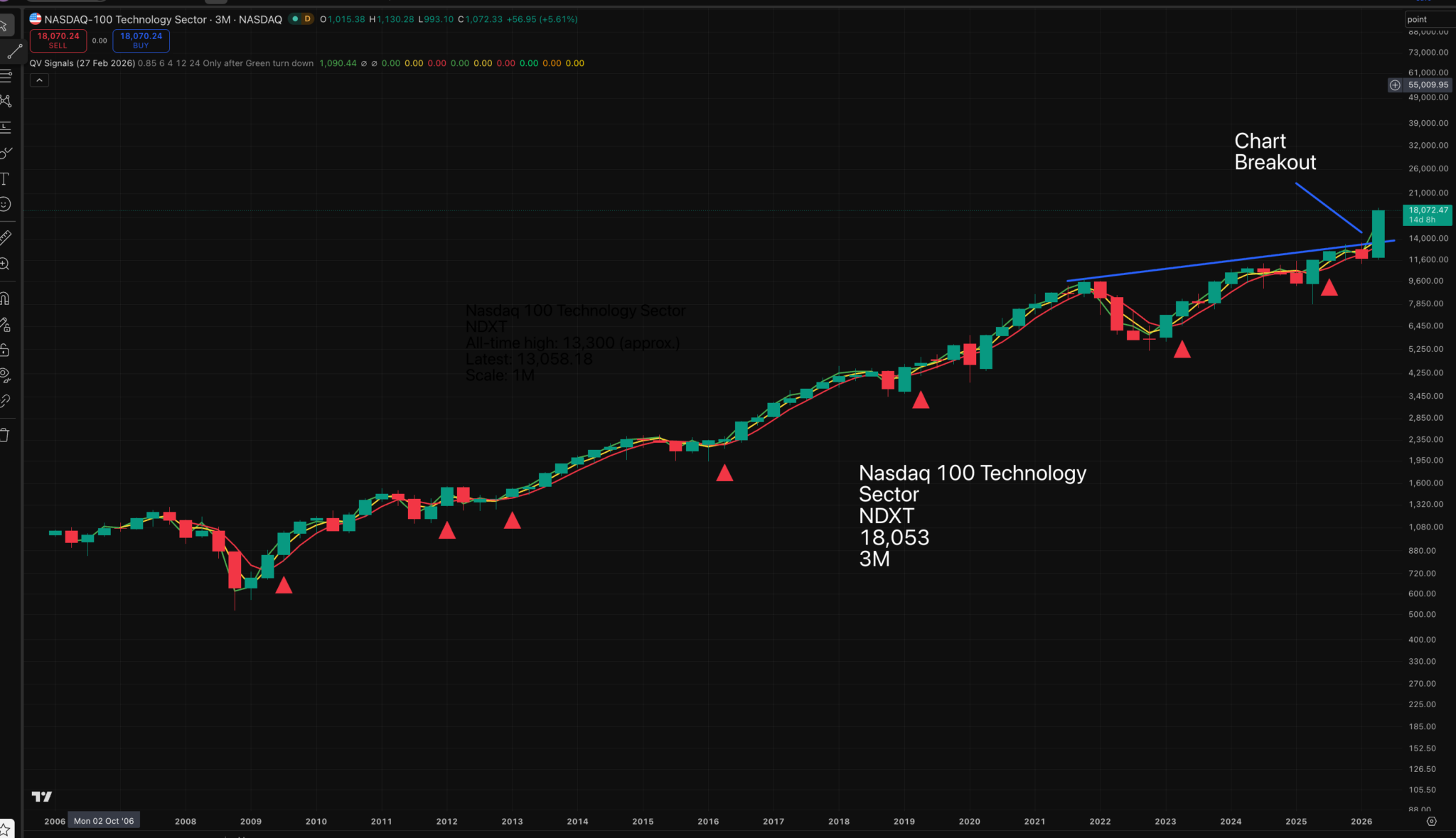
This looks like a chart breakout to me, and an important one. Each candlestick represents three months, so the breakout, which has the explosive characteristics that signify a true breakout, is from 54 months of sideways trading. The chart suggests that this index is heading much higher.
The fundamentals are pointing in the same direction. The technology revolution is rolling on from AI Training to AI Inference and Agentic AI, which require more computing power exponentially and all the rest of the associated infrastructure, memory, connectivity, cooling, energy and more.
AI training, AI inference, and Agentic AI represent the three distinct phases and capabilities in the machine learning lifecycle.
- AI Training: The “learning” phase where a model analyzes massive datasets to learn patterns.
- AI Inference: The “application” phase where the trained model uses its learned knowledge to make predictions in real time.
- Agentic AI: The “autonomous” phase where AI systems observe their environment, form plans, and execute multi-step actions to achieve goals.
AI Training
AI training is the intensive, foundational phase of the artificial intelligence lifecycle. It is the process of teaching a model to recognize patterns or correlations in data.
- How it works: Developers feed the AI vast amounts of data (e.g., text, images, code). The model makes guesses, calculates its errors, and adjusts its internal “weights” (parameters) to improve its accuracy.
- Analogy: It is like attending school or a medical residency.
- Resource intensity: Training is computationally heavy, takes weeks or months, and costs millions of dollars in compute (typically using massive GPU clusters).
- AI Inference
- AI inference is the execution phase where the already-trained model is used in real life. Once “taught,” the model evaluates new, unseen inputs to generate predictions, classifications, or text.
- How it works: Instead of learning, the model applies what it already knows. When you submit a prompt to an AI chatbot or use a facial recognition feature, you are triggering inference.
- Analogy: It is like the actual professional taking a test or seeing a patient. ]
- Resource intensity: Inference is usually much faster (taking seconds) and far cheaper than training, as the model’s weights are fixed and it only performs a “forward pass” of data.
- Agentic AI
- Agentic AI goes beyond simply generating a reactive response (like a basic chatbot). It refers to an AI system that is goal-driven and possesses a degree of autonomy to act in a continuous loop.
- How it works: Instead of waiting for a human prompt and stopping there, Agentic AI can receive a high-level goal, observe its environment, make a plan, execute tasks, analyze the results, and self-correct if things go wrong. Often, it interacts with external software tools (like browsing the web, running code, or calling APIs).
- Analogy: It is like hiring a digital project manager who takes an assignment and figures out the necessary steps to complete the project without requiring instruction for every minor detail.
Above is a simplified snapshot of what is happening in the world of AI, and does anyone think it will stop there? Remember the Jevons Paradox: however powerful the computer, there will always be even more computationally intensive applications coming along. Demand is insatiable. Human ambition vaults ever higher. Look at Elon Musk. Will he ever be satisfied?
The explosive breakout in the Nasdaq 100 Technology index is being replicated across numerous individual charts, all of which look to me like massive early-stage breakouts. Old valuation methods for shares are also breaking down.
Does anyone think there is much point in calculating the PE ratio for SpaceX? Exactly. My impression, incredibly, is that SpaceX is worth what Elon Musk says it is. He is going to Mars, he is going to harness the power of the sun, he is going to build data centres bigger than all the world’s current data centres put together, and he is no doubt dreaming even bigger when he has had a few puffs of marijuana or whatever floats his boat. He is kinda mad, but in a breathtakingly effective way. Nobody wants to bet against this guy, especially after Tesla scorched a whole generation of short-sellers. He is not just a businessman, but he makes business so much fun.
Other things happening with AI are that it is moving to the edge with devices generally, phones, laptops, TVs, cars, everything needing more memory as everything becomes smarter. It is also, so we are told, about to go physical with robots, robo cars, robo factories, robo rockets, robo soldiers, and this will require massive amounts more compute, semiconductors, connectivity, etc., etc.
The revolution is proceeding at such a pace that even the gigantic cash flows of companies like Google are not enough to pay the bills, and they are mobilising fresh capital. Meanwhile, all of us, except for the many people from my generation who are still using Nokia phones and generally wishing that technology would go away, are learning how to use this stuff.
I want AI to help me prepare synopses of all my books, and already, like Musk, I have another dream. I train AI with everything I have ever written, which is on record and then ask AI to write books in my style. This wasn’t my idea, but was suggested to me by one of my tech-savvy sons-in-law, and I think it is a great plan; I am just not sure that this poor old dotard can carry it out.
Maybe it could also pick the kind of stocks that I like, homing in on those explosive growth stories that send my adrenaline soaring.
This is the brave new world which is just around the corner, and, presently, America carries most of the load for taking us there. No wonder the US stock market is going crazy.
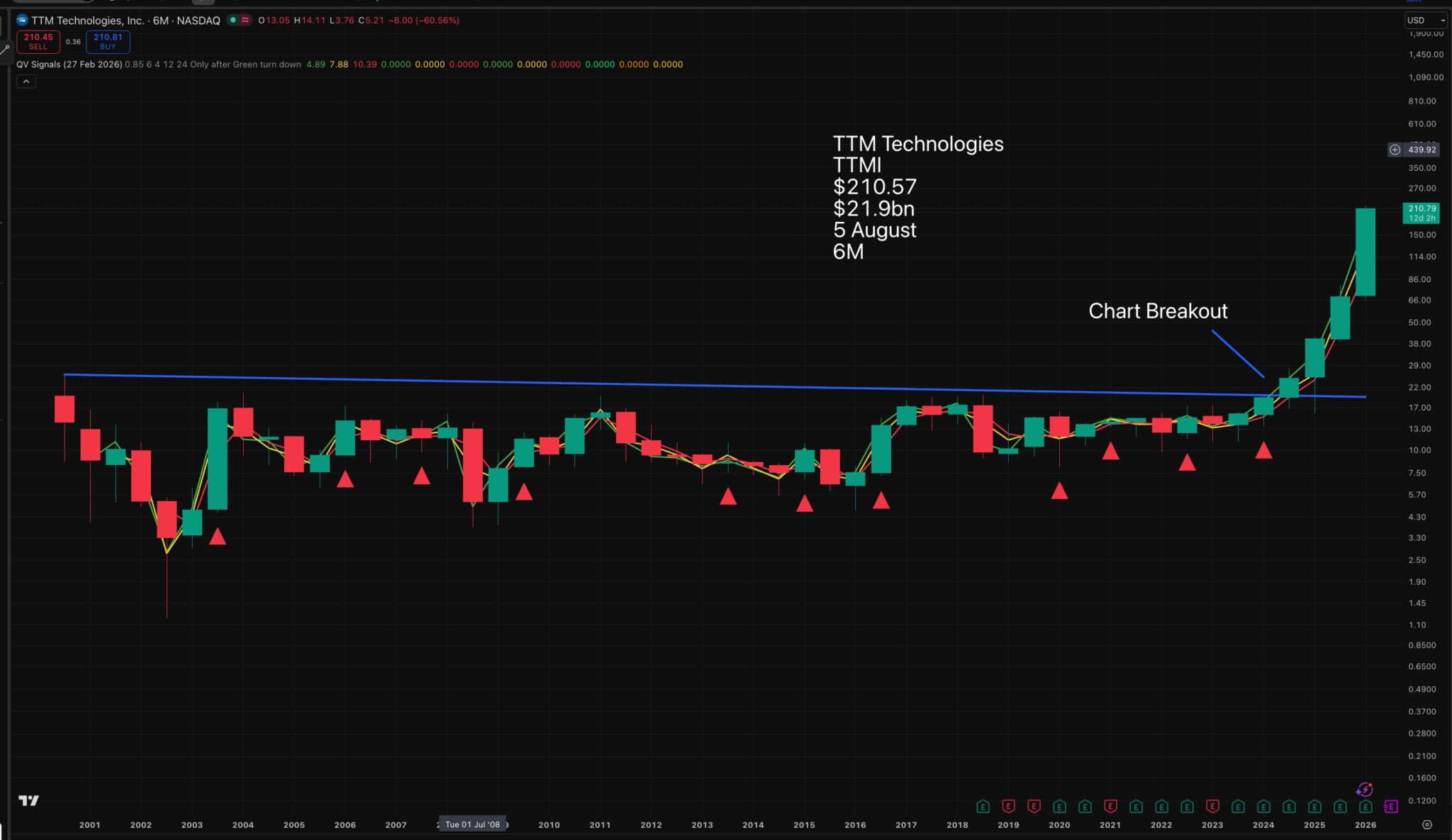
This is both an epic chart and symptomatic of what is happening with the charts of many US stocks, especially those that are supplying hardware for the AI data infrastructure build-out.
I don’t understand what these guys do. They make printed circuit boards and other stuff that is important for connectivity. Let’s get their take on what they do, and maybe you will understand what it is all about.
At TTM Technologies, we are focused on designing and manufacturing complex products and solutions in 2 strategic directions. The first is advanced interconnect, which includes highly complex printed circuit boards, substrates and advanced packaging. The second strategic direction built on our advanced interconnect technology to design and manufacture sophisticated modules, subsystems and systems. Examples of this include our RF modules, thermal and power management systems etch and AI processing products as well as complex subsystems and fully integrated mission systems. We believe the future of electronics lies in speed to market, high reliability and efficient technology interim.
The markets in redo business continue to demand highly complex technology solutions in an increasingly compact size and footprint. Our strategy is to stay at the cutting edge of advanced interconnect technologies through innovation and continue to move up the value chain into complex modules and subsystems that combine sensors, actuators RF and Photonics. We engaged early with our customers to ensure alignment on product development and speed to market while also enabling optimal management of their complex supply chains. From a demand standpoint, we are experiencing healthy multiyear tailwinds due to our participation in 2 key megatrends currently driving economic growth, artificial intelligence and defense.
We previously stated that approximately 80% of our net sales are related to these 2 megatrends, and that this puts us in a unique position to benefit our investors. Our ability to seize these organic growth opportunities requires our continuous focus on technological innovation as well as expanding our capacity across our strategic footprint. We are further investing capital and resources to take full advantage of these opportunities today and in the future through our global footprint, which offers our customers manufacturing options across 24 sites located in China, Malaysia, Canada and the United States.
We stand well positioned to support this growth across our end markets, and we are tracking well ahead of our previously communicated plan to grow revenues 15% to 20% per year for the next 3 years and to double our earnings from 2025 to 2027, which were closed that were reiterated on our February 4 earnings call. In our commercial segment, we are highly focused on supporting the demand wave of artificial intelligence in the data center and networking end markets where customer demand has materially accelerated.
We are also focused on evolving opportunities in the use of automation and AI in our medical, industrial and instrumentation end markets, while we remain strategically positioned in automotive where our highly valuable solution designs are positioned to benefit from competitor consolidation and have additional transfer application into other markets. In our airspace and defense end markets, we continue to excel with our leading position in advanced interconnect products and we work to expand our product offerings in indicated and electronics, including modules, subsystems and full mission systems. Recently, we were proud to be a participant in the success of Artemis-I mission with our microelectronics, PCBs and assemblies for both the space large vehicle and the Orion crew capsule.
The key things that emerge from this for me are that their growth rate is accelerating, and 80pc of their sales are for artificial intelligence and defence. One of the things which is significant with all these fast-growing hardware companies is that rapid growth in sales and profits feeds into higher spending on research and development and massive growth in free cash flow.
This means that these companies are steadily reinventing themselves to address a fast-changing technology landscape, and that puts them in virtuous circles of growth that can be far more durable than might be apparent from just looking at what they do now.
Because the shares are rising so fast, there are periodic bouts of profit-taking, and the value guys have hysterics when share prices rise faster than sales and profits. This makes for volatility but within a strongly rising secular trend. Two years ago, the shares were $20; now they are $210. It’s a big rise, but that is what happens when business is as good as it is presently.
The planet is building the infrastructure for a brave new world of AI in which the way we do everything is changing. It is an unimaginably huge development, and companies are growing from small to large to huge on the back of it.
A year ago, it seemed like Nvidia was almost the only game in town for playing the AI boom. Not any more. There is a whole ecosystem of exciting, explosively growing companies out there.
One analyst summed up what is happening at TTMI as follows.
TTM Technologies, Inc. (TTMI), for a long time, was valued like a traditional (PCB) manufacturer, whose results mainly depended on electronics market cycles. However, in 2026, the company’s business profile looks completely different from what it did a few years ago.
Today, the main TTM Technologies growth story is connected not to consumer electronics but to artificial intelligence infrastructure, data center expansion, aviation, and defense programs. The company is becoming an important part of the supply chain in the markets, in which technological complexity, certification requirements, and long-term contracts allow it to reach better profitability and bigger revenue visibility.
In my opinion, the main investment thesis today is that TTM Technologies is gradually transforming from a cyclical PCB manufacturer to a higher-value AI and defense infrastructure supplier. For this reason, the current company’s growth looks more structural than temporary, while the 2026 results indicate that this transformation is just starting to gain momentum.
It is not dissimilar to the story driving memory stocks, but the growth is less explosive.
Share Recommendations
TTM Technologies. TTMI

MegaCaps Place Huge Bets On AI

Stuck In A Rut

Pick One Great Stock (From The AI Trade) And Buy The Buy Signals/ $-Cost Average