
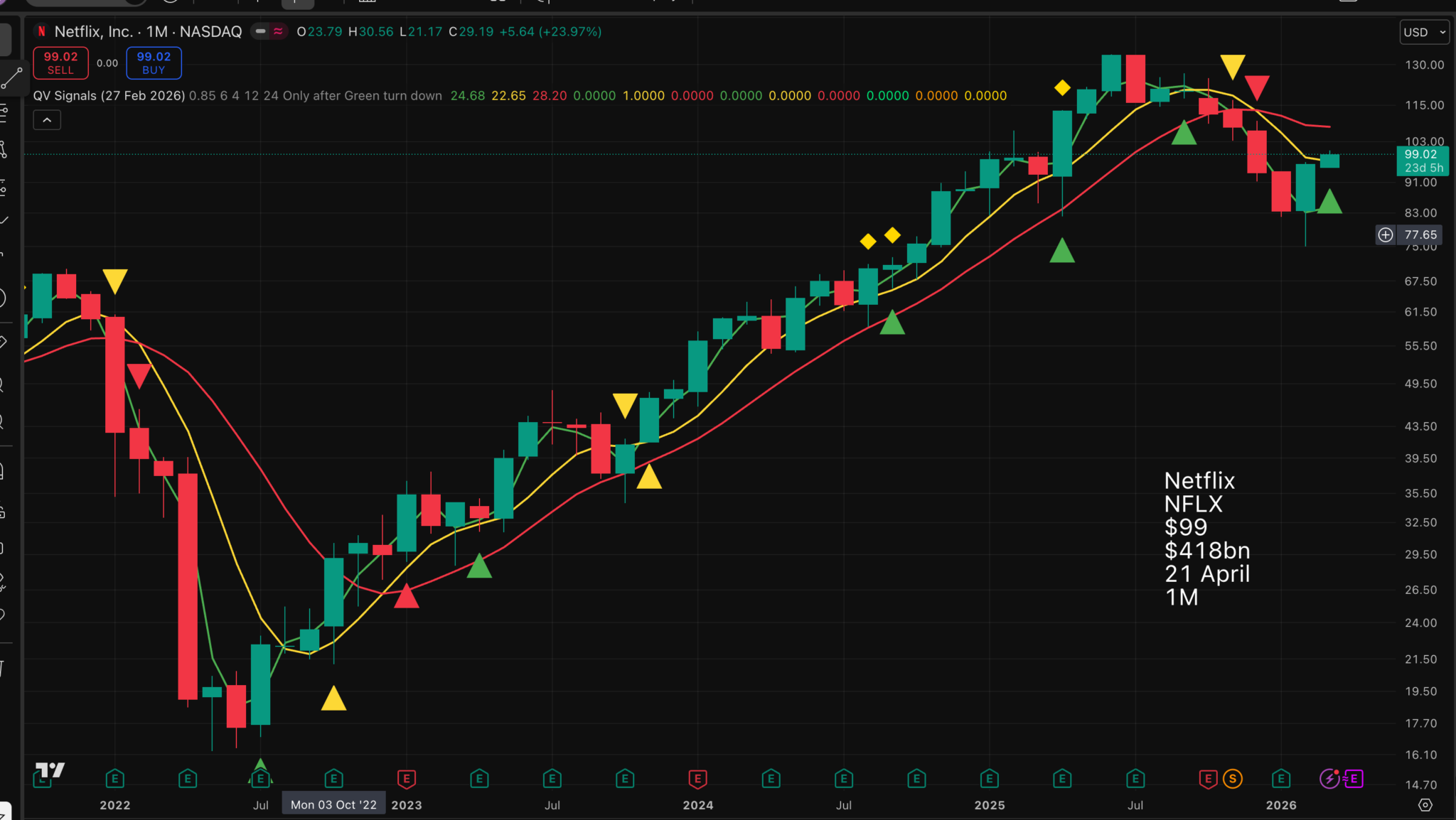
I am trying to think outside the box. Instead of focusing on buy signals, I want to emphasise sell signals. The Netflix chart above offers us options. Let’s imagine we are redlining this stock. We sell in February 2022 and December 2025. We then buy in January 2023 and on all subsequent buy signals until the latest red line sell signal.
Hot off the presses, we have a green line buy signal. This is high risk given a falling red line, but you could act on it. The green buy signal in 2022 worked well.
The point of the sell signals is not so much to take profits as to step aside during a period of high risk for the share price, release funds for other opportunities, and be ready to repurchase the stock on whichever buy signal strategy you are following.
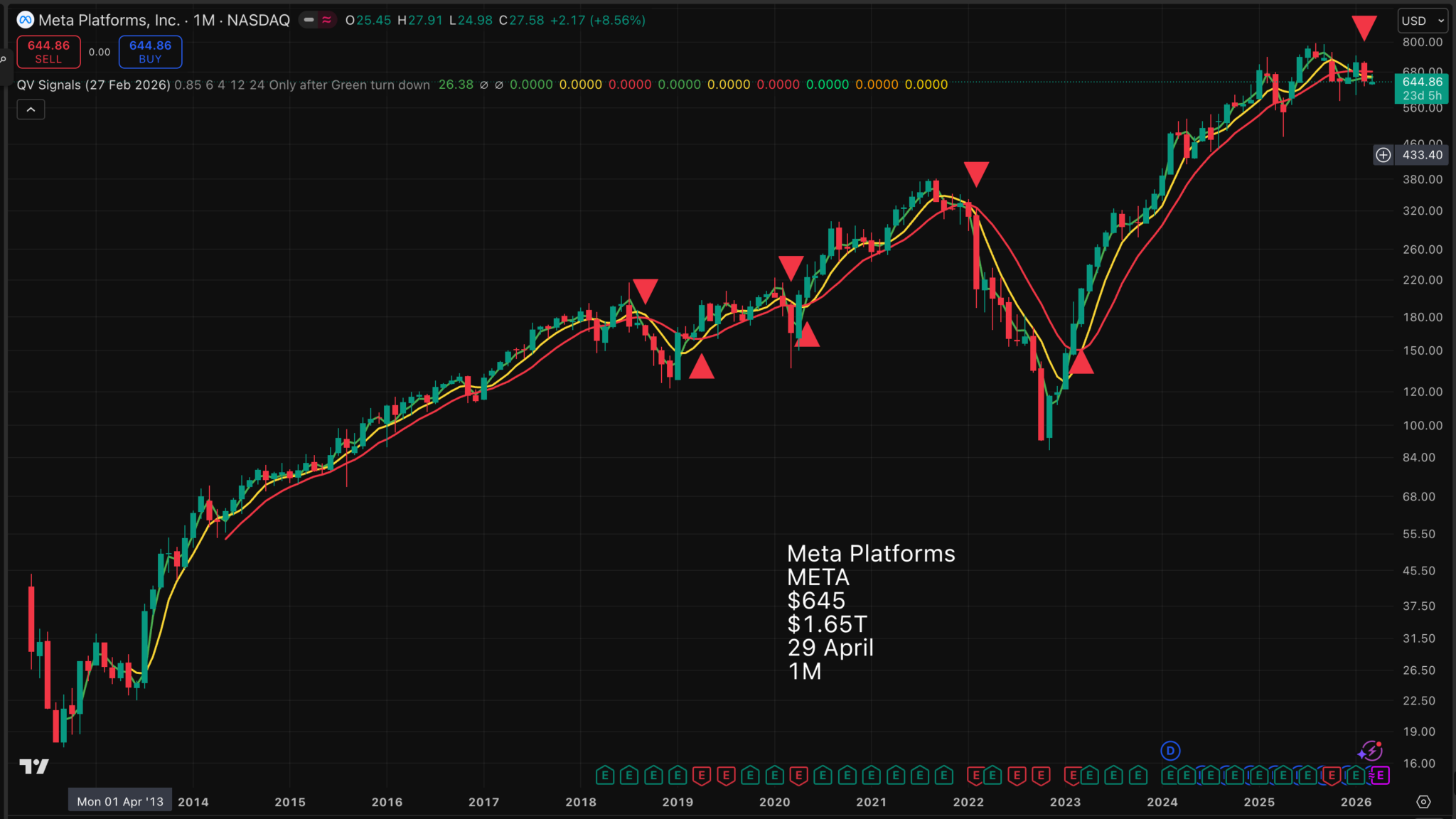
I have cleaned up this Meta Platforms chart so that we only have red-line buy and sell signals. The first buy signal is not marked, but Meta Platforms was a buy in July 2013 when the yellow moving average turned higher. Since then, there have been four red-line sell signals, one just given. They all look good on the chart, but when they are closely followed by buy signals, acting on them often involves losses.
This is the price you pay for being out of the stock when there is a severe sell-off like that in 2022. What is exciting is that the buy signals are often followed by dramatic rises. Overall, buying and selling on red line signals is a good strategy with a crucial proviso.
It only works with shares in exciting companies. We need companies delivering strong growth and with exciting stories. Meta Platforms meets these characteristics.
We are now seeing a major AI acceleration. I expect 2026 to be a year where this wave accelerates even further on several fronts. We’re starting to see agents really work. This will unlock the ability to build completely new products and transform how we work. In ’25, we rebuilt the foundations of our AI program. Over the coming months, we’re going to start shipping our new models and products. I expect our first models will be good, but more importantly, we’ll show the rapid trajectory that we’re on. And then I expect us to steadily push the frontier over the course of the year as we continue to release new models.
I’m very excited about the products that we’re building. Our vision is building personal superintelligence. We’re starting to see the promise of AI that understands our personal context, including our history, our interests, our content, and our relationships. A lot of what makes agents valuable is the unique context that they can see. And we believe that Meta will be able to provide a uniquely personal experience. We’re also working on merging LLMs with the recommendation systems that power Facebook, Instagram, Threads, and our ad system. Our world-class recommendation systems are already driving meaningful growth across our apps and ads business, but we think that the current systems are primitive compared to what will be possible soon.
If it is all so exciting, why do we have a sell signal for the shares? The short answer to that is that I don’t know, but it is a warning that we need to respect. On past form, there will be a buy signal, and we can pile back into the shares. We are selling because a red line sell signal is a precondition for a major fall in the share price. The worst doesn’t always happen, but it does sometimes.
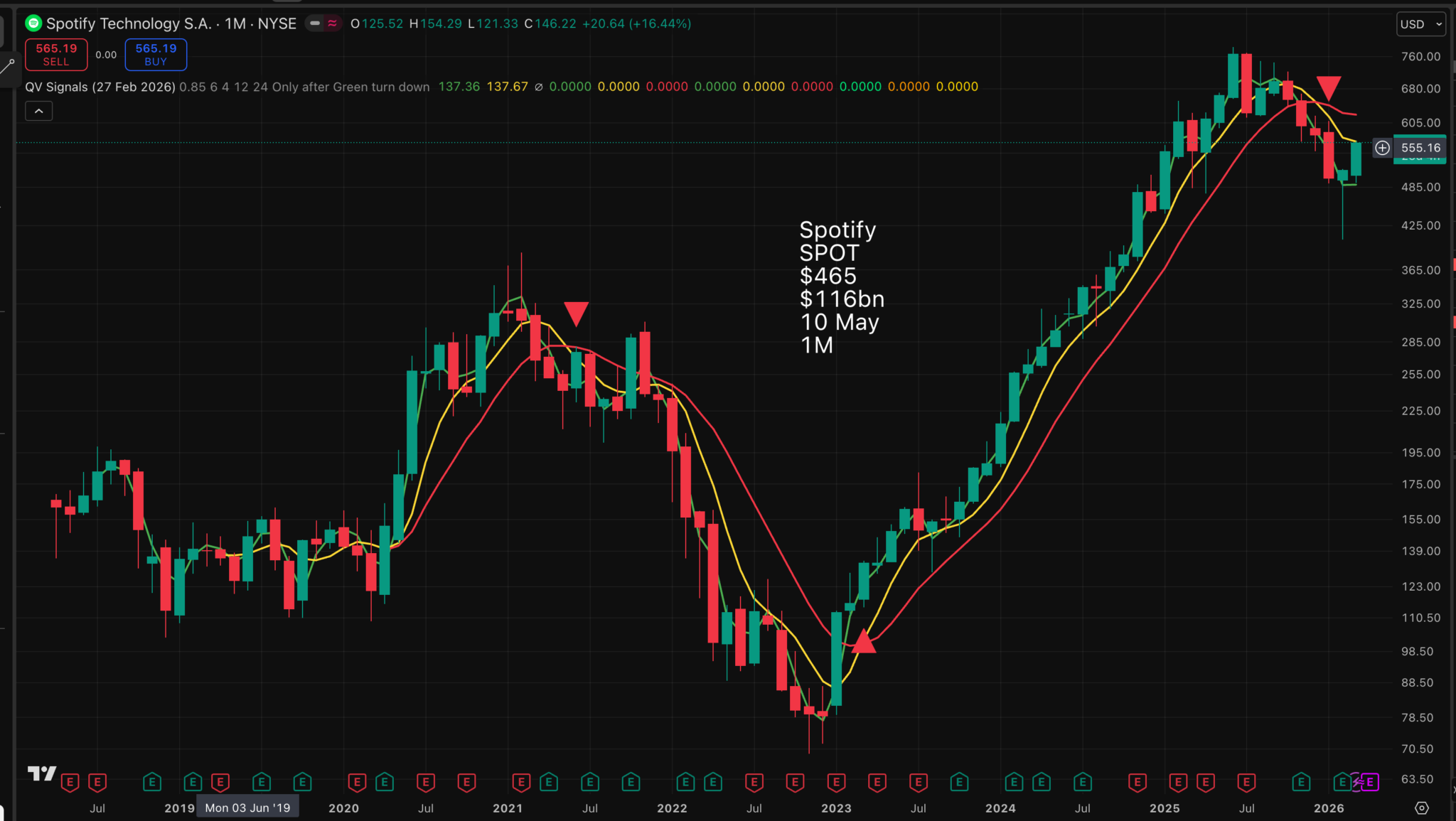
We can read the Spotify chart using red line buy and sell signals. There would have been a buy signal in May 2020. Red line sell signals are late; that is inevitable with such long-term moving averages. You need to forget about the share price and just follow the line.
The key is to step aside, be out of the shares, when the red line is falling, and be in the shares when it is rising. You may miss out on some gains, but you will be less vulnerable to bad decisions when the shares are collapsing, and you will be in the shares for some chunky gains.
As we can see on the chart, the most recent signal is a sell signal.
If you do your buying and selling in a spread betting account, you won’t need to worry about tax.
Strategy – Buy And Hold When Charts And Fundamentals Are Aligned
My strategy is simple. If the fundamentals are great, and all the moving averages are rising, it makes sense to hold the shares. If your chosen moving average, the red line in the examples above, is falling, you should step aside.
I increasingly feel that waiting for buy signals before buying will (a) make sense for many investors and (b) allow us to have an exit strategy. This is the long-term trading approach. Buy on a long-term buy signal and sell on a long-term sell signal.
This can be supplemented by adding more shares on shorter-term buy signals as long as the red line is rising.