The fact that a business is doing well is no longer a safe reason to buy the shares. Shares can plunge while business is booming. This happens, but never so dramatically as presently. It is a minefield out there, and many hitherto exciting shares are falling sharply.
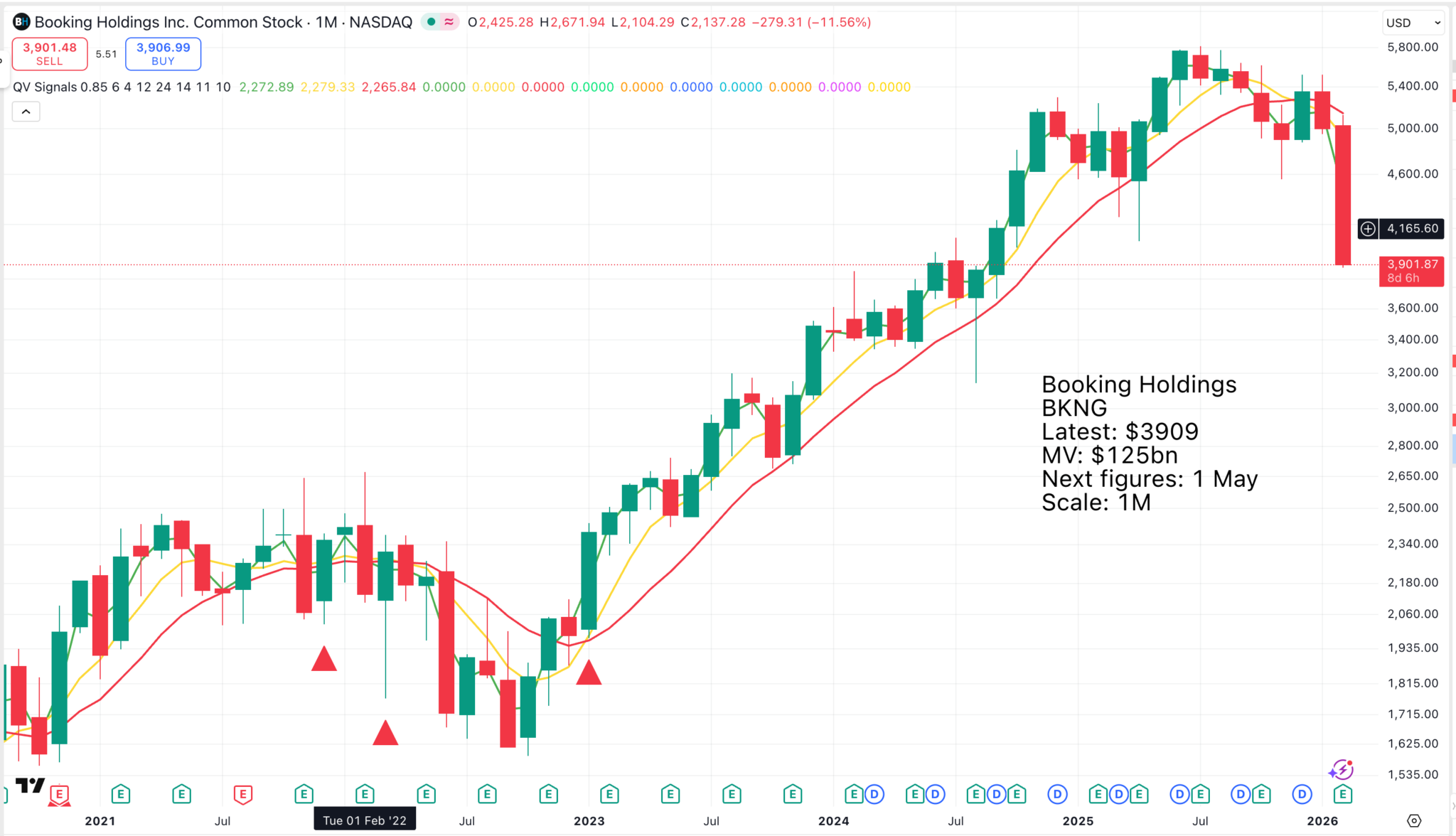
Shares in Booking Holdings had been steaming ahead since an epic red line buy signal in January 2023, but not anymore. Most recently, the moving averages have bunched and broken down sharply. Below is a snapshot explanation for the decline.
Booking Holdings shares have faced downward pressure, recently hitting 52-week lows, primarily due to intensifying competition from Google’s AI-powered travel tools and concerns over slowing growth in travel demand. Despite strong financial performance and a planned 25-for-1 stock split, investor sentiment is affected by AI competition, high valuation, and potential consumer slowdowns.
This is a perfect example of AI popping up as a threat to an established business. Below is more on that threat.
AI competition threatens Booking Holdings by shifting travel planning from traditional search/booking sites to conversational, AI-native platforms (e.g., ChatGPT, Gemini), which reduces brand loyalty, shrinks consumer research time, and lowers entry barriers for new, tech-savvy competitors. These AI tools risk disintermediating Booking Holdings by allowing, say, Expedia Group and Google to own the customer relationship, while also challenging their dominance through more personalized, end-to-end trip planning.
Let’s look at another powerhouse business, whose shares have turned sharply negative.
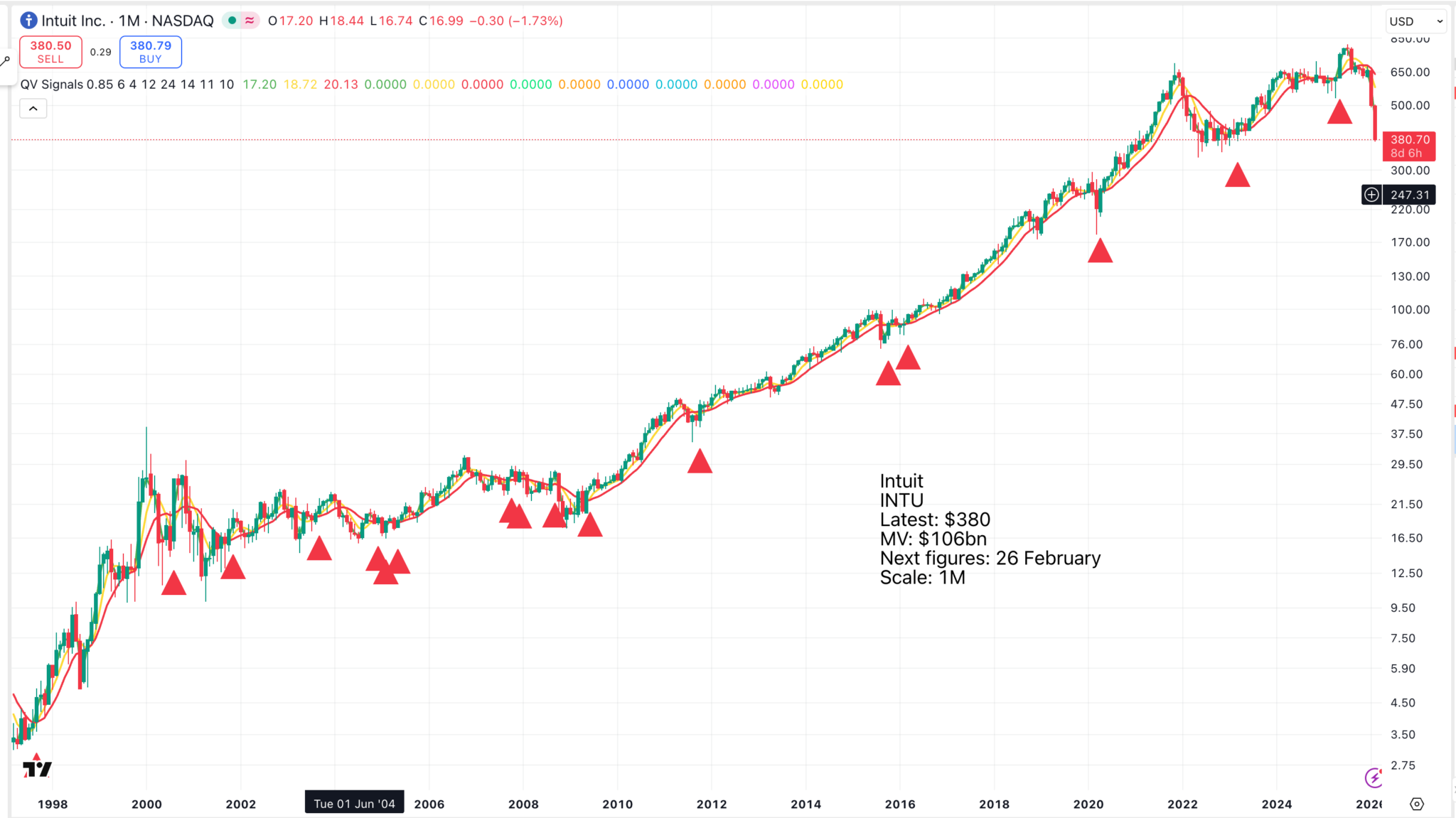
So what is the problem with Intuit?
Intuit’s sharp slide over the past year has been driven largely by AI anxiety. Investors fear that generative AI could disrupt traditional financial software models, even though that threat hasn’t materially surfaced in the company’s actual results.
Nobody seems safe.
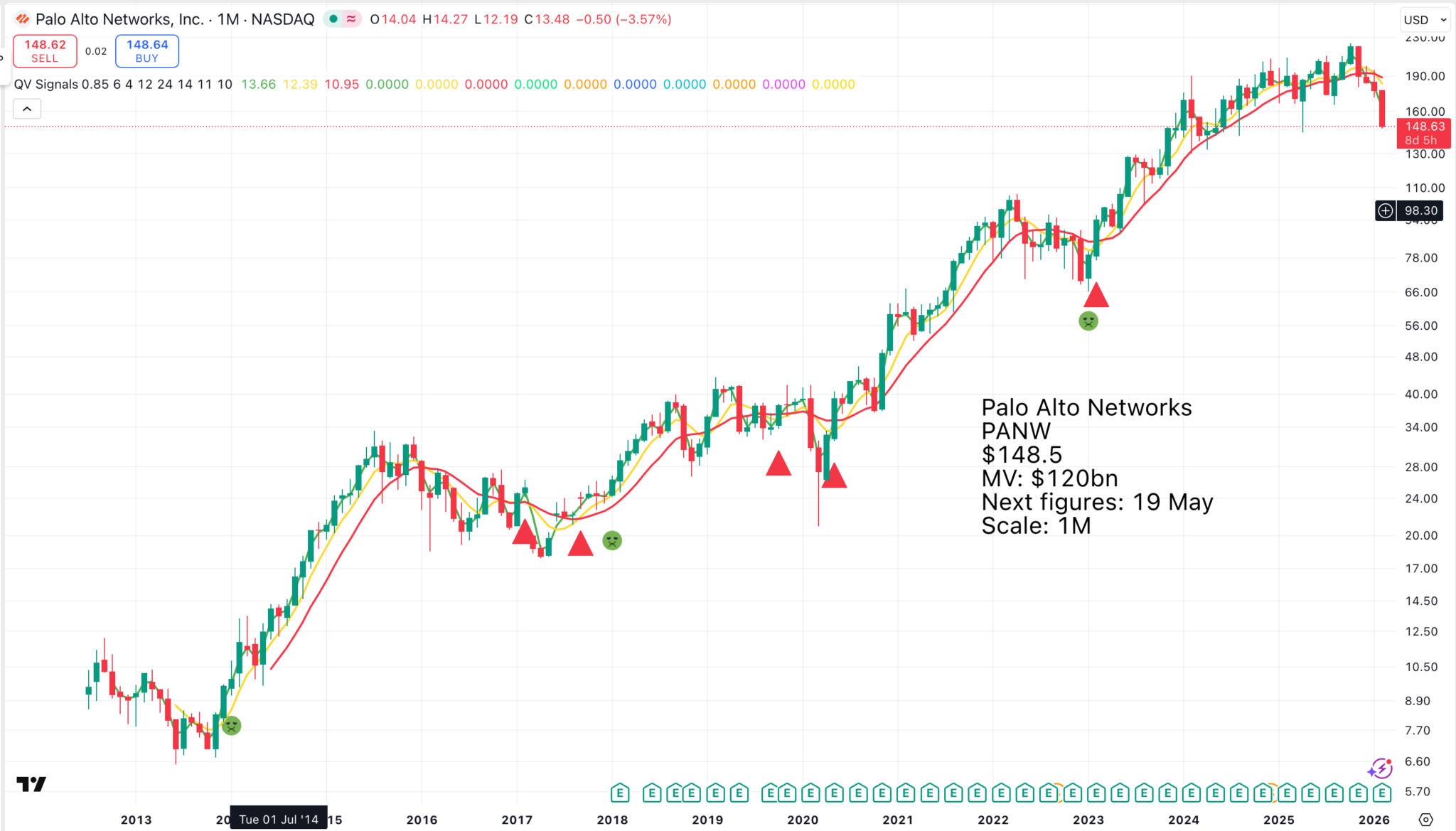
Palo Alto shares fell 8% on Wednesday after the cybersecurity firm lowered its annual profit forecast on higher integration costs related to recent acquisitions, including its $25 billion CyberArk deal.
The company has been repositioning itself as a one‑stop shop as AI‑driven threats push customers toward integrated platforms, but rising costs from recent deals, including a $2.3 billion outlay for CyberArk in the fiscal third quarter, are weighing on profit.
Yet another company where AI is perceived as a threat rather than a benefit.
The list goes on.
The meteoric rise of artificial intelligence, which once propelled markets to record highs, has hit a wall of scepticism.
In early February 2026, a sharp sell-off rippled through global exchanges as the narrative shifted from “AI as a saviour” to “AI as a disruptor.”
This volatility was primarily driven by two factors: a massive spike in capital expenditure by tech giants that has yet to yield commensurate returns, and the release of highly specialised AI agents capable of automating complex professional tasks.
Investors are no longer just asking who will build the AI, but rather who will be “cannibalised” by it.
Here are the three sectors most at risk.
Enterprise software
For years, the Software-as-a-Service (SaaS) model was the gold standard of steady, recurring revenue.
However, the emergence of autonomous AI agents – like the newly updated Claude Cowork – has sparked what Wall Street is calling the “SaaSpocalypse.”
Investors fear that instead of paying for expensive “per-seat licenses” for CRM or HR tools, firms may simply start using AI to build custom in-house solutions or automate the workflows entirely.
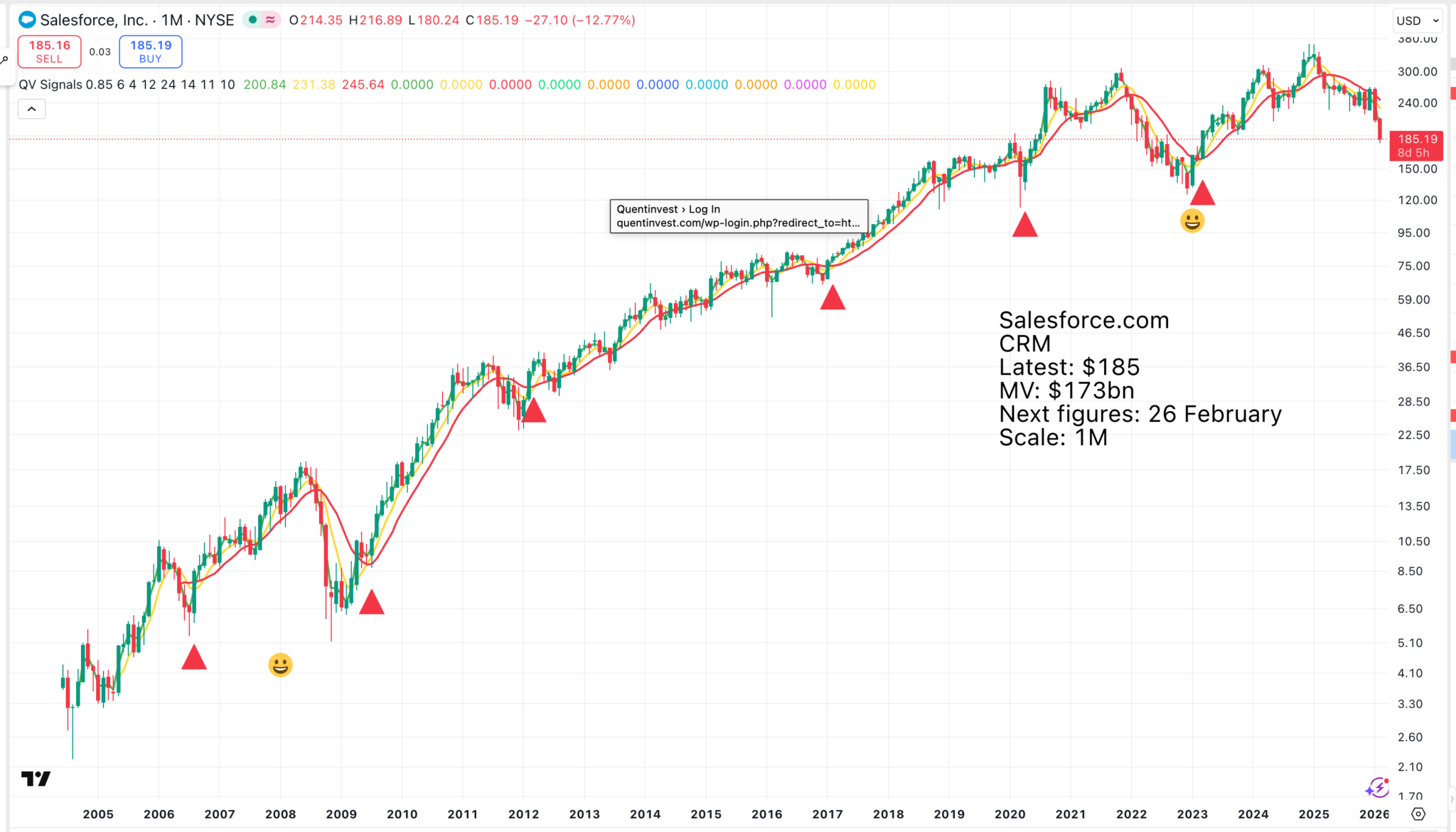
Salesforce CRM – a longtime industry bellwether – has felt the brunt of this anxiety.
Its stock price plummeted over 15% in a single week following reports that large enterprises were pausing seat-count expansions, opting instead to trial Anthropic’s “AI-powered” automation tools that reduce the need for human software operators.
Commercial real estate services
The real estate sector, particularly firms focused on commercial leasing and property management, has entered a period of deep uncertainty.
The concern is two-fold: AI automation could lead to material white-collar layoffs – reducing the overall demand for office space – and AI tools are beginning to automate “information asymmetry” that real estate brokers rely on for fees.
CBRE Group CBRE – the world’s largest commercial real estate services firm – saw its shares sank 12% as markets realised that AI can now handle complex lease valuations and market analysis with 99% accuracy.
As investors rotate out of labour-intensive business models, the “high-fee” structures of traditional real estate giants are being viewed as increasingly vulnerable.
Professional information and data services
Sectors that trade on specialised knowledge – legal, accounting, and tax services – are the latest to be swept up in the AI fear trade.
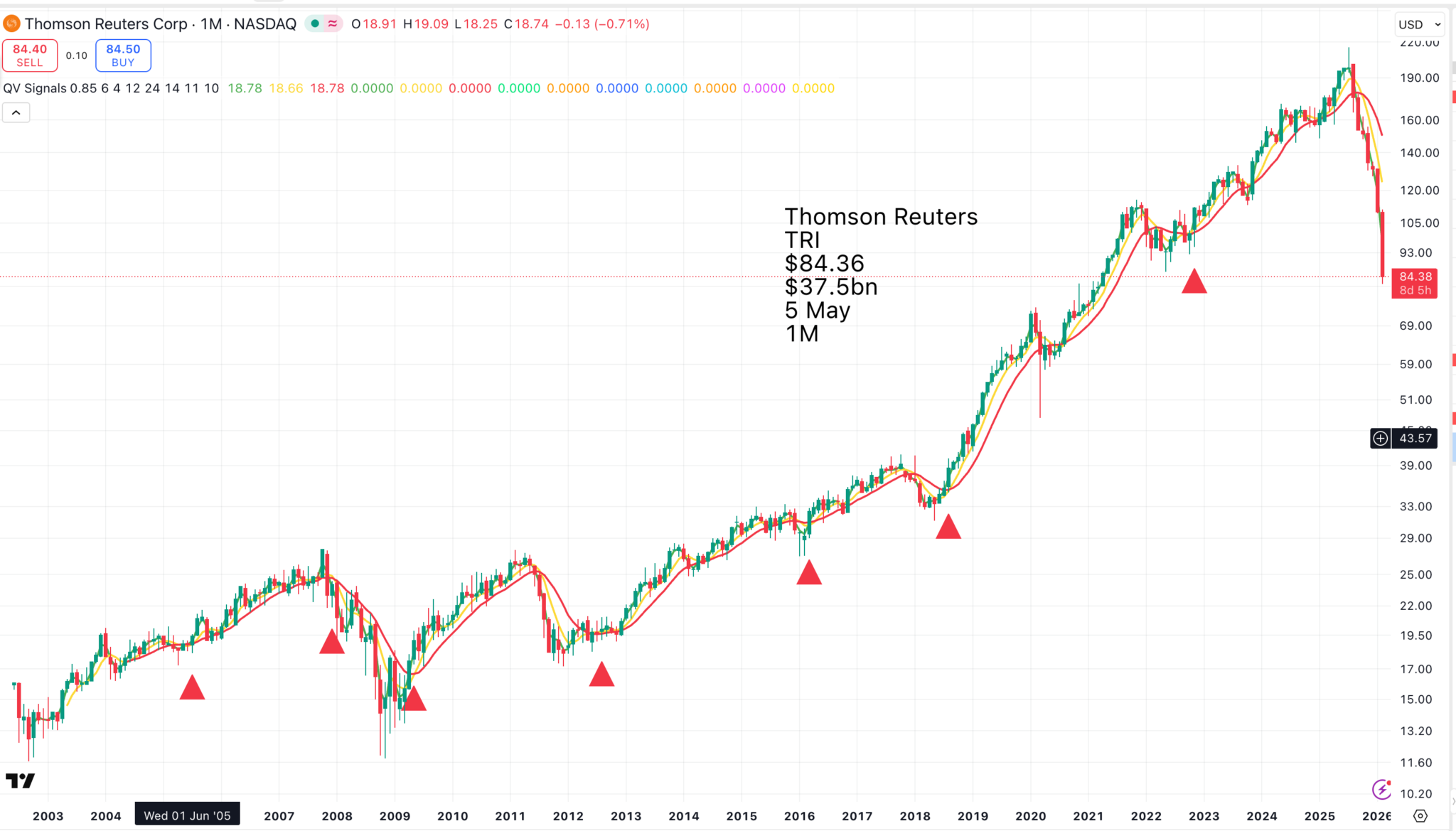
For years, companies like Thomson Reuters and RELX were considered “AI winners” because they owned the data used to train the models.
However, a new wave of vibe coding and specialised legal artificial intelligence agents has shown that the moat provided by proprietary databases may be shrinking.
Thomson Reuters TRI fell over 26% recently as analysts questioned whether AI could now synthesise case law and draft legal filings at a fraction of the cost of the company’s premium subscription services.
The market is currently betting that “democratisation of expertise” will hit the bottom line of these data giants far sooner than expected.
What is alarming is the speed at which these shares are being ripped apart. It does make sense. We are being told that the AI revolution will change everything with a dramatic impact. It is the ultimate disruptor, and who knows who is safe?
Fundamentals v chart over Palantir.
The latest bullish analysis raves on about Palantir’s incredible fundamentals.
Artificial intelligence (AI)-powered data mining and analytics company Palantir Technologies Inc. PLTR has been witnessing a price downturn in the past six months despite reporting strong earnings results and operational performances.
PLTR is currently trading at a discount of 34.8% from its all-time high recorded on Nov. 3. This weakness in the stock price opened up a lucrative opportunity for investors to enter this AI analytics software giant, as it has massive short-term price upside potential.
The chart below shows the price performance of PLTR year to date.
Attractive Diversified Business Model
In the last reported quarter, government revenues climbed 60.4% year over year to $730 million. Commercial revenues jumped 81.8% annually to reach $677 million. As of Dec. 31, the total customer count was 954.
Palantir’s core customer base comprises businesses seeking tailored AI/ML services, particularly large government and corporate clients willing to invest heavily in its systems. This has generated solid revenues, registering a 21.3% CAGR from 2020 to 2024.
PLTR’s commercial business has gathered pace besides its traditional government contracts. This is primarily due to PLTR’s aggressive venture in the AI space. In 2023, PLTR launched its Artificial Intelligence Platform (“AIP”), an AI-powered system that helps customers quickly concentrate and analyze data and discover how it can help advance their business goals.
AIP provides unified access to open-source, self-hosted, and commercial large language models (LLMs) that can transform structured and unstructured data into LLM-understandable objects and turn organizations’ actions and processes into tools for humans and LLM-driven agents. This shift in revenue structure has enabled the company to no longer depend on government defense agencies.
Extensive Thrust on AI
Palantir’s AI strategy is comprehensive, combining its proprietary Foundry and Gotham platforms with a solid plan to promote AI adoption across both government and commercial sectors. Its AIP is the backbone of these capabilities, enabling organizations to process large datasets and derive real-time insights.
This is especially valuable in sectors requiring extensive data integration, such as defense, healthcare, finance and intelligence, where operational efficiency and decision-making speed are critical.
In the government sector, PLTR is aligning its AI strategy with U.S. defense priorities. Its work in high-profile initiatives, such as the Department of Defense’s Open DAGIR project, highlights its ability to modernize military operations through AI-driven solutions where data interoperability and real-time decision-making capabilities are imperative. These capabilities solidify Palantir’s position as a key player in the defense sector.
In the commercial space, PLTR’s AIP boot camps — providing hands-on experience to over 1,000 companies — have proven instrumental in customer acquisition. Boot camps showcase the platform’s capabilities and demonstrate its adaptability across logistics, manufacturing, and supply chain management.
Guidance Signals Confidence, Not Caution
Management’s outlook for 2026 reinforced the strength of the current trajectory. First-quarter revenues are guided to $1.53 billion at the midpoint, implying 8.5% sequential growth. For the full year, Palantir expects revenues of roughly $7.19 billion at the midpoint, indicating 61% year-over-year growth.
Profitability is expected to remain exceptional. Adjusted operating income guidance of around $4.13 billion implies further margin expansion, while adjusted free cash flow is projected between $3.9 billion and $4.1 billion. The company also expects to maintain a Rule of 40 score near 118%, a level rarely achieved at this scale.
Future Catalysts
Palantir plans to invest more in hiring talent and advancing product features using its AI-powered technologies. This will enable the company to win and properly execute both government and commercial contracts.
PLTR’s modular sales approach expands beyond the core customer base, allowing clients to purchase specific product components instead of committing to the full platform upfront. This model also incorporates usage-based pricing, which lowers the entry barrier for new clients.
By starting small, clients can gradually increase spending as they scale their usage of PLTR’s solutions. This has expanded its U.S. commercial customer base. Aside from Palantir Technologies, BigBear.ai Holdings Inc. BBAI and C3.ai Inc. AI are the other major contenders in the AI-powered defense analytics software segment.
Excellent Estimate Revisions
For 2026, the Zacks Consensus Estimate currently shows revenues of $7.22 billion, suggesting an improvement of 61.3% year over year and earnings per share of $1.34, indicating an increase of 78.7% year over year. The Zacks Consensus Estimate for current-year earnings has improved 28.8% over the last 30 days.
For 2027, the Zacks Consensus Estimate currently shows revenues of $10.11 billion, suggesting an improvement of 40% year over year and earnings per share of $1.89, indicating an increase of 40.7% year over year. The Zacks Consensus Estimate for current-year earnings has improved 36% over the last 30 days.
Moreover, PLTR has an impressive long-term growth potential. At present, the Zacks Consensus Estimate for PLTR’s earnings per share for long-term (3-5 years) has surged to 49.5% compared with just 16.3% growth for the broad-market index — the S&P 500.
Massive Short-Term Price Upside
The short-term average price target of brokerage firms for the stock represents an increase of 48.2% from the last closing price of $135.24. The brokerage target price is currently in the range of $260-$90. This indicates a maximum upside of 92.3% and a downside of 33.3%.
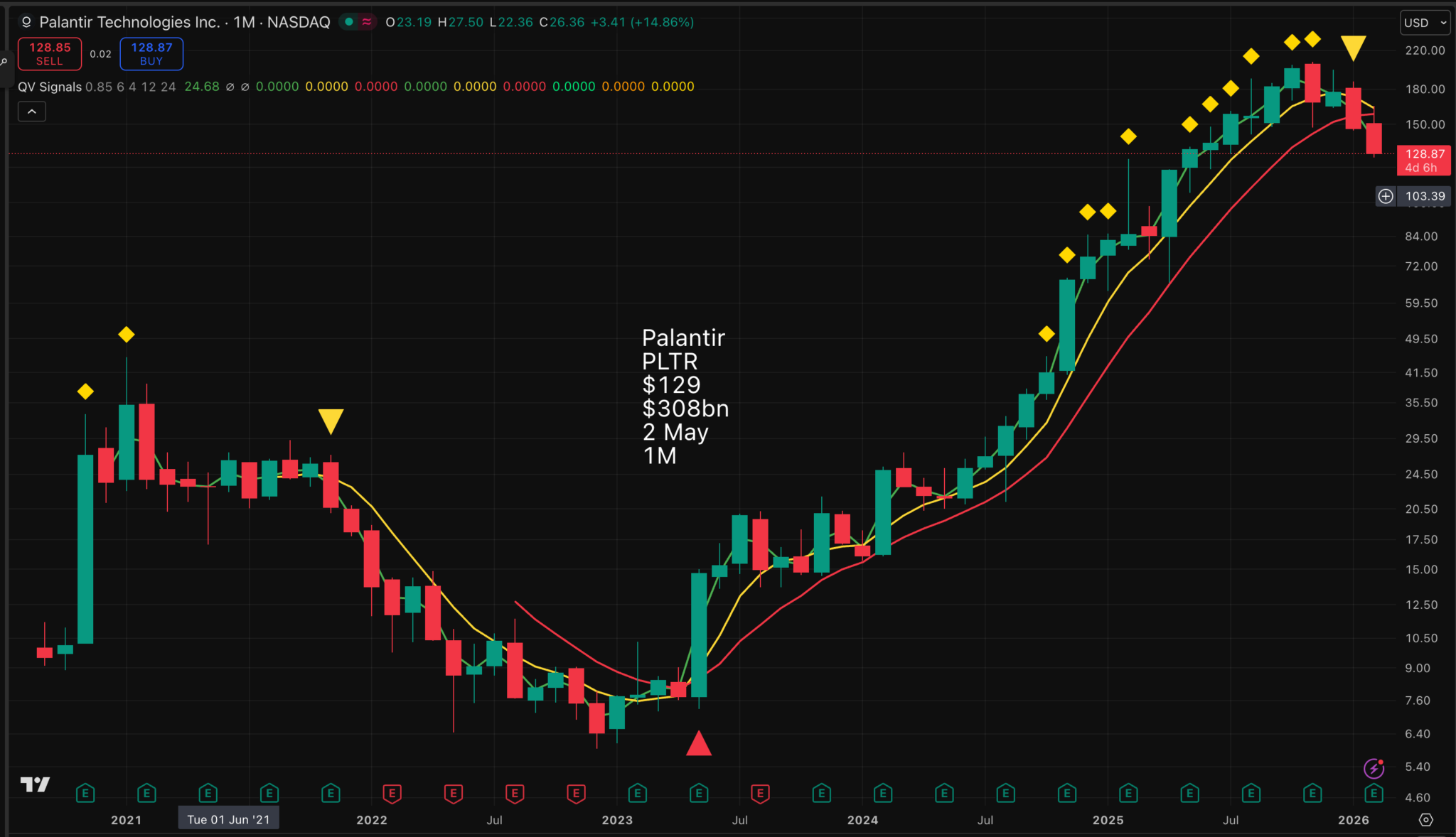
My problem is, yes, the fundamentals are amazing, but why does the chart look so negative?
The last time the chart looked this bad, with a sell signal on the yellow moving average, was November 2021. What followed was an explosive rise in interest rates, which hit the whole market and especially clobbered high-growth shares where much of the value lies in future years.
This happens because the rate at which future profits are discounted back to the present rises. If this rate doubles, and it did much more than that in 2022, the present value of those future profits as reflected in the share price, halves. Higher interest rates are like kryptonite for shares in fast-growing companies.
The problem this time is unlikely to be another explosive rise in interest rates. Still, maybe there is another scary black swan event lurking beyond the horizon which is being dimly perceived by the collective wisdom of investors.
Companies like Palantir have a special problem because many investors are along for the ride and will jump ship if the helter-skelter is dipping. My reading of this chart is that Palantir shares might be a great buy, but with my chart hat on, they look frighteningly vulnerable.
That is what charts do. They make us think the unthinkable. I love exciting shares, and Palantir is as exciting as it gets, like Eileen Gu in the Winter Olympics when she straps her skis on. But I am a chartist, and that chart is scaring me. And, as we can see from the other charts above, it is not alone. Many of the shares which have led this market higher for years are looking wobbly.
I have stopped banging out the buy recommendations because buy signals are conspicuous by their absence. There is something not right about this market.
Nvidia is hanging in there, and Jensen Huang is adamant that data centre demand remains strong, but the shares are buoyed by the imminence of Q4 earnings. Once those figures are done and dusted, however good they are, the shares may be vulnerable. The chart is neutral, which is arguably disappointing ahead of figures that are expected to be amazing.
Look at the streaming shares.
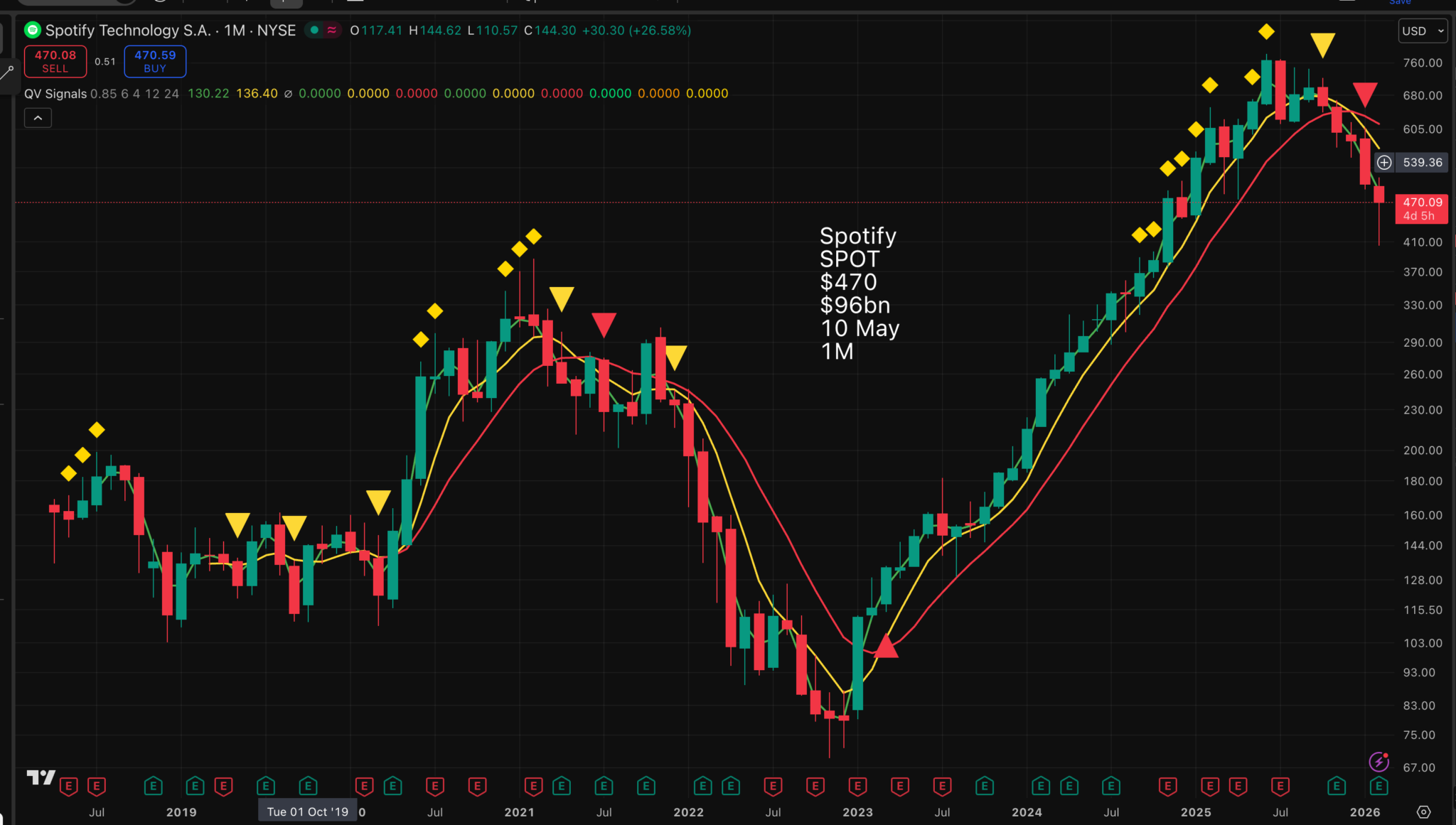
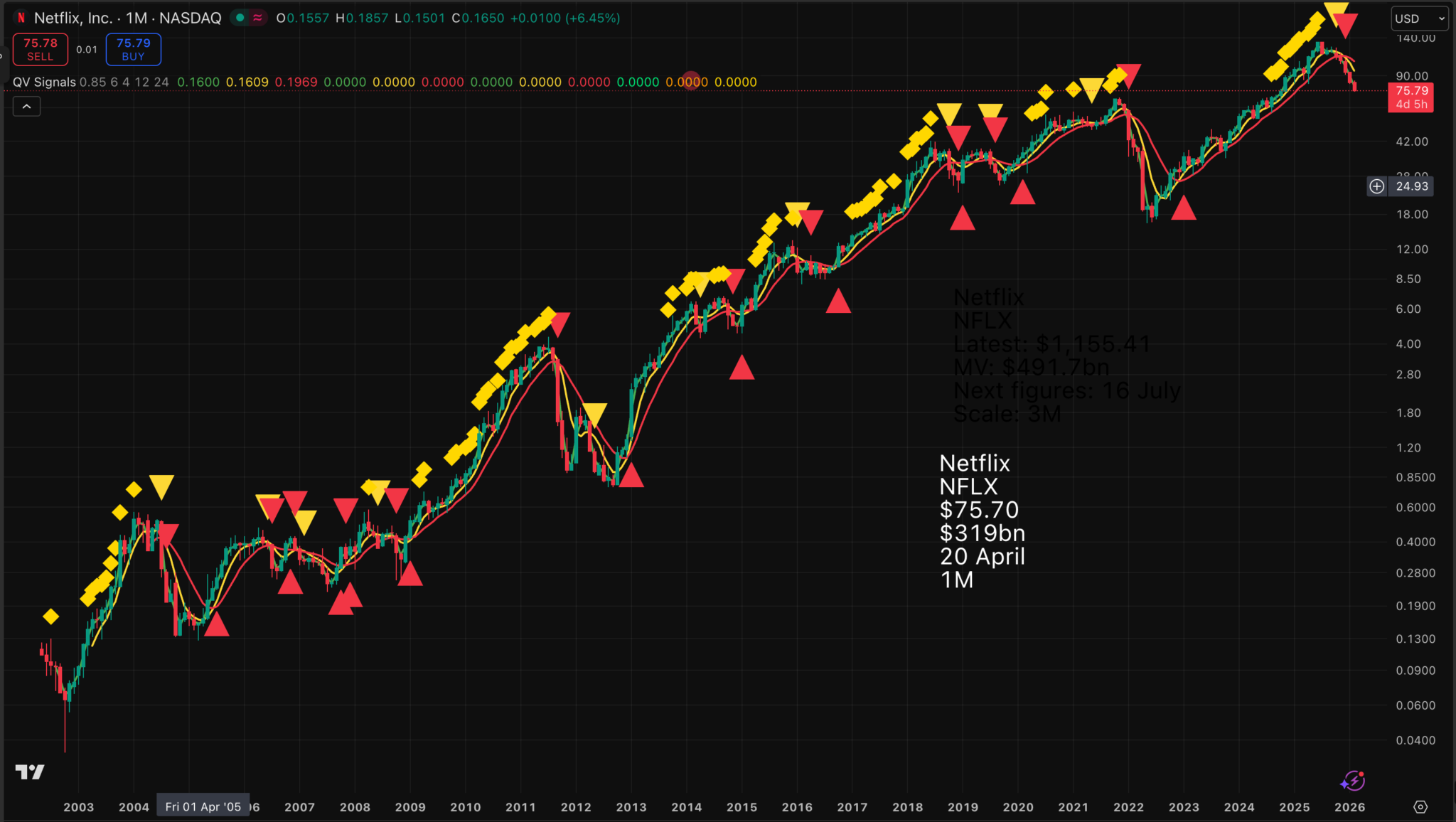
They have bounced sharply in recent days, but the all-important red line m/a is falling on this Spotify chart. The last time that happened was a blood bath. The Netflix chart looks similar.
What is alarming about this chart is that the red line is not flat-lining; it is falling steeply. Previous occasions when that has happened have been associated with major sell-offs.